



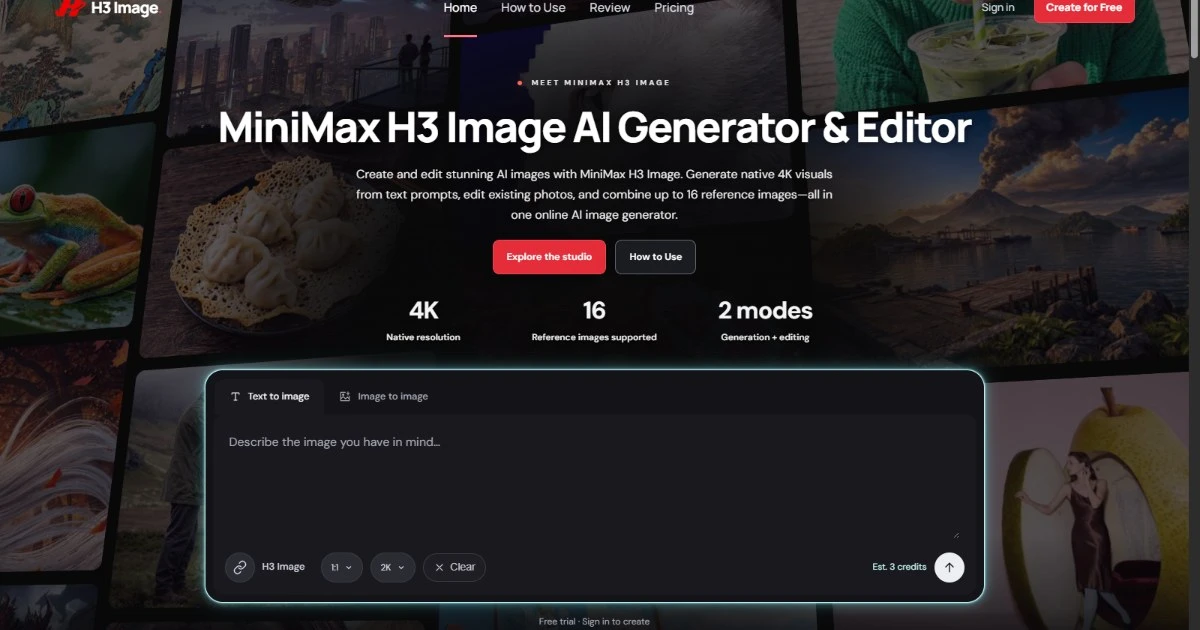
A brief that says only "make something modern" gives an image generator almost nothing to work with. The result is a pile of attractive drafts that none of the reviewers can agree on, followed by a long thread about what everyone actually meant. According to the product page, H3 Image turns written descriptions into visual drafts across several output sizes, which makes the quality of that written description the real starting point. This piece is about the short document that makes those descriptions reviewable before a single draft is generated.
The first field in the brief is the subject, stated as a plain noun phrase rather than a mood. "A laptop on a desk" is checkable; "a dynamic workspace" is not. Reviewers can look at a draft and say whether the subject is present, and they cannot do that with an adjective. Keeping the subject concrete removes the largest source of circular feedback.
The second field is framing. State whether the subject fills the frame, sits in the middle third, or appears with clear negative space on one side. This matters more than it sounds, because a draft that is otherwise correct but tightly cropped is unusable for a layout that needs copy beside it. Writing the framing down once prevents three people from asking for three different crops later.
The third field is palette, limited to two or three named colors plus one explicit exclusion. An exclusion is the useful part. Saying that a set of drafts should avoid neon gradients is a faster way to converge than listing every color that is acceptable. A small exclusion list also gives the generator a boundary that is easy to respect.
The fourth field is output ratio. The same concept has to be rendered differently for a square social tile, a wide banner, and a portrait story frame. Deciding the ratio in the brief means the drafts can be compared within a single format instead of across three incompatible shapes. It also makes the review conversation shorter, because everyone is looking at the same geometry.
Turning the brief into a first pass
With those four fields written, generate a small batch rather than a large one. Three to five drafts per format is enough to see whether the description is doing its job. The aim of this pass is to learn which field was vague, not to pick a winner. If every draft misses the framing, the framing sentence needs rewriting; if the subjects vary wildly, the subject phrase needs to be more concrete.
A practical habit is to keep the brief and the drafts side by side, and to mark each mismatch with the field number it came from. Over one or two rounds this produces a short list of phrases that reliably work for a given visual style. That list becomes the team's default brief, so the next project starts from something already tested rather than from a blank page.
Deciding what is good enough
The last step is a rejection rule, written before the review meeting. A draft is rejected if the subject is absent, if the framing breaks the layout, or if the excluded palette element appears. Anything that passes those three checks moves on, even if it is not everyone's favorite. This keeps taste from turning into an endless loop of small regenerations.
For teams comparing generators, the same brief should be run through each tool unchanged. Because the description is fixed, differences in output can be attributed to the tool rather than to a different prompt. According to the product page, several output sizes are supported, so the same brief can be checked across formats without rewriting it.
The broader point is that generation speed is not the bottleneck anymore. The bottleneck is the clarity of the instruction and the discipline of the rejection rule. A one-page brief that names the subject, framing, palette, ratio, and exclusions turns a subjective argument into a short, repeatable review. That is what makes a set of drafts useful rather than merely plentiful.