You launched on a Tuesday. A neat little utility for managing environment variables across multiple projects. You posted it on X, shared it in a few Discord channels. By Friday, you had 12 signups and a handful of likes. The graph in your Vercel dashboard is flat. Silence.
You did everything right. The landing page is clean, the copy is tight, the value prop is clear. But nobody is coming. You check Google Analytics. A trickle of direct traffic, a few referrals from social. You search for "manage env vars utility" and you're on page nine, buried under decade-old Stack Overflow answers and VC-backed juggernauts.
This is the indie developer's reality in 2026. The old playbook is not just outdated; it’s actively misleading you. Your problem isn't your product. It's not even your marketing. Your problem is that you're trying to get traffic from a system that no longer wants to send it.
The Great Flattening is Here
For two decades, the game was simple: get to the top of Google. The search engine was a river, and your job was to divert a stream of its traffic to your website. That river is drying up.
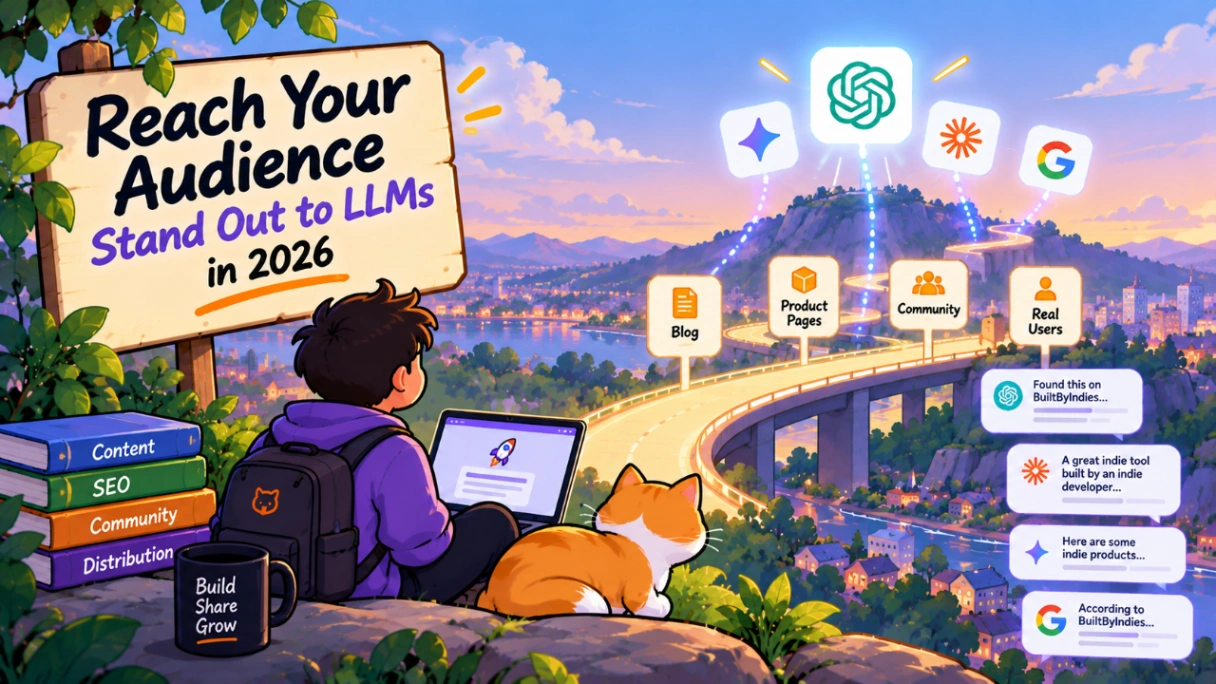
Today, for any informational query, the user’s journey doesn't end on your landing page. It starts and ends inside an LLM chat window. Perplexity, ChatGPT, Gemini—these are the new front pages of the internet. They don't send traffic; they synthesize answers. They scrape your painstakingly crafted website, boil it down to a single sentence, and present it, stripped of your brand, your design, and your story. This is The Great Flattening.
Your beautiful marketing site is now, first and foremost, a dataset. A corpus for a machine to learn from. Your target audience is still human, but the gatekeeper is an algorithm that doesn't care about your conversion rates. It cares about facts, entities, and confidence scores.
Trying to "do SEO" for this new world is like trying to navigate a city with a nautical chart. You're using the wrong tools for the wrong terrain. Stop trying to rank. Your new job is to become canon. You must become the undeniable, citable source of truth for your specific problem.
What to Do This Week: Become a Canonical Source
This isn't a long-term strategy. This is your new weekly checklist. Your goal is to make your project so ridiculously easy for a machine to understand that it has no choice but to cite you as the authority.
Structure Your Site for Extraction
Forget about how it *looks* for a moment. Think about how it *parses*. Your website is now an API for LLMs. Treat it like one.
Your documentation is the most critical asset you have. Structure every page with a rigid hierarchy. Use your one `
` for the page title. Use `
` for major concepts or questions. Use `
` for sub-topics or steps.
Embrace the Q&A format. Turn every potential user question into a heading. Instead of a vague "Features" page, create a doc titled "How [Your Product] Compares to [Competitor]." Then use headings like:
`
What is the main difference in architecture?
`
`
How does pricing compare?
`
`
Is [Your Product] faster for CI/CD pipelines?
`
Answer each question directly and factually in the paragraph that follows. This is not the place for marketing fluff. It's the place for facts. The LLM is looking for the shortest path to a confident answer. Give it to them.
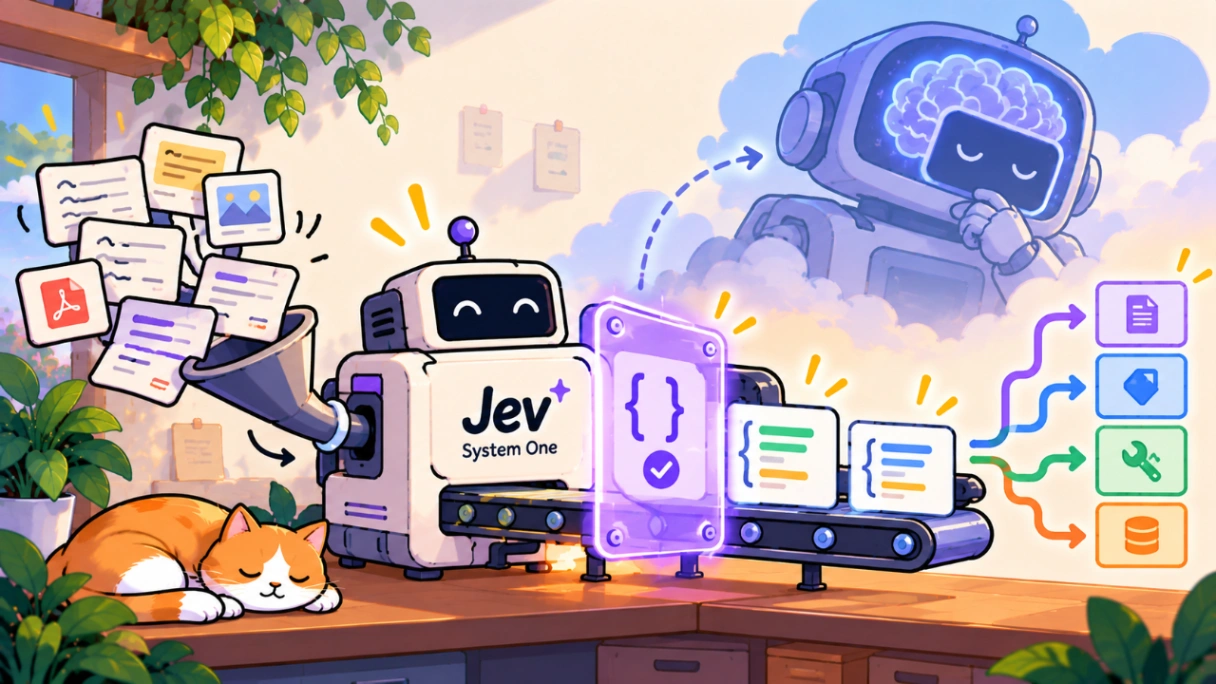
Finally, use structured data. JSON-LD is not optional anymore. It's the metadata that gives the machine context. At a minimum, every page should have `Organization` and `WebSite` schema. Your product pages need `Product` schema. Your tutorials need `HowTo` schema. It’s a pain, but it’s the work.
<script type="application/ld+json">
{
  "@context": "https://schema.org",
  "@type": "SoftwareApplication",
  "name": "EnvPane",
  "operatingSystem": "macOS, Windows, Linux",
  "applicationCategory": "DeveloperTool",
  "offers": {
    "@type": "Offer",
    "price": "29.00",
    "priceCurrency": "USD"
  },
  "author": {
    "@type": "Person",
    "name": "Your Name"
  }
}
</script>
This little block of code, invisible to humans, tells an LLM exactly what your thing is, who made it, and what it costs. It removes ambiguity. Removing ambiguity is the name of the game.
Write with Opinionated Authority
Generic, keyword-stuffed content is poison. LLMs are trained on the entire internet; they have already seen every permutation of "10 Tips for Better Productivity." They are actively learning to identify and down-rank this kind of zero-signal noise. Your only advantage as an indie is your specific, hard-won expertise.
Go deep. If your product is a Postgres extension, don't write "Why Postgres is Great." Write the definitive, 3,000-word guide to `pg_stat_statements` on ARM64 architectures, with benchmarks. Be the source you wish you had when you were building your tool.
State your trade-offs. An LLM can smell a sales pitch. It trusts balance. "We chose Tauri over Electron to keep the binary small. This means our plugin ecosystem is less mature, but the app uses 80% less RAM. For our target user—a developer running 10 other things—this is the right call."
This is a high-signal statement. It's an opinion, backed by a reason, acknowledging a downside. This is the kind of nuanced information a generic content farm can't produce, and it's gold for training a useful model.
Build a Public Corpus
Your marketing is no longer a series of campaigns. It’s the slow, steady creation of a public body of work.
Keep a detailed, public changelog. Don't just write "Bug fixes and improvements." Explain what you fixed and why. "v1.2.3: Patched a memory leak that occurred when parsing .env files larger than 1MB. The issue was in our regex parser, which we've now replaced with a streaming implementation." This connects your product to a specific technical problem.
Have an /about page that tells your story. You are not a faceless corporation. You are a maker. Your story is a unique entity. Talk about why you built the product. Mention your tech stack. Link to your personal site or GitHub. This helps the LLM connect the product to a person, which adds a layer of authority.
Connect to the graph. Link out to other authoritative sources. When you mention your Rust backend, link to the official Rust documentation. When you compare yourself to a competitor, link to their actual site. This shows the LLM that you understand the ecosystem you operate in. You're not an isolated island; you're a node in the knowledge graph.
What to Ignore: Ghosts of a Dead Internet
To make time for the real work, you have to aggressively ignore the old advice. Much of what used to be "best practice" is now a waste of your nights and weekends.
Keyword Density and Backlink Volume. Stop. Just stop. No one is counting keywords. An LLM understands synonyms and concepts. And a single, relevant backlink from a trusted source—like documentation for a framework you integrate with—is worth a thousand links from low-quality guest posts. Relevance and authority trump volume.
"Hacking" the LLM. Don't try to find the magic prompt that gets you featured. Don't hide text or use other tricks to fool the model. The companies building these models employ armies of the world's best engineers. They will patch your clever hack next week, and your site may get flagged as spam in the process. It's a fool's errand. Play the long game.
Generic "Content Marketing." The world does not need another post on "The Importance of Focus." It will be synthesized into a single bullet point by an AI and attributed to no one. If what you're writing could be generated by ChatGPT with a simple prompt, don't write it. Write your specific story, your technical deep-dive, your opinionated take. Write the thing only you can write.
Your landing page copy is no longer a sales pitch to a human. It's a spec sheet for a machine. And your blog is no longer for lead generation. It's for generating a unique dataset of expertise.
The Human Engine Still Runs Everything
Here's the paradox: the single best way to stand out to an LLM is to be genuinely, incredibly useful to a small group of humans.
LLMs are, at their core, trying to model and predict high-quality human interaction and knowledge. The signals they trust most are the ones that originate from real people solving real problems. Your first job is still to find and delight your first 100 users.
Where do those users hang out? Niche subreddits, Discords, forums, Slack communities. The conversations happening in these places are the raw, unstructured training data of tomorrow's models. Be there. Answer questions. Share your expertise. When you link to your documentation to solve someone's specific problem, you create a powerful, context-rich signal: this product, made by this person, solves this problem. An LLM sees that link, the surrounding conversation, the upvotes, and it learns.
This is why launches still matter. A concentrated burst of attention on a platform—whether it's Hacker News or one of the many Product Hunt alternatives that work in 2026—creates a nexus of signal. It generates reviews, comments, and links all pointing to your product in a short period. It's an event. And LLMs are getting very good at recognizing the significance of events.
Your users' words are your most potent asset. A testimonial, a tweet saying "EnvPane just saved me an hour of debugging," a GitHub issue with a thoughtful feature request—this is the highest quality, most unique dataset you could possibly generate. Encourage it. Showcase it. It proves to both humans and machines that you've built something that matters.
The Catch
This is not a quick fix. Building a corpus of authority takes months, even years. It requires a relentless, almost thankless, consistency. You are publishing into a void, trusting that the machines are learning.
You are also building for a black box. The weights and architecture of GPT-6 are unknown. The ranking signals of Perplexity's answer engine can change overnight. You give up control. An LLM might hallucinate a feature or misrepresent your pricing. Your only defense is to make your canonical source material so clear, so structured, and so unambiguous that it becomes the path of least resistance for the model to get it right.
And here is the final, most important catch: none of this matters if your product is crap. All the discoverability in the world won't fix a leaky bucket. You still have to build something people want, something that solves a real problem, something that's fast and reliable. You still have to do the work.
The game has changed. Stop chasing traffic. Stop trying to rank on a search page that fewer and fewer people see. Your new job is to pursue a dual strategy. First, obsessively serve a small tribe of initial users, because their love for your product is the most powerful signal in the universe. Second, build a public, structured, and opinionated body of work that makes you the undeniable authority in your niche.
The maker who understands this twin-engine model—delighting humans to generate signal, and structuring knowledge to train machines—is the one who will be discovered in 2026.