


You’re staring at your user list. Twelve signups since you pushed the launch live on Tuesday. It’s not zero, but it’s not life-changing. You check Product Hunt and see a competitor just shipped a new AI feature that does exactly what you were planning to build next quarter. They did it with a clever prompt and a weekend of work. Your roadmap feels slow. Your moat feels like a puddle.
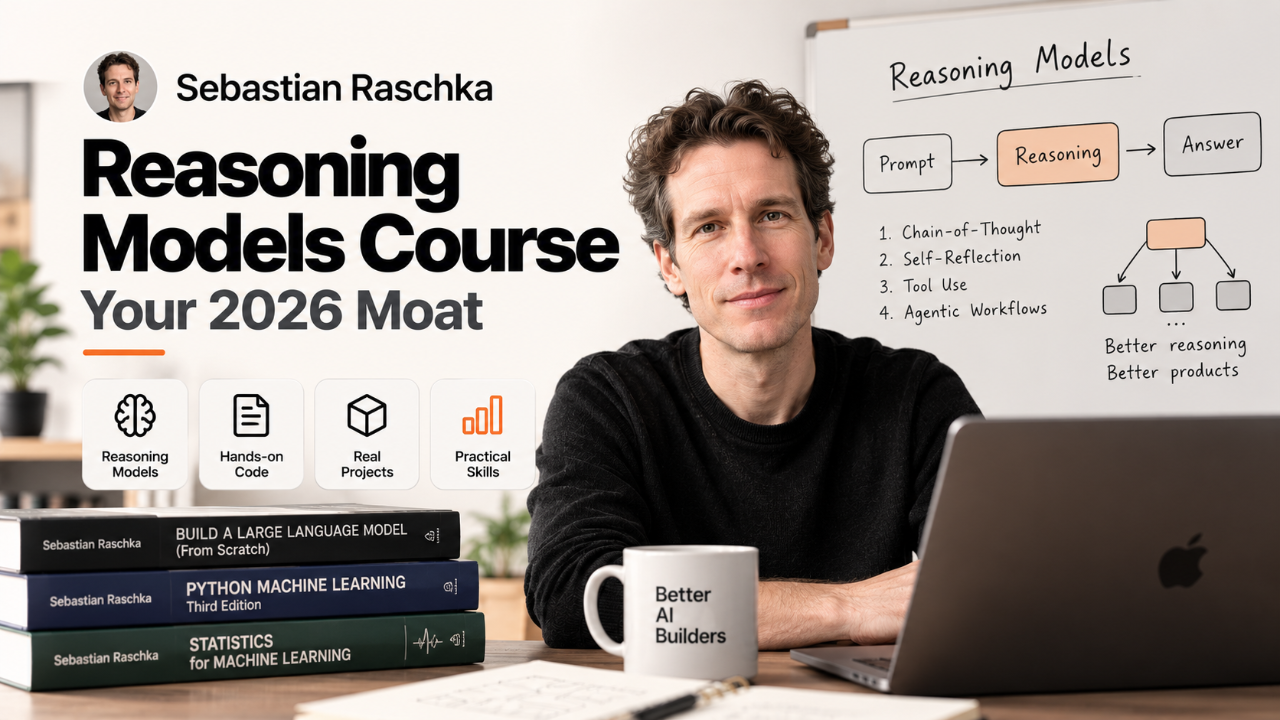
Then a link pops up on Hacker News: "Sebastian Raschka's from-scratch video course on building reasoning models". Your first thought: a distraction. Another deep, technical rabbit hole to pull you away from shipping. Your second thought: maybe this is the moat.
This isn't just another course. It's a signal. The easy wins from wrapping a single API call are gone. The next layer of value is in building systems that think. Raschka is giving away the schematics. The question for an indie founder isn't "can I build this?" but "should I?" The answer is yes, but not in the way you think.
What Actually Shipped
Let's be clear. This is not a "How to use the OpenAI Assistants API" course. This is the opposite. Raschka is walking you through the fundamental mechanics of how models perform complex tasks. Think of it as learning to build an engine, not just drive a car.
The course covers the primitives of reasoning:
Planning: Breaking a complex goal ("plan a trip to Tokyo") into a sequence of smaller, executable steps.
Tool Use: Teaching a model to call external functions, like your app's own API, a weather service, or a database query.
Self-Correction: Creating loops where the model can evaluate its own output, identify errors, and try again.
Most AI features you see are single-shot inferences. You send a prompt, you get a response. Reasoning models are different. They are multi-step processes. An LLM acts as the CPU in a loop, calling tools, reading the results, and deciding what to do next. Sebastian Raschka's from-scratch video course gives you the code to build that loop yourself, without relying on a black-box framework.
Why a Solo Founder Should Care
Because your GPT-wrapper app has no long-term defense. When your core feature can be replicated by a competitor who finds a better prompt, you’re not building a business; you're just renting a feature from OpenAI. The moment they release a new model or a feature like the Assistants API gets a bit better, your entire product can be commoditized overnight.
Understanding reasoning primitives is how you escape this trap. It lets you build bespoke workflows that are specific to your domain. Instead of asking a model to "write a marketing email," you can build an agent that:
Pulls the latest customer data from your database (Tool 1).
Analyzes their past purchases (LLM step).
Checks your current inventory for related products (Tool 2).
Drafts a personalized email mentioning those specific products (LLM step).
Evaluates the draft for tone and clarity (Self-correction step).
This five-step chain is unique to your application and your data. A competitor can't just copy it with a prompt because it’s a system, not a single inference. It’s a small, defensible moat dug with code, not just words.
How to Build a Reasoner in a Day
Do not watch the entire course. You don't have time. Your goal is not to become an AI researcher; it's to ship a feature that gets you to 100 users. Steal the parts you need and ignore the rest.
Here’s your weekend plan. Budget about 4-6 hours.
1. Watch Selectively (1 hour): Open the course playlist. Watch the videos on basic agent loops and tool-use. Skip the deep dives into attention mechanisms or fine-tuning. You're looking for the simplest possible ReAct (Reason + Act) loop. Get the concept, then get the code.
2. Grab the Code (15 mins): Clone the course repository. Find the most basic agent implementation. It’s likely a single Python file with a loop that alternates between calling the LLM for a "thought" and executing a "tool" based on that thought.
3. Define One Tool (1 hour): A "tool" is just a Python function. Don't overthink it. Pick one simple, specific action a user might want to automate in your app. Can they look up a customer? Check an order status? Find a relevant document? Write a single function for it.
# Your app's "tool"
def get_user_email(user_id: int) -> str:
    """Retrieves the email for a given user ID."""
    # ... your database logic here ...
    if user_id == 123:
        return "test@example.com"
    return "User not found."
4. Wire It Up (2 hours): Adapt Raschka's agent code. The core logic is a loop. The LLM's prompt will include the description of your tool (the function's docstring is perfect for this). Your goal is to get the LLM to output a JSON object like `{"tool": "get_user_email", "args": {"user_id": 123}}`.
Your Python code then parses this, runs your `get_user_email(123)` function, gets the result, and feeds it back into the LLM in the next iteration. The loop stops when the LLM decides it has the final answer.
By the end of the day, you won't have a full-fledged AGI. You will have a single, magical input box in your app that can perform one specific, multi-step task that your competitors can't easily replicate.
The Catch: What Breaks in Production
The demo you build on Saturday will feel like magic. The version you deploy on Monday will break. Building from scratch means you are the sole owner of every single failure mode.
Brittleness is the default. Your agent will work perfectly for the exact phrasing you tested. A user will type "find email for user 123" instead of "get me the email of user ID 123" and the whole chain will collapse. Frontier models are trained on the entire internet and have robustness; your small, hand-rolled agent has only the logic you gave it.
Latency is a killer. Each "step" in your reasoning loop is a full round-trip to an LLM API. A five-step chain can easily take 10-15 seconds. Users expect instant feedback. A "thinking..." spinner gets old fast. Production-grade agents require aggressive caching, parallel tool calls, and other optimizations you won't find in a tutorial.
Cost is unpredictable. A simple user query might spiral into a 20-step agent loop, costing you 50x more than a single API call. Without strict limits on the number of steps, you risk a surprise bill that could wipe out your monthly budget.
This is the fundamental trade-off. A from-scratch model gives you maximum control and defensibility, but at the cost of speed and reliability.
The Verdict: Steal, Don't Switch
So, is this course worth your time? Is it worth switching your stack to a from-scratch reasoning engine? No. Absolutely not.
You don’t switch. You integrate. You steal one idea to solve one problem.
Think of AI implementation as a spectrum of trade-offs. You can call a simple API, use a framework like LangChain, or build from scratch. Each has its place.
This table compares the approaches for an indie hacker in 2026:
Approach | Control & Defensibility | Dev Speed | Production Brittleness | Cost Predictability |
|---|---|---|---|---|
Simple API Call (e.g., GPT-4) | Low | Very High | Low | High |
Agent Framework (e.g., LangChain) | Medium | Medium | Medium | Medium |
From-Scratch Loop (Raschka's method) | High | Low | Very High | Low |
The sweet spot for a solo founder is to stay on the left side of that table for 90% of your product. Use simple API calls for everything you can. But for that one core feature—the one that makes your product unique—dip your toes into the from-scratch approach. Build a tiny, single-purpose agent to do one thing really well.
From Theory to Shipped Product
It's easy to see this as academic. Let's make it concrete. Look at the products shipping on Builtbyindies today.
Consider a tool like Stivio, a smart video editor. Most AI video tools can transcribe audio. That's a simple API call. A defensible feature would be an agent that analyzes the transcript's narrative arc, identifies the climax, and automatically suggests a music change at that exact moment. That requires reasoning—a chain of "find the topic," "analyze sentiment," "identify peak," "suggest edit." It's a bespoke workflow.

The Stivio video editor interface, showing a timeline and transcript.
Or look at the world of generative video. A product like Flux 3 Video Generator could move beyond one-shot generation. Instead of a user prompting "a cat riding a skateboard," they could prompt a goal: "Create a 3-part ad for a cat toy." A reasoning agent could plan the shots: 1) cat looks bored, 2) toy appears, 3) cat joyfully plays with the toy. This turns a generator into a storyteller. Many new tools in the AI Video space are exploring exactly this.

Flux 3 Video Generator's UI, showing options for generating video content.
The temptation, after building a small agent, is to shout about it. To start a building in public thread on the technical details of your reasoning loop. Resist this. Your users don't care about your ReAct implementation. They care that your video editor just saved them an hour. Ship the benefit, not the technique.
Sebastian Raschka's course is a gift. But it's also a trap. It offers the power to build truly unique, defensible features, but it asks for your most valuable resource in return: time. Don't fall into the trap of building a general-purpose brain. Steal the one cog you need for your feature, ship it, and get back to talking to your users.