You launched on a Tuesday. By Friday, you had 12 signups and a dopamine hit that could power a small city. Three months later, it’s a different story. You have 47 users, two of whom are paying. Your MRR is $28. You spend your nights pushing bug fixes no one asked for and your weekends trying to write marketing copy that feels like screaming into the void. The excitement is gone. In its place is a low, persistent hum of dread. You’re not just tired. You’re burnt out.
The internet is full of advice for this. Take a walk. Get more sleep. Meditate. This is well-meaning but useless advice. It’s like telling a user to restart their computer when your app has a memory leak. It might temporarily fix the symptom, but it ignores the root cause. Your burnout isn't a personal failing. It’s a system error.
Your Burnout Is a Code Smell
Burnout for a solo founder isn't about the number of hours you work. We all signed up for long nights. Burnout is the corrosive friction between effort and outcome. It’s the feeling of pushing a boulder uphill, only to watch it roll back down every morning. You’re shipping, but the needle isn’t moving. You’re writing, but no one is reading. You’re answering support tickets, but churn remains stubbornly high.
This gap—between the energy you invest and the results you get back—is the source of the rot. Your solo-founder "operating system" has a critical bug. Your workflow is generating more heat than light. The burnout you feel is a code smell. It’s a signal that your system for building, marketing, and supporting your product is inefficient, broken, or pointed in the wrong direction entirely.
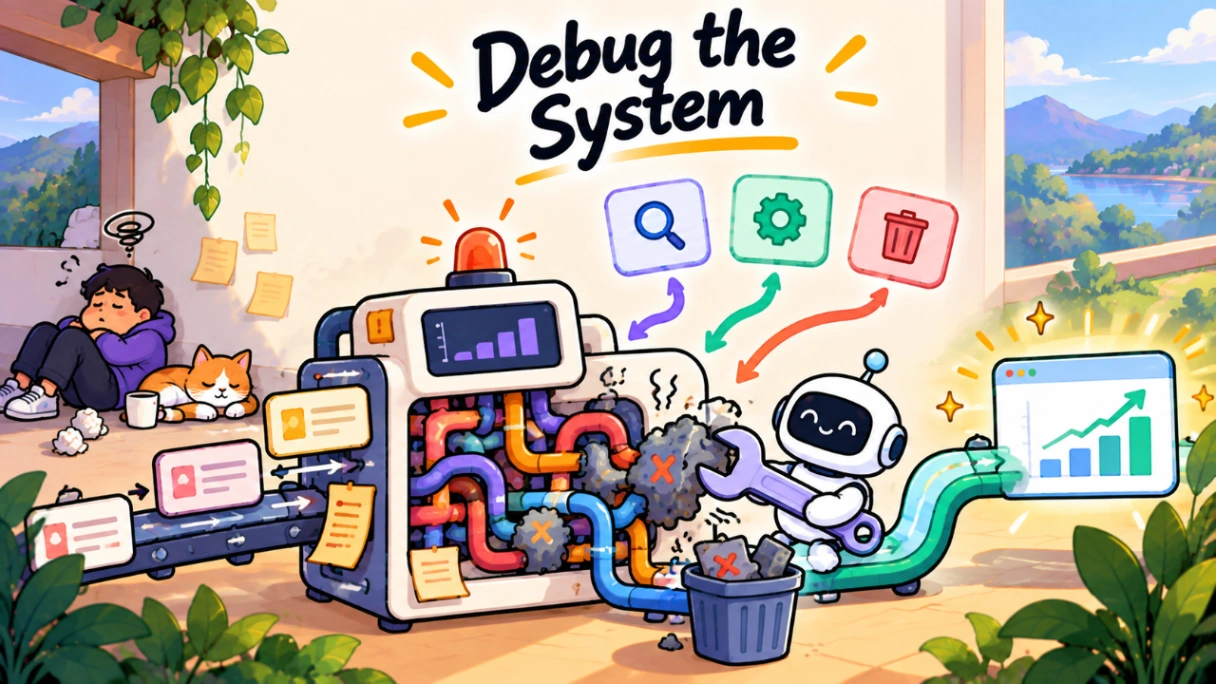
The solution isn’t to stop working. The solution is to refactor your work. You don’t need a vacation; you need a debugging session for your entire operation.
What to Do This Week
This isn’t about long-term strategy. This is an emergency patch. Your goal this week is not to grow your MRR. It’s to stop the bleeding—the slow, draining bleed of your motivation. You need to re-introduce a positive feedback loop where your actions create tangible, rewarding results.
Step 1: The One-Day Audit
Block out one full day. Or two consecutive evenings. No new features. No marketing posts. No coding. Your only job is to analyze. Open your database, your analytics, and your Stripe dashboard.
Who are your best users? Not all users. The 2 out of 47 who pay, or the 5 who use the product daily. Where did they come from? What was the first thing they did? What one feature do they use religiously? Be ruthlessly specific. Write down their names or user IDs.
What is your biggest time sink? Look at your commit history and your support emails. Are you constantly patching the same fragile part of the app? Are you answering the same three questions over and over? Find the one task that eats your time and soul.
Where is the 80/20? 80% of your growth, however small, is likely coming from 20% of your effort. Was it one blog post that still gets traffic? One specific community you posted in? Identify it. The rest is noise.
The deliverable for this audit is a single page of notes with three headings: “What’s Working,” “What’s Broken,” and “What’s Waste.”
Step 2: Automate One Painful Task
Look at your "What's Broken" list. Pick the most repetitive, mind-numbing task. This week, you will eliminate it. Not with a perfect, scalable solution, but with a quick, dirty script or a no-code workflow. Are you manually sending a welcome email? Use a Zapier trigger. Answering the same support question? Set up a saved reply in your email client or a simple bot that points to a documentation page.
The goal is a quick win. A small piece of leverage that gives you back 15 minutes a day. The psychological impact of deleting a recurring task from your life is immense. It’s a direct blow against the friction that causes burnout. If you need inspiration, we’ve documented a few high-leverage automations for solo devs: What to Automate When You Are Running a Product Alone. The point is to prove to yourself that you can make your life easier.
Step 3: Kill a Feature
Now look at your "What's Waste" list. Find a feature that you're maintaining but that your best users (from Step 1) don't touch. It’s the "export to PDF" function that one person requested two years ago. It’s the complex settings panel no one opens.
This week, delete it. Not hide it behind a feature flag. Delete the code. Delete the tests. Delete the UI. Watch your LOC count go down. This will feel terrifying and liberating. Every line of code is a liability. It’s something that can break, something that adds cognitive load, something you have to maintain. By deleting a zombie feature, you are not losing value; you are gaining focus and simplifying your system. You are making your product, and your life, easier to manage.
What to Ignore
The world is full of distractions disguised as productivity. When you’re burnt out, your ability to filter is at an all-time low. You need to be aggressively ignorant.
Ignore New Tech
A new JavaScript framework just dropped. A revolutionary vector database promises to solve all your problems. Your first instinct might be to see this as a solution. A rewrite! A migration! This will fix everything!
This is a trap. It’s procrastination that feels like work. Your burnout isn’t because you chose React instead of Svelte, or Postgres instead of MongoDB. It’s because you don’t have enough customers. Rewriting your backend is the most expensive, time-consuming way to avoid talking to users. Unless your system is actively on fire and unable to serve your existing users, do not touch your core infrastructure. The temptation to refactor your way out of a business model problem is immense, but you must resist. Your stack is almost certainly good enough. If you find yourself agonizing over these choices, remember the core principles for how to choose a tech stack as a solo founder in 2026: boring is better.
This applies doubly to the endless hype cycle of AI. Chasing the latest, most powerful model is a full-time job. If your product uses AI, stick with the model that works and is cost-effective. Don't get distracted by a 2% performance gain on a benchmark that doesn't matter to your users. Deciding how to choose an AI model for your product should be a one-time decision you revisit quarterly, not daily.
Ignore Most Feedback
This sounds like heresy, but it’s critical. In a state of burnout, your emotional resilience is shot. One drive-by negative comment on Twitter can derail your entire week. One enthusiastic feature request from a non-paying user can send you down a two-month rabbit hole of building something for the wrong audience.
For now, you have permission to ignore almost everyone. The only feedback you should listen to is from the handful of people you identified in your audit: your best, paying, most engaged users. Create a private channel for them—a Discord, a Slack, a simple email group. Talk only to them. Build only for them. Everyone else is noise you cannot afford to process right now.
Ignore Hustle Porn
Close Twitter. Mute the accounts posting screenshots of their 16-hour workdays and exponential MRR charts. Comparison is the thief of joy, and when your joy is already at zero, it’s a death blow. The narrative of "just grind harder" is a lie. It assumes your effort is being applied to the right things. Your audit proved it isn’t. Working harder on a broken system just breaks you faster.
The Catch
There is, of course, a catch. This process of auditing, deleting, and automating feels like you're going backward. You are intentionally not building new things. You are intentionally reducing your product's surface area. In a world that glorifies shipping speed, this feels like failure.
It's not. It's consolidation. It's regrouping. It’s what a smart army does when its supply lines are overextended and its troops are exhausted. You are pulling back to a defensible position from which you can advance again.
The second, harder catch is that your audit might lead to an uncomfortable conclusion: the product isn't working. The core idea is flawed, the market isn't there, or the solution doesn't resonate. You might find that even your "best" users are not that engaged, or that the path to profitability is a decade-long slog for a product you no longer love.
In this case, the fix for your burnout is the ultimate act of deletion: killing the project. This is not failure. This is freeing yourself from a dead end. The solo founder's journey is a marathon of multiple projects. Your most valuable asset is not your current product; it's you. Your energy, your creativity, and your will to build. If the current project is destroying that asset, the most strategic move is to shut it down. Salvage the code, write a post-mortem, and carry the lessons to the next idea. A clear-eyed shutdown is a success. It’s an escape from a local maximum. It’s what allows you to take what you learned and apply it to a fresh product launch in the future.
Burnout is a signal that the story you've been telling yourself about your product is no longer true. The story that if you just keep pushing, it will work. The cure is to stop, listen to what the system is telling you, and write a new story. A story where your effort is respected, your time is leveraged, and your work, once again, creates a spark.