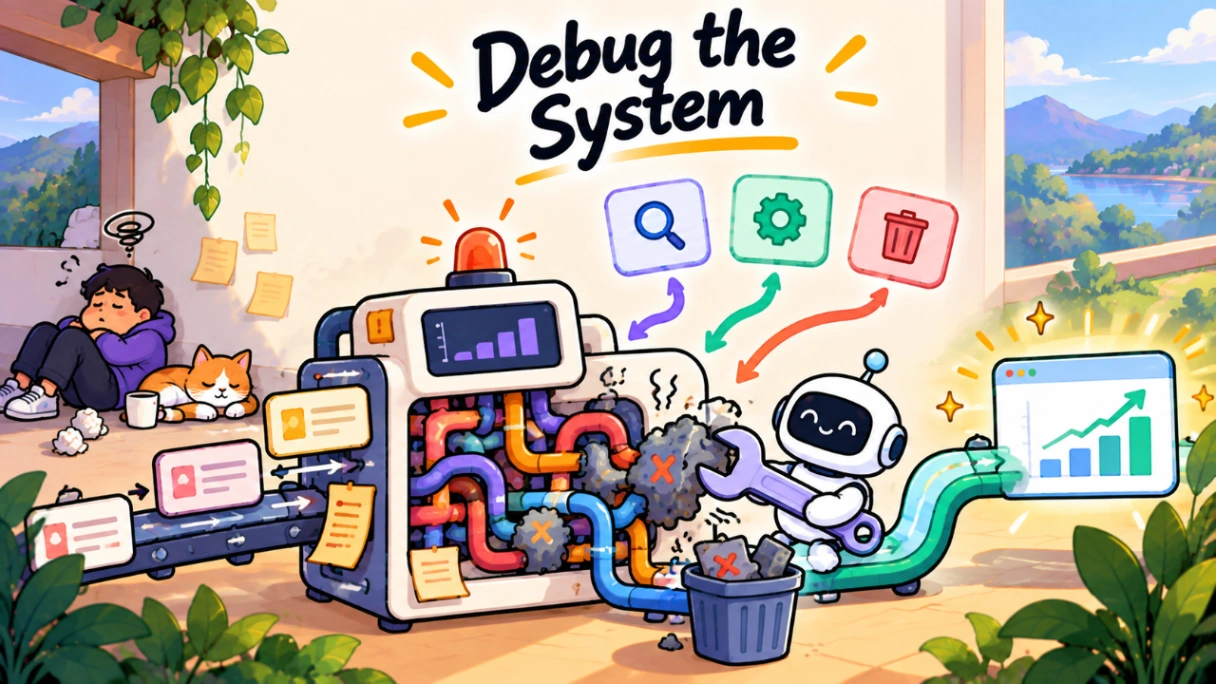
You spent Saturday wrestling with GPT-4.5. Your goal was simple: take an unstructured customer support email and turn it into a structured ticket. Priority, category, summary. You wrote the perfect prompt. You gave it few-shot examples. You even used the latest function-calling spec.
It worked. Mostly. Until a user wrote in German. Or mentioned two separate issues. Or used sarcasm. The JSON it returned was a mess. A key was missing. The summary was a hallucinated fantasy. You wrapped it in a `try/catch` block, added a retry mechanism with exponential backoff, and wrote a validation layer with Zod. Your simple feature is now a fragile, asynchronous chain of prayers.
You’re debugging a prompt. This is not why you became a developer.
This is the dirty secret of building with AI in 2026. The big "System Two" models—the GPTs and Claudes of the world—are incredible thinkers. They can reason, plan, and create. But they are also moody, expensive, and unpredictable. Building a product on top of them feels like building on sand. The constant prompt-fiddling and error-handling is a major cause of solo product burnout. You’re not debugging your code; you’re debugging a non-deterministic black box.
TypeSafe AI’s Jev is the answer. But not to the question you think you’re asking. Jev is not a better thinker. It’s not here to kill GPT-5. Jev is a "System One" model. It’s the AI equivalent of a reflex. It’s fast, cheap, and brutally consistent. It doesn't think; it reacts. And for 90% of the AI-powered features an indie hacker needs to build, that’s exactly what you want.
The Real Problem: You Need a Tool, Not an Oracle
For two years, the AI race has been about scale. More parameters, bigger context windows, more modalities. We’ve been conditioned to believe that the solution to every problem is a bigger brain. This has led us down a dead-end street of probabilistic programming where we hope for the best and write code to handle the worst.
The real problem for a solo founder isn’t a lack of intelligence in our models. It’s a lack of reliability. We need components that behave like good APIs: predictable inputs, predictable outputs, and deterministic errors. We need to stop treating AI as a magical oracle and start treating it as a systems component.
Jev is designed for this. Its architecture isn't optimized for passing the bar exam; it's optimized for fitting into a system. The "TypeSafe" in the company’s name is the whole story. Jev is constrained at an architectural level to respect the "type"—the schema—you provide. It’s not just a prompt instruction; it’s a guardrail baked into the model itself.
This is a fundamental shift. Instead of asking a model to please give you JSON, you give Jev a schema and a blob of text. Jev’s job is to fill that schema. If it can, it will. If it can’t, it will fail cleanly. It won’t try to be creative. It won’t hallucinate a clever workaround. It will simply fail, and that failure is a feature.
This makes Jev a completely different beast. When you're choosing an AI model for your product, you're not just picking a brand name. You're making a core architectural decision. Choosing a big model is a bet on intelligence. Choosing Jev is a bet on reliability.
What to Do This Week: Build a Parser, Not a Prompt
Stop what you’re doing with your RAG pipeline. Forget your prompt library. I want you to try something this week that will take about an hour. Pick a small, annoying, unstructured data problem in your life.
Parsing workout notes from a text file.
Extracting recipe ingredients from a blog post.
Turning meeting notes into action items.
Let's use the support ticket example. First, define your desired output using a TypeScript interface or a Zod schema. This is the most important step.
import { z } from 'zod';

const TicketSchema = z.object({
  summary: z.string().describe("A concise, one-sentence summary of the user's issue."),
  category: z.enum(["billing", "bug_report", "feature_request", "other"])
             .describe("The primary category of the support ticket."),
  priority: z.enum(["low", "medium", "high", "urgent"])
             .describe("The urgency of the issue based on its impact."),
  userEmail: z.string().email().optional().describe("The user's email if provided.")
});
Look at that schema. It's not just types; it includes descriptions. These descriptions are Jev's "prompt." They are the direct instructions for how to map the source text to the fields. Now, here’s how you use it.
import { jev } from 'typesafe-ai';

const userEmail = `
  Hey team,

  I think my invoice for last month (inv_123) is wrong. I was supposed to be on the
  Pro plan for $29 but I got charged $99. This is pretty urgent as my card is
  about to be charged again. Can you fix this ASAP?

  Thanks,
  Jane Doe ([email protected])
`;

const ticket = await jev.generate({
  schema: TicketSchema,
  text: userEmail,
});

// The output 'ticket' is fully typed and validated.
// ticket = {
//   summary: "User was incorrectly charged $99 for the Pro plan instead of $29.",
//   category: "billing",
//   priority: "urgent",
//   userEmail: "[email protected]"
// }
That's it. No `JSON.parse`. No `try/catch`. The `jev.generate` call returns a promise that resolves to an object matching `TicketSchema` or rejects with a structured error. The object you get back isn't just a string you have to parse; it's a typed object, ready to use. Your IDE knows its shape. TypeScript won't let you access a key that doesn't exist.
This is a system. The old way was a conversation. This is a function call.
What to Ignore: The Hype and the Benchmarks
You will see benchmarks comparing Jev to GPT-5 on MMLU or HumanEval. Ignore them. It’s like comparing a screwdriver to a sledgehammer. They are tools for different jobs. Complaining that Jev can't write a sonnet is missing the point entirely.
Ignore Jev for:
Creative Content Generation: Don't use it to write blog posts, marketing copy, or clever tweets. It has no soul. It will produce bland, functional text.
Open-Ended Chatbots: If you're building a conversational companion, Jev will be a disappointment. It can't maintain context, remember previous conversations, or engage in witty banter.
Complex Reasoning and Analysis: Don't ask it to summarize a 200-page research paper or analyze market trends. It lacks the "System Two" horsepower for deep, multi-step reasoning.
Embrace Jev for:
Data Extraction: The canonical use case. Pulling structured data from emails, PDFs, transcripts, and product reviews.
Classification and Routing: Is this email a lead or a support request? Is this user comment spam or legitimate feedback? Jev is incredibly fast and accurate for these tasks.
Agentic Tool Use: Jev is the perfect "router" in a multi-agent system. It can look at a user request and decide which tool to call: a search API, a database query, or a call to a larger, more expensive model.
Semantic Search & RAG Prep: Use it to clean and structure user queries before they hit your vector database. Or to extract metadata from chunks to improve retrieval quality.
Think of Jev as the autonomic nervous system for your application. It handles the reflexes. When a real thought is required, Jev can escalate the task to a bigger, slower brain like GPT-4.5. But for the thousands of small, repetitive, structural tasks that make up an application, Jev is the right tool.
The Catch: You Have to Be the Architect
Jev is not magic. It comes with a significant trade-off, but it's one a good developer should welcome. The catch is this: the burden of clarity is on you.
With a model like GPT-4, you can be lazy. You can throw messy data and a vague prompt at it, and it will often use its vast world knowledge to figure out what you meant. It’s forgiving. Jev is not. Garbage in, error out.
Your schema design is paramount. The names of your fields and the quality of your descriptions matter more than any prompt engineering trick. If your schema is ambiguous, Jev will fail. If your input text doesn't contain the information needed to fill the schema, Jev will fail. This forces you to be a better systems designer. It forces you to think clearly about your data models and the boundaries of your application's components.
This is a good thing. It replaces the dark art of "prompt whispering" with the engineering discipline of API design. You are no longer coaxing a ghost in the machine; you are defining a contract and expecting the machine to adhere to it.
The second catch is cost, or rather, how you think about it. Jev isn't free. But its cost is predictable. Because the output is constrained by your schema, the token count for a given task is tightly bound. You're not going to get a surprise 3,000-token JSON blob with nested commentary. This is a game-changer for pricing your own product. When your COGS are predictable, you can write a SaaS pricing plan that doesn't feel like a gamble. You can offer a fixed-price feature without worrying that a power user will bankrupt you with pathological inputs.
Jev isn't a cheaper GPT. It’s a different category of tool with a different cost model, one that aligns with building a sustainable indie business.
Ship a System, Not a Science Project
The last few years of AI have felt like a gold rush for prospectors. We've been digging for intelligence, hoping to strike it rich with AGI. Jev represents a new era: the era of the craftsperson. It’s a tool for builders who need to ship reliable, maintainable, and profitable products.
It’s a boring tool. And in the world of nights-and-weekends shipping, boring is beautiful. Boring means predictable. Boring means it doesn't wake you up at 3 AM. Boring means you can build a feature and move on to the next one.
So this weekend, put down the prompt engineering guide. Pick a small, well-defined problem. Define a schema. Use Jev to build a rock-solid parser that does one thing well. Experience the joy of an AI component that feels less like a moody intern and more like a compiled function.
Build something that just works. And when you're ready to launch, we'd love to see it. Our product directory is full of tools built by founders who chose the right tool for the job.