## When the Script Sounds Right on Paper but Wrong Out Loud
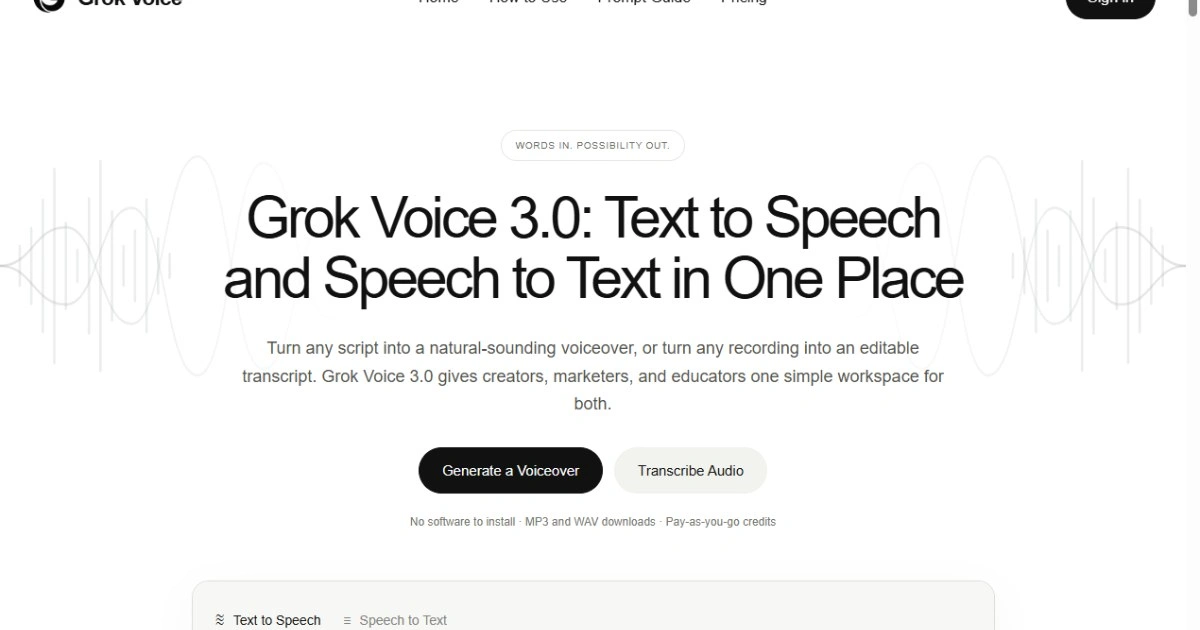
A product marketer I talked to recently described a familiar snag: her team had finished a 30-second ad script for a feature launch, and everyone liked it on the page. But nobody agreed on how it should actually sound — fast and upbeat, or slower and reassuring — and booking a voice actor for three separate test reads felt excessive before the script was even locked. That's the gap a tool like <a href="Grok Voice 3.0">Grok Voice 3.0</a> is built to sit in: a way to hear a script out loud before committing a budget or a studio session to it.
## Turning a Draft Into Something You Can Actually Hear
The workflow her team ended up using was simple enough to fit into an afternoon. According to the product page, you start by adding a source — typing or pasting a script directly, or uploading an existing audio file or link if you're starting from a recording instead of text. You can draft this part as a guest, which matters when you're just testing an idea and don't want to create an account yet. Signing in with Google or email only becomes necessary once you're ready to actually generate audio.
From there, the product page describes a generate-and-download step: you follow the task status while it processes, play back the result once it's ready, and download the audio or the transcript. If the read isn't quite right, you edit the script and run it again rather than starting over. That loop — write, listen, adjust, listen again — is closer to how a copywriter revises a line than how a traditional production process works, where changes after recording usually mean rebooking time with a voice actor.
## A Small Case: Comparing Tones for the Same Line
Here's where the use case gets concrete. The marketer's team had one line — "This isn't just another update, it's a different way to work" — and they weren't sure if it should land as a confident pitch or a quieter statement. According to the product page, the voice options include Eve, described as a soothing female voice suited to lifestyle narration and calm video intros; Ara, an upbeat female voice built for product ads and brand spots; and Atlas, a male voice with a storyteller's pacing aimed at fiction and audio drama openers.
Running the same line through Ara and then through Eve gave the team two genuinely different impressions of the same script — one leaning toward energy, the other toward trust. That comparison is the actual value of the exercise: it's not about picking a final voice on the spot, it's about hearing the tonal range available before anyone argues about it in a meeting using only adjectives.
## Where the Review Step Still Needs a Human Ear
It's worth being direct about what this replaces and what it doesn't. A generated read is useful for testing pacing, tone, and whether a script even sounds natural when spoken — things that are hard to judge from text alone. It's not a substitute for a final review pass. Brand guidelines around pronunciation, regional phrasing, or legal disclaimers in ad copy still need a human check before anything goes out publicly. The team treated the output as a working draft: good enough to settle an internal debate about tone, not good enough to skip a final listen before publishing.
There's also a practical limit worth naming — this works best as an early-stage decision tool. Once a direction is chosen, teams that need broadcast-quality final audio or specific licensing terms will still want to loop in a producer or voice talent for the finished asset.
## Deciding If This Belongs in Your Workflow
If your team regularly debates tone before a script is finalized — ad reads, product demo narration, intro voiceovers for video — the cost of testing that debate out loud is low compared to guessing in a meeting or booking studio time for something that might get rewritten anyway. Trying a script through a tool like this before the creative is locked doesn't replace a production process; it just moves the "does this sound right" question earlier, when changing your mind is still cheap.