You launched on a Tuesday. By Friday, you have 12 signups. Not bad for a weekend project. But you spent Sunday wrestling with password reset tokens instead of shipping the one feature your first users are asking for. User management is a tar pit. You know you shouldn't roll your own auth, but the $25/month for a managed service stings when you have zero revenue.
Then you see it trending on Hacker News: "Bitwarden Dual License Model 2026". Your eyes glaze over. Licensing debates are a time sink. You close the tab.
Don't. This isn't just another open-source drama. It's a strategic gift for indie makers. Bitwarden just accidentally shipped a free, self-hostable, end-to-end-encrypted backend for your next project. But it comes with a catch.
What Actually Shipped
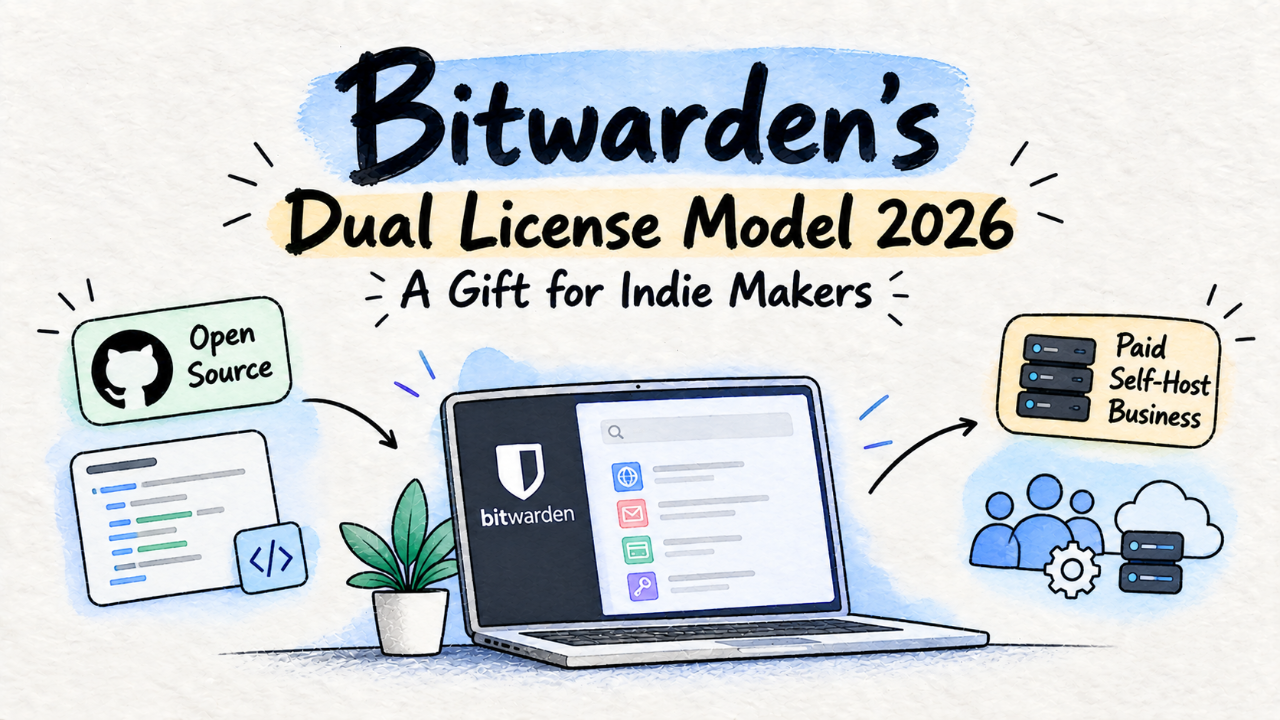
For years, Bitwarden's server-side code was under the AGPLv3 license. This was great for personal use but tricky for commercial products. The AGPL is "viral" — if you use an AGPL library in your backend, you must open-source your entire backend. For a solo founder building a closed-source SaaS, that was a non-starter.
The new dual-license model, effective this year, changes that. You now have a choice:
AGPLv3: The same as before. If you modify the Bitwarden server code and offer it as a service, you must share your source code.
Bitwarden Commercial License (BCL): This is the new part. It lets you use the Bitwarden server code in your closed-source commercial SaaS without open-sourcing your own code.
The BCL is free to use. The trigger for payment isn't usage, it's scale and specific use cases. The terms are clear: you only need a paid BCL license if your business (A) earns over $100,000 in annual recurring revenue, or (B) you sell a self-hosted version of your software that bundles the Bitwarden server.
This isn't just a password manager anymore. It's a full-featured identity and secrets management platform you can build your product on top of. Think of it as a self-hosted Auth0 or Clerk, but with end-to-end encryption (E2EE) at its core.
Why a Solo Founder Should Care
Because you get an enterprise-grade user backend for free until you have product-market fit. This is huge.
Your typical auth options have painful trade-offs:
Roll your own: Don't. You will get it wrong. Security is subtle. The hours you spend implementing secure password hashing, 2FA, and session management are hours you're not spending on your actual product.
Firebase Auth / Supabase Auth: Great for getting started. They are cheap or free at first, but you're locked into their ecosystem. Scaling costs can be unpredictable, and their feature sets are geared toward general-purpose apps. E2EE is often an afterthought, if it exists at all.
Auth0 / Clerk: The gold standard for managed identity. They are powerful, secure, and have great DX. They are also expensive. Their free tiers are limited, and costs ramp quickly as your user base grows. Paying $50/month for a pre-revenue product is a drag on your runway.
The new Bitwarden model gives you a fourth option: a professional, battle-tested solution that costs you nothing but a few hours of setup time and a cheap VPS. You get user signups, logins, 2FA, secure credential storage ("vaults"), and organization management out of the box. Because it's E2EE, you can honestly tell your users that you, the service provider, cannot access their core data. That's a powerful trust signal in 2026.
You should be spending your weekend building your core product, not reinventing OAuth. There are entire categories of indie products built in a few weekends because the founders focused on their unique value proposition, not on commodity infrastructure.
How to Try It in a Day
You can get a production-ready Bitwarden instance running in an afternoon. No kidding. Their team has poured years into making self-hosting robust. You'll need a domain name and a server with Docker installed (a $6/mo DigitalOcean droplet is fine).
The goal for day one is simple: get the service running, create a user account through the web vault, and then use the API to authenticate that user from a simple script. That's it.
Step 1: Get the installer.
curl -Lso bitwarden.sh https://go.btwrdn.co/bw-sh
chmod +x bitwarden.sh
Step 2: Run the installer and configure.
You'll need installation keys from bitwarden.com/host. It's free. The installer will ask for your domain and if you want to use Let's Encrypt for SSL (you do).
./bitwarden.sh installStep 3: Start the server.
./bitwarden.sh startThat's it. A dozen Docker containers will spin up, orchestrating the database, the web app, the API, and an NGINX proxy. Go to the domain you configured. You should see the Bitwarden Web Vault login screen.
Now, go build your app. Bitwarden has an API and a growing set of SDKs. You can treat it as your user backend. When a user signs up for your product, you can create a user in your Bitwarden instance. When they store sensitive data, you can store it in their encrypted vault via the API. You hold the keys to your application data; they hold the keys to their personal data.
This decoupling of application data and user-secret data is a modern, secure architecture that users are starting to demand.
The Catch (and What Breaks in Production)
This isn't a free lunch. It's a calculated business decision by Bitwarden, and you need to understand the trade-offs.
The Catch is the License. The BCL is generous, but it's not a FOSS license. You are building on proprietary infrastructure that happens to have a free tier. The $100k ARR revenue trigger is the key. Once your SaaS is successful, you have to pay. The pricing isn't public yet, but expect it to be in line with enterprise software. Think four to five figures per year. Once you hit $100k ARR, a $5k/year license is just another cost of doing business, something you should already be modeling in your SaaS pricing strategy. The risk is that they could change the terms or the pricing in 2028, and you'll be faced with a choice: pay up or perform a painful migration.
What breaks in production? Your code won't break. Your business model might. If your plan was to sell a downloadable, self-hosted version of your product, this model is a problem. You would be redistributing the Bitwarden server, which requires a paid BCL license from day one. For a pure SaaS, nothing breaks. You just need to budget for the license fee as a future COGS.
The other catch is operational overhead. You are the one running the server. You are responsible for updates, backups, and uptime. It's a well-oiled machine, but it's still a machine you own. A managed service like Clerk takes that burden away, for a price. For a bootstrapper, trading a few hours a month for hundreds of dollars is usually the right call.
This decision to use Bitwarden's core vs. a fully managed service is similar to the trade-offs you face when choosing an AI model for your product: cost, control, and scalability. You're taking on more responsibility in exchange for zero initial cost and greater control.
Here is how the Bitwarden BCL option stacks up against the alternatives for a solo founder.
Option | Initial Cost | Time to Implement | Security Burden | Cost at Scale |
|---|---|---|---|---|
Bitwarden (BCL) | $0 | ~4 hours | Low (Updates/Backups) | $$$ (License fee) |
Roll Your Own | $0 | Weeks/Months | Very High | $ (Server time) |
Supabase Auth | $0 | ~2 hours | None | $$ (Usage-based) |
Clerk / Auth0 | $0 (Limited Tier) | ~2 hours | None | $$$$ (Per user) |
Is This Worth Switching To?
The answer depends on where you are in your journey.
For a brand new project starting this week: Yes. Absolutely. It is the most powerful, secure, and cost-effective way to get a serious user backend off the ground in 2026. The risk of future licensing costs is a "good problem to have" — it means you've built a successful business. Use it to ship faster and defer costs until you have revenue.
For an existing project on a managed provider: Probably not. Migrating your user base from one identity provider to another is one of the riskiest and most difficult infrastructure projects you can undertake. It involves forcing password resets, migrating data, and risking user lockout. Unless your current provider has become prohibitively expensive or is shutting down, stay put. The switching cost is too high.
The chatter on Hacker News and among indie hackers is right to be excited. The Bitwarden dual license model creates a new, compelling path for bootstrappers. It lets you use enterprise-grade tools with a pricing model that understands the founder's journey: free until you're making real money. Build on it, get to product-market fit, and by the time the bill comes due, you'll be glad to pay it.