You hit the front page of Hacker News on a Tuesday. By Wednesday, your Vercel bill is forecasting a four-figure month. Your function execution times are climbing. The free tier of your database is groaning. This is the dream, and also the nightmare.
Then you see it, climbing the ranks right below your own launch: "Show HN: I wrote a modern web app in C." You click. You scroll. A single 4MB static binary. Sub-millisecond response times. Memory usage measured in megabytes, not hundreds of them. The author is running their entire SaaS on a single $5 Linode, handling thousands of requests per second.
The temptation is immediate. Should you rewrite your app in C?
No. But you absolutely should know why it's suddenly relevant again in 2026, and you should have it in your toolbelt for one specific job.
What "A Modern Web App in C" Actually Means
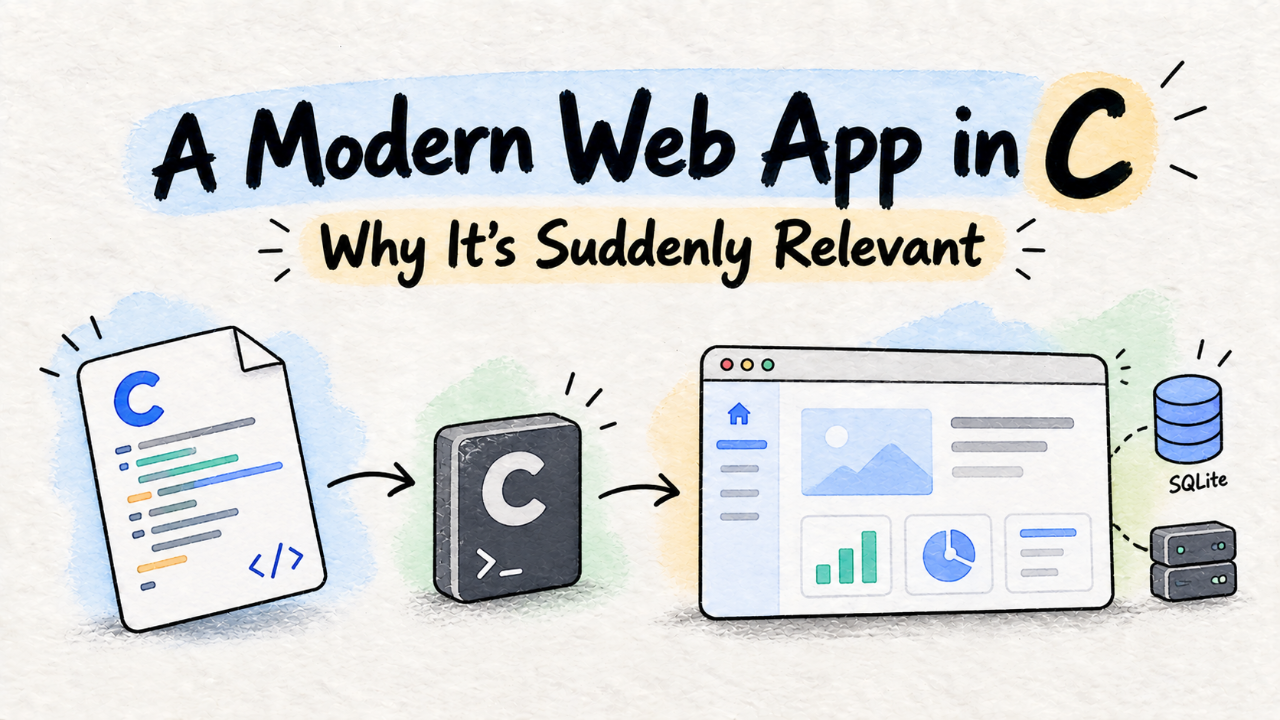
Let's get specific. This isn't your uncle's CGI-BIN script from 1998. The recent crop of C web projects that keep hitting HN are built on modern libraries like Kore or H2O. They give you just enough to be productive: an event loop, HTTP parsing, and maybe some helpers for JSON and Postgres.
The result is a self-contained executable. No `node_modules` folder. No virtual environment. No container image juggling. You compile your app on your machine:
$ cc -o myapp myapp.c -lkore
You copy the resulting binary to a cheap VPS:
$ scp myapp user@your.server.ip:/home/user/
And you run it. Forever. That's it. The appeal is the radical simplicity of the deployment artifact and the brutal efficiency of the runtime. We're talking orders of magnitude less RAM and CPU than an equivalent Node.js or Python app for a raw, I/O-bound task. For a bootstrapper, that translates directly to a lower cloud bill and a longer runway.
The Indie Hacker's Use Case: The Hyper-Specific Microservice
Rewriting your entire Next.js marketing site or your Rails monolith in C is a guaranteed way to never ship again. You'd spend a year rebuilding basic features like authentication, database migrations, and form handling that your framework gives you for free.
The sweet spot for a solo founder is not the monolith. It's the micro-binary. A tiny, single-purpose service that does one thing exceptionally well and cheaply.
Think about the parts of your system that are all cost and no glamour:
The Analytics Ingester: A simple endpoint that receives a tracking event, validates it, and queues it for processing. It needs to be fast, handle massive traffic spikes, and cost almost nothing to run.
- The Webhook Catcher: An endpoint that catches webhooks from Stripe or GitHub, does a tiny bit of work, and calls another internal API. It must be reliable and quick to acknowledge the request. - The URL Shortener: A read-heavy service that does a single database lookup and returns a 301 redirect. Latency is everything.
This is the job for C. These services have minimal business logic. Their value is in their performance and low overhead. You write it once, deploy it to the cheapest server you can find, and forget about it.
Consider a product like Statable, a privacy-focused analytics tool. The main dashboard can be a beautiful React app, but the data collection endpoint that gets hit with every single page view? That's a perfect candidate for a C micro-binary. It just needs to capture the request, maybe do a quick GeoIP lookup, and write to a fast message queue. No templating, no complex logic, just raw I/O performance.
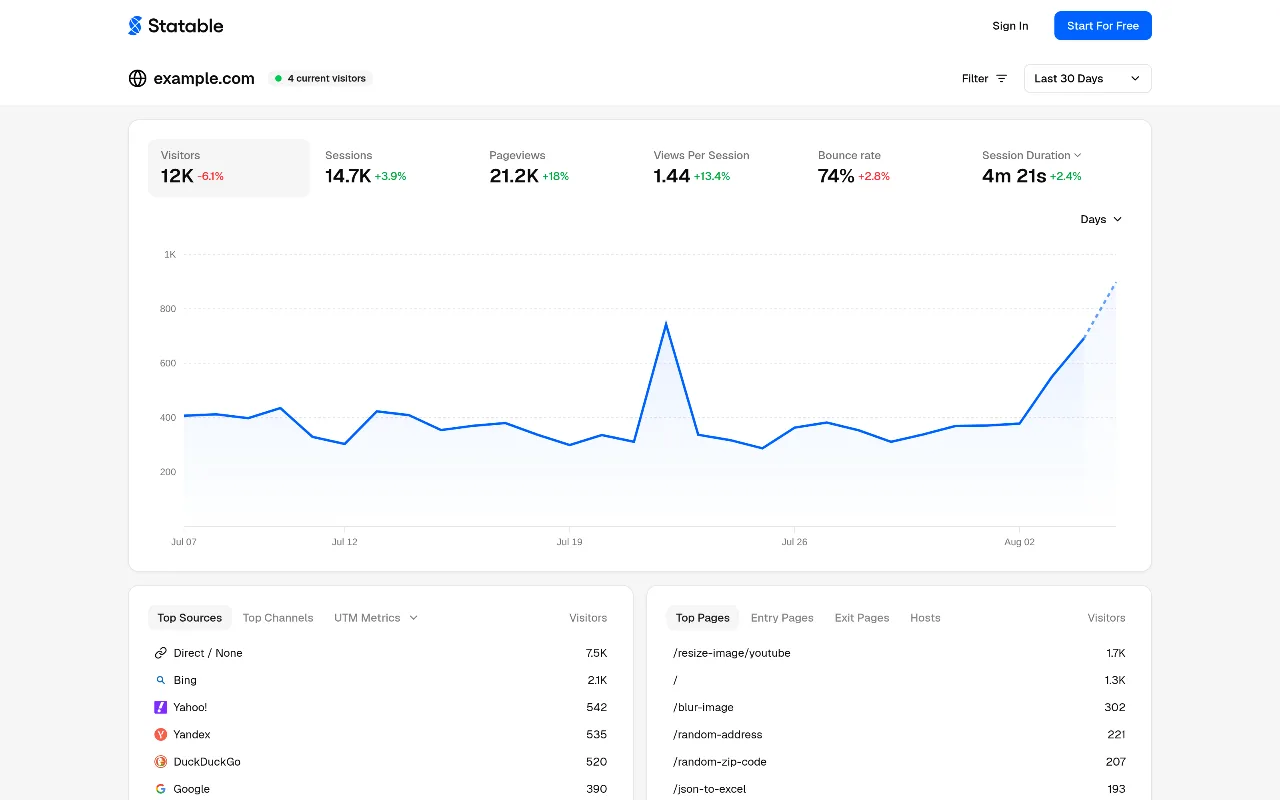
Statable's dashboard showing real-time visitor data
By carving off this one hot path, you can keep the rest of your stack in a high-productivity environment like TypeScript or Ruby, while ensuring your infrastructure costs don't scale linearly with your traffic.
How to Try It in a Day
Don't just read about it. Build something. The best way to understand the trade-offs is to feel them. Here’s a weekend project: a 1x1 tracking pixel server using Kore.
First, get Kore on your machine (macOS example using Homebrew):
$ brew install kore
Now, create a file called `tracker.c`:
#include <kore/kore.h>
#include <kore/http.h>

// A 1x1 transparent GIF.
const u_int8_t pixel[] = {
	0x47, 0x49, 0x46, 0x38, 0x39, 0x61, 0x01, 0x00, 0x01, 0x00,
	0x80, 0x00, 0x00, 0x00, 0x00, 0x00, 0xff, 0xff, 0xff, 0x21,
	0xf9, 0x04, 0x01, 0x00, 0x00, 0x00, 0x00, 0x2c, 0x00, 0x00,
	0x00, 0x00, 0x01, 0x00, 0x01, 0x00, 0x00, 0x02, 0x02, 0x44,
	0x01, 0x00, 0x3b
};

int serve_pixel(struct http_request *);

int serve_pixel(struct http_request *req) {
	// Log the request path and user agent.
	// In a real app, you'd write this to a DB or queue.
	kore_log(LOG_INFO, "hit: %s from %s", req->path,
	    http_request_header(req, "user-agent", NULL));

	http_response_header(req, "content-type", "image/gif");
	http_response(req, 200, pixel, sizeof(pixel));
	return (KORE_RESULT_OK);
}
Create a simple config file, `conf/tracker.conf`:
bind 127.0.0.1 8888
load ./tracker.so

domain * {
    attach myapp

    route /pixel.gif {
        handler serve_pixel
    }
}
Now compile and run it:
$ kodev build
$ kodev run
Visit `http://127.0.0.1:8888/pixel.gif?page=/about` in your browser. You’ll see a tiny dot, and in your terminal, you’ll see the log line. You just built a web server that can handle an absurd number of requests using barely any system resources. This is the superpower.
The Catch: Why You'll Still Ship Your Main App with Next.js
The superpower comes at a steep price. The moment your logic gets more complex than an `if` statement and a `printf`, you'll start to feel the pain. This is not a path to shipping your SaaS faster.
C gives you all the rope you need to hang yourself, your server, and your customers' data along with it.
Here's what breaks in production:
Memory Management: That `malloc` you forgot to `free`? That’s a memory leak. In a long-running server process, that's a slow, silent death. Your server's memory usage will creep up until the OOM killer executes your app with zero ceremony.
String Handling: In C, a "string" is just a pointer to a block of memory with a null byte at the end. Concatenating two strings is a manual memory allocation and copy. Parsing a query string is a minefield of buffer overflows and off-by-one errors. It's tedious, error-prone, and a massive security risk if you get it wrong.
The Ecosystem Desert: Need to talk to the Stripe API? Find a C library. Need to parse a complex JWT? Write it yourself. There is no npm, no pip, no Cargo for the C web world. You are on your own. For a solo founder, the rich ecosystems of other languages are a massive competitive advantage.
Tooling and DX: Forget hot-reloading. Forget amazing IDE integration. Your debugger is `gdb`, a tool as powerful as it is unforgiving. You're back to the compile-run-debug loop, and it's slow.
This is why focused, compiled utilities like DevCleaner are often built as desktop apps rather than web services. The trade-offs of a compiled language make more sense for a self-contained client application than for a complex, networked service with constantly evolving business logic.
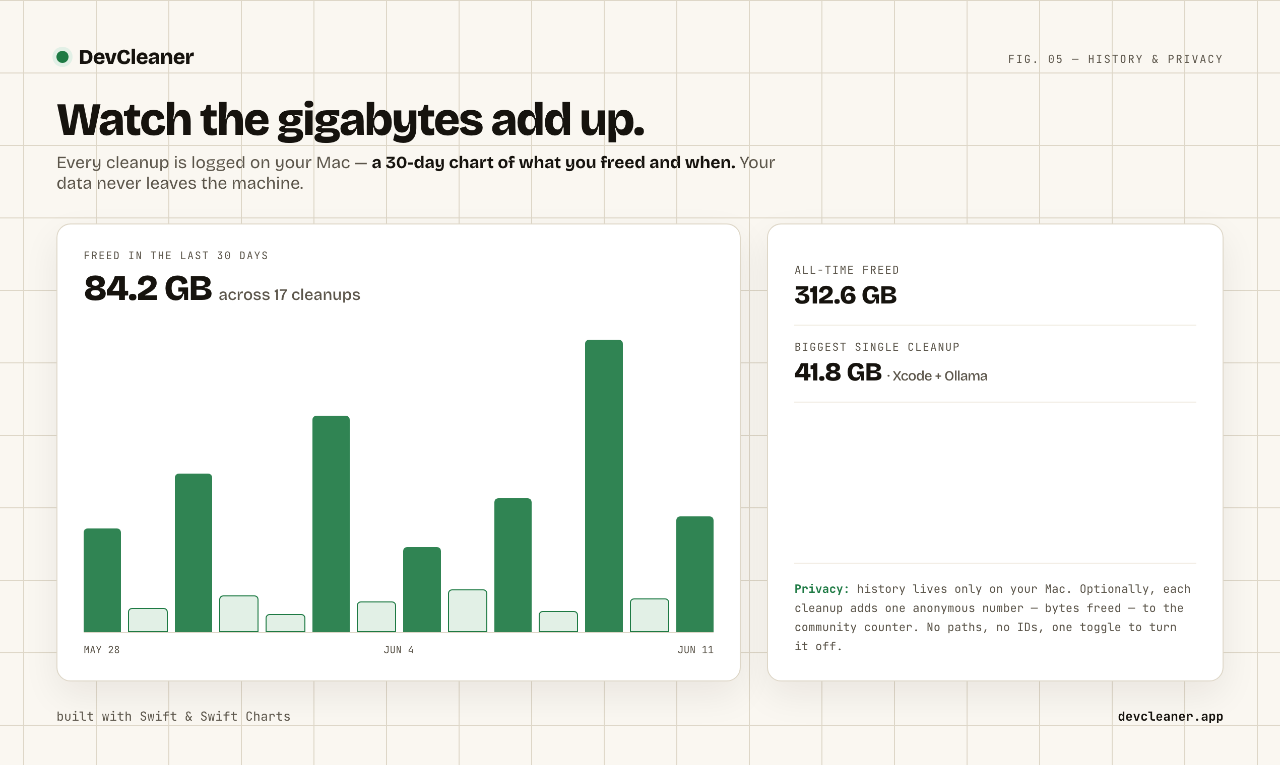
DevCleaner finding and removing gigabytes of cached files from a development machine
For a clear view, here's how C stacks up against more common choices for a simple API endpoint.
Stack | Dev Velocity | Performance | Memory Usage | Ecosystem | Deployment |
|---|---|---|---|---|---|
Node.js (Express) | High | Good | High | Massive | Easy (Vercel/etc.) |
Go (net/http) | Medium | Excellent | Low | Good | Simple (Binary) |
C (Kore) | Very Low | Exceptional | Minimal | Sparse | Simple (Binary) |
Looking at this, Go often hits the sweet spot for performance-sensitive services without the extreme downsides of C. But when you need to squeeze out every last drop of performance for the absolute lowest cost, C is still the undisputed king.
So, Is It Worth It?
For your main product? No. Don't get distracted. The goal is to ship features and find product-market fit. Use the tools that let you move fastest: Next.js, SvelteKit, Rails, Laravel, Django. Their "slowness" is a feature; it's the cost of an ecosystem that does the heavy lifting for you.
But as your app grows, keep C in your back pocket. When you're building a high-volume data firehose, like a custom service to hit the new Web Search API 2026 thousands of times a minute, a C microservice could be your secret weapon. When your analytics bill is out of control, a tiny C-based ingester could save you thousands. See it for what it is: a specialized tool for a specialized job.
Build your business with a framework that prioritizes your time. Pay your bills with a tiny C binary that prioritizes the machine's time.