You launched on a Tuesday. By Friday, you have 12 signups. Six of them are your friends. The dopamine from the launch has worn off, replaced by a pit in your stomach. The common wisdom screams from every corner of Indie Twitter: “Build in public!”
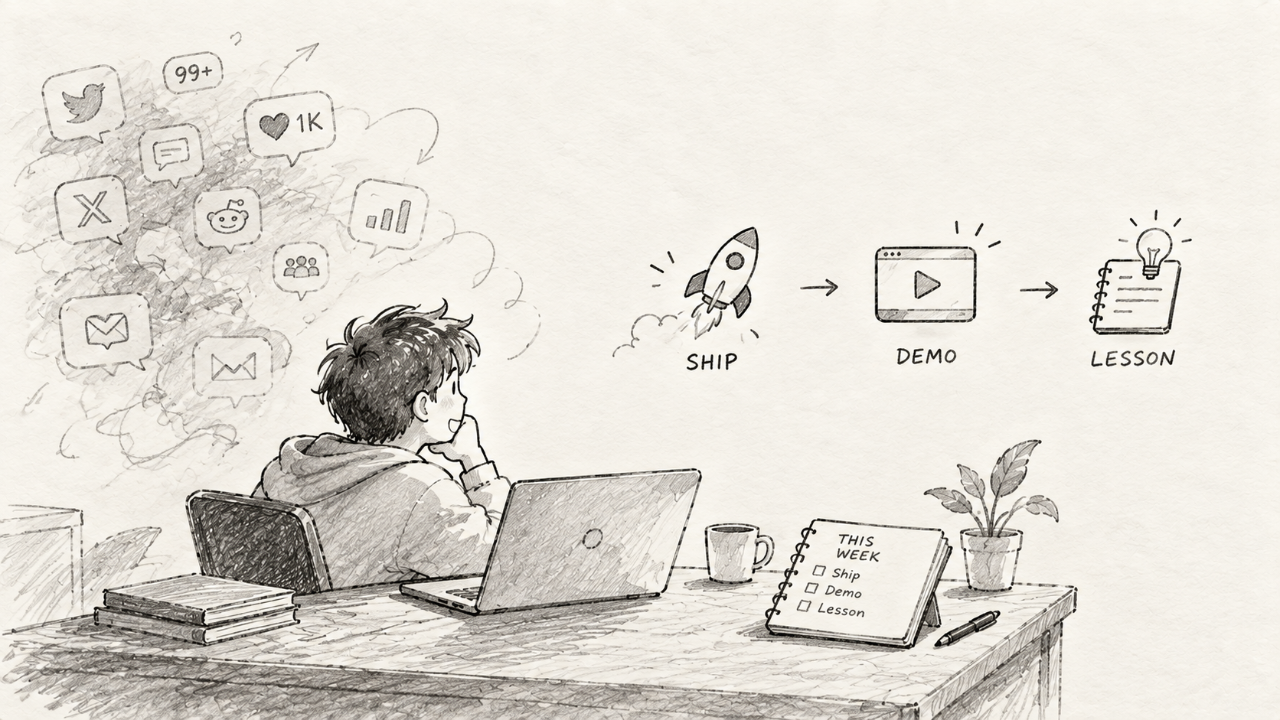
So you try. You post your MRR. You tweet about a bug. You get three likes. A week later, you do it again. It feels like shouting into a void, another chore on a list that’s already too long. You’re a builder, not a content creator, and the pressure to perform on social media is burning you out faster than a runaway `while` loop.
The 2020 model of building in public is dead. Simply tweeting your Stripe balance or a screenshot of your analytics dashboard is no longer enough. The space is too crowded, the audience too jaded. In 2026, building in public still works, but not as a performative spectacle. It works as a disciplined practice. It works when you have a system.
This is not a guide to becoming a Twitter celebrity. This is a system for using public accountability to ship better product, find your first 100 users, and do it all without sacrificing your nights, weekends, and sanity.
The Sustainable Cadence: One Ship, One Demo, One Lesson
Forget posting every day. Daily posting is for full-time creators. You are a builder. Your job is to build. A sustainable cadence respects that. It creates compound interest, not a constant state of anxiety. Adopt this weekly ritual. Block out 90 minutes on your calendar every Sunday evening.
1. The Ship: Your Proof of Work
This is the non-negotiable. Every week, you must ship something. It doesn’t have to be a groundbreaking feature. It can be a bug fix, a performance improvement, a documentation update, or a tiny UI tweak. The size doesn’t matter. The consistency does.
Shipping is your anchor. It proves to yourself, and to your audience, that you are making progress. It’s the “build” in “building in public.” Without it, you’re just talking. A public shipping log keeps you honest. Your weekly post is a summary of that log.
Your commit history is your source of truth. If you can’t find something to ship, look at your commits from the past week. `feat: add keyboard shortcut for search`, `fix: correct timezone offset in user profiles`, `refactor: simplify pricing component state`. These are all valid shipments.
2. The Demo: Show, Don't Just Tell
You shipped a fix. Great. Nobody can see a bug that’s no longer there. You need to make your progress tangible.
For every ship, create a short demo. A 30-second screen recording (use Cleanshot or Kap). A GIF. A set of before-and-after screenshots. This is not a polished marketing video. It’s a work-in-progress artifact. Show the feature in action. Show the UI before and after your tweak. Show the Lighthouse score improving.
The demo translates your code into user value. It’s the bridge between your IDE and your audience’s imagination. It makes your progress feel real to them, and, more importantly, to you.
3. The Lesson: Build Authority, Not Just an Audience
This is what separates a content grinder from a respected builder. Every week, share one specific lesson you learned. This is your chance to pay it forward and build genuine authority.
A lesson is not a generic productivity tip. It’s a concrete takeaway from the work you just did. It could be:
A technical trade-off you made.
A clever CSS trick.
An insight from a user interview.
Why you chose one API over another.
A surprising discovery while debugging.
For example, instead of saying "I improved database performance," share the specific query you optimized. Show the `EXPLAIN` plan before and after. Explain why you added a specific index.
“This week I learned our user onboarding flow was confusing. My hypothesis was the copy. After 3 user calls, I realized the button placement was the real issue. Moving it above the fold increased activation by 10%. Lesson: Watch what users do, not just what they say.”
Sharing your learnings, including the tech you use, builds a connection with other developers. They’ll follow you for your insights, not just your product updates. If you're deciding on your stack, seeing what others have battled with is invaluable. We see these patterns every year in our annual tech stack report; the stories behind the choices are what matter.
The Public Logbook vs. The Private Diary
“Be transparent” is lazy advice. The goal is not to turn your life into content. It’s to use public documentation as a forcing function for progress. You need a filter. Think of it as a public logbook, not a private diary.
What to Share
Process and Trade-offs: Why did you choose SvelteKit over Next.js for your new marketing site? Why did you opt for a serverless Postgres provider like Neon instead of running your own? Explain your reasoning. This is gold for other builders.
Code Snippets: Share a small, useful piece of code. Not your secret sauce, but a helper function, a custom hook, or a clever configuration. Context is everything. Explain what it does and why it’s useful.
// Our simple hook for debouncing search input in React
import { useState, useEffect } from 'react';

export function useDebounce(value, delay) {
  const [debouncedValue, setDebouncedValue] = useState(value);

  useEffect(() => {
    const handler = setTimeout(() => {
      setDebouncedValue(value);
    }, delay);

    return () => {
      clearTimeout(handler);
    };
  }, [value, delay]);

  return debouncedValue;
}
High-level, Anonymized Insights: “Spoke to five users this week. A common theme: they want an easier way to export their data.” This shows you’re listening without revealing user identities.
Failures and Null Results: “I spent two days trying to implement feature X. It turned out to be too complex and not worth the effort right now. Shelving it. Here’s what I learned…” This builds trust far more than a constant stream of wins.
What to Keep Private
Precise Revenue Numbers: Unless you are in the business of selling “how to make money” courses, your exact MRR is a vanity metric. It invites comparison and judgment. If you must share, use ranges (“passed the $1k MRR mark”) or growth percentages (“up 20% MoM”). Focus on user count and retention instead.
Personal Drama or Rants: Don’t subtweet competitors. Don’t complain about your personal life. It dilutes your message and makes you look unprofessional. Your public feed is your professional logbook.
Your Core IP: Share the problem your algorithm solves, not the algorithm itself. Share the structure of your database schema, not the raw data. Be open with the "how," but protect the "what" that gives you a unique edge.
Escaping the Vanity Trap
Burnout often comes from chasing the wrong metrics. The old model of building in public glorified the vanity scoreboard: follower counts, launch day upvotes, and likes on an MRR screenshot.
These metrics are sugar highs. They feel good for a moment, then leave you empty. They do not correlate with a sustainable business.
The metrics that matter are the ones that measure the health of your product:
Activation Rate: What percentage of new signups complete the core action of your app? This tells you if your product’s value is clear.
User Retention: Of the users who signed up last month, how many are still active this month? This is the single most important metric for product-market fit.
Paid Conversion Rate: How many free users become paying customers? This validates your business model.
A huge launch on a major platform might feel like a win, but if it results in thousands of signups with a 1% activation rate, it was a failure. You just acquired a massive cohort of disengaged users who will churn in a week. Often, a more targeted launch on one of the many Product Hunt alternatives that serve a specific niche can yield far better-qualified users.
Focus your energy on moving these health metrics. Your weekly build-in-public update should reflect that. Instead of "We hit 10k followers!", try "We shipped a new onboarding checklist and improved our activation rate from 25% to 40%." One is vanity. The other is a business.
When Building in Public Backfires
This system isn't foolproof. Being public opens you up to risks. You need to be aware of them to navigate them.
The Copycats
If your idea is good and you share your progress, someone will try to copy you. Accept it. Secrecy is not a moat. Your speed of execution, your unique perspective, and the relationship you build with your users are your moat. While a copycat is reverse-engineering your last feature, you are talking to users and building the next one. Keep shipping.
The Public Scrutiny
People will criticize your product, your pricing, your tech stack, and your grammar. Some of this feedback will be invaluable. Most of it will be noise. Learn to distinguish between good-faith criticism from a potential user and bad-faith trolling. Engage with the former, block the latter. Develop a thick skin.
The Audience Capture Trap
This is the most insidious danger. You start to notice that tweets about fundraising or dramatic failures get more engagement than your thoughtful posts about product decisions. You subconsciously start optimizing for the audience, not the user. You begin building a media company about building a company, instead of just building the company.
The moment you feel this happening, stop. Go back to basics. Talk to your users. Re-read your initial notes. Remind yourself why you started. A public audience is a consequence of building something interesting, not the goal. The goal is to build something people will pay for because it solves a real problem—a problem you should have validated before you wrote a single line of code.
A Tool, Not a Lifestyle
Building in public is not a moral imperative. It is a tool. A powerful one, if used with intention and discipline. The 1-1-1 cadence—one ship, one demo, one lesson—is a system to wield that tool effectively.
It grounds your public presence in your work. It forces you to make consistent progress. It builds an audience that is invested in your skills and insights, not just your personality. It lets you reap the benefits of public accountability without letting it consume your life.
Your goal is to ship a great product. Stop trying to be a full-time influencer. Start being a builder who documents their work. See what others are building and how they share their journey by browsing the projects on Builtbyindies. Get inspired, then get back to work.
Now, go ship.