Your AI App Is Too Slow. DeepInfer Promises a Fix.
It’s Thursday night. Your new feature, a code assistant powered by DeepSeek Coder V3, is live. You got a nice little traffic spike from a launch aggregator and a few dozen signups. Then the feedback emails start. “Cool idea, but it feels sluggish.” “Why does it take 10 seconds to generate a function?”
You’re running the model on a single A10G from Runpod. It’s costing you about $0.60 an hour, which feels fine until you realize the user experience is garbage. The latency is killing you. Then you see it on the front page of Hacker News: “DeepInfer: High-performance inference framework for DeepSeek models”.
Another framework. Another promise of “state-of-the-art throughput” and “low-latency inference.” Your first instinct is to ignore it. You have real work to do. But the promise is specific: a performance framework built *just* for the models you’re already using. This isn’t a generic tool. It’s a custom-built engine for a specific set of models. That’s different.
This is our take on what DeepInfer means for you, the solo founder shipping this week.
What Actually Shipped Here?
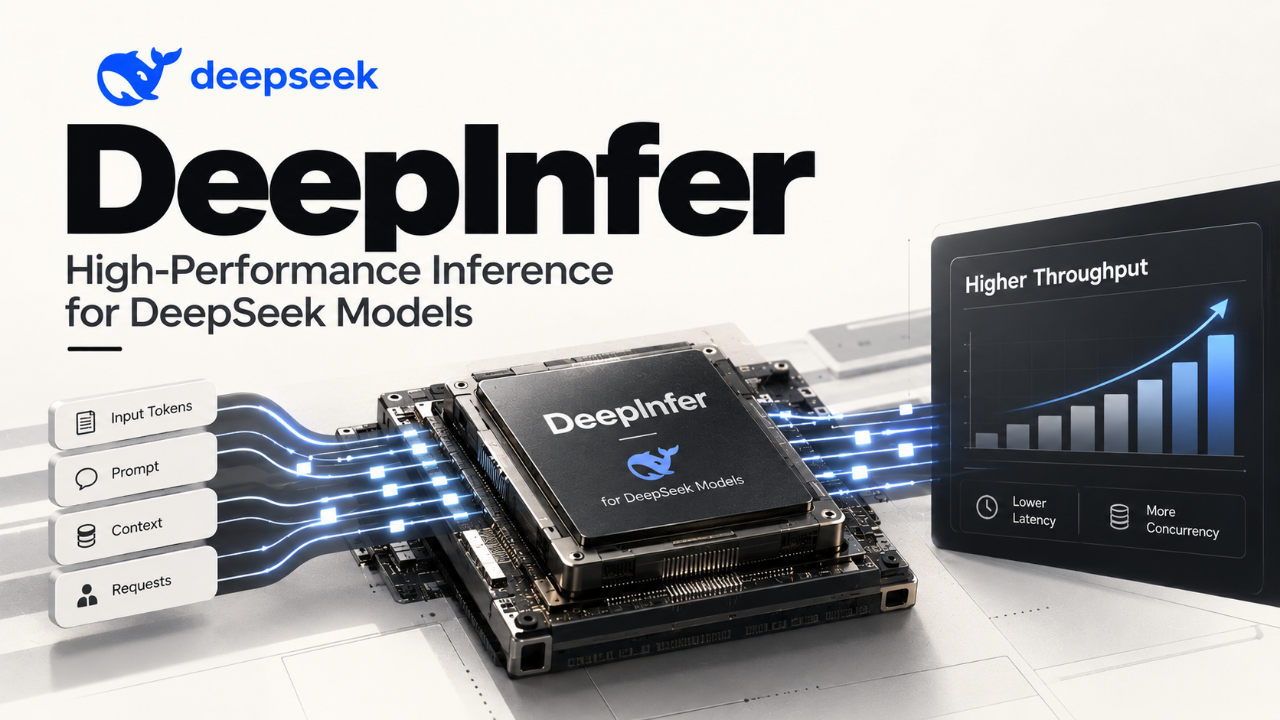
Let’s cut the marketing speak. DeepInfer is not a new model. It’s an inference server, like vLLM or Hugging Face’s Text Generation Inference (TGI), but with a narrow focus. It’s designed from the ground up to do one thing: run DeepSeek’s family of models (LLM 67B, Coder V3, etc.) as fast as possible on NVIDIA GPUs.
How? By ditching generality. While tools like vLLM are built to support a wide range of architectures—Llama, Mistral, Falcon—they pay a small performance tax for that flexibility. DeepInfer throws that away. It uses hand-optimized kernels, custom memory management, and advanced quantization techniques tailored specifically to the DeepSeek architecture.
Think of it like this: vLLM is a high-end, adjustable wrench that fits most bolts. DeepInfer is a custom-milled socket wrench that fits exactly one type of bolt, but it gives you perfect torque every time. The result is higher throughput (more simultaneous users on one GPU) and lower per-token latency (a faster response for each user).
Why a Solo Founder Should Care
For a venture-backed startup, shaving 100ms off inference time is a nice metric for a slide deck. For you, it’s the difference between a user sticking around or closing the tab. For an indie hacker, performance isn’t a feature; it’s a prerequisite for survival.
There are two costs to slow inference:
The User Experience Cost: Anything over a two-second response time for an interactive AI feature feels broken. Your users have been conditioned by ChatGPT’s perceived speed. If your app feels like it’s “thinking” for too long, they will leave. A snappy, responsive UI is critical to converting a curious visitor into a paying customer. It's the foundation of a product that's compelling enough to ace your product demo.
The Financial Cost: You’re paying for every second your GPU is active. Higher throughput means you can serve more users on the same instance, or scale down to cheaper hardware. If DeepInfer lets you handle your current traffic on a $0.60/hr A10G instead of needing a $2.00/hr A100, you’ve just cut your biggest infrastructure cost by more than half. That’s more runway. More life.
DeepInfer directly targets these two costs. It’s not just a technical curiosity; it’s a tool for improving your product and your bottom line. That’s why it’s worth paying attention to.
How to Try It in a Day
Don’t just read the benchmarks. Test it on your own workload. You can get a feel for DeepInfer in under an hour. Here’s a no-fluff plan.
First, get a shell on a machine with a modern NVIDIA GPU and CUDA installed. Services like Vast.ai or Runpod are perfect for this.
1. Install It
The team has packaged it cleanly. It’s a simple pip install.
pip install deepinfer2. Run the Server
Point it at the DeepSeek model you want to serve. Let’s use `deepseek-ai/deepseek-coder-v2-lite-instruct` as our test case. It’s small enough to load quickly.
python -m deepinfer.server.api_server --model deepseek-ai/deepseek-coder-v2-lite-instructIf all goes well, you’ll see the model weights download and the server start up on port 8000. It mimics the OpenAI API format, which has become the de facto standard.
3. Send a Test Request
Now, from another terminal, use `curl` to hit the endpoint. Time the request to get a rough latency measurement.
time curl http://localhost:8000/v1/completions \
  -H "Content-Type: application/json" \
  -d '{
    "model": "deepseek-ai/deepseek-coder-v2-lite-instruct",
    "prompt": "def fibonacci(n):",
    "max_tokens": 50
  }'
Jot down the `real` time from the output. Now, do the same thing using your current setup (e.g., a basic Hugging Face `pipeline` or a vLLM server). This isn’t a scientific benchmark, but it’s a gut check. Is it noticeably faster? For a simple, single request, it might not be. The real magic of frameworks like DeepInfer and vLLM comes from their ability to handle concurrent requests efficiently through continuous batching.
The goal of this one-day test isn’t to migrate your entire stack. It’s to answer one question: does this new tool provide a significant enough performance jump for *my use case* to be worth the adoption risk?
The Catch: This Will Break in Production
This is a 0.1 release that just hit Hacker News. It’s not battle-tested. Adopting it today for your main, revenue-generating product is a gamble. Here’s what you’re signing up for:
Bugs & Memory Leaks: Early releases of complex software often have subtle bugs. A small memory leak might not show up in a one-hour test, but it will crash your server after three days of continuous operation.
Limited Model Support: The framework’s biggest strength is also its biggest weakness. It only supports DeepSeek models. If you’re planning to offer a Llama 4 or Mistral-2 model alongside your DeepSeek Coder, you’ll now need to manage two separate inference stacks. That’s more complexity, more points of failure.
Sparse Documentation: The README is probably great. The edge cases? Not so much. When you hit a cryptic CUDA error or want to implement custom logging, you’ll likely be digging through the source code yourself. There’s no big community on Stack Overflow to help you yet.
API Instability: The flags, configuration options, and API endpoints in v0.1 might be completely different in v0.2. Be prepared to refactor your deployment scripts.
This isn’t a criticism of the DeepInfer team; it’s the reality of new infrastructure. Someone has to find the sharp edges. Don’t let it be you, on your production app, at 3 AM.
The Verdict: Is It Worth Switching To?
Yes, but not everywhere. You have to segment your risk.
Here’s a comparison of your main options for self-hosting today in 2026.
Framework | Best For | Model Support | Performance | Maturity |
|---|---|---|---|---|
DeepInfer | New features, prototypes | DeepSeek only | Very High (for DeepSeek) | Low (v0.1) |
vLLM | General production workloads | Broad | High | High |
Hugging Face `pipeline` | Local dev, simple scripts | Very Broad | Low-Medium | Very High |
Based on this, here is our recommendation:
For a brand new project or a non-critical feature: Go for it. If you’re spinning up a new AI-powered app this weekend and you’ve decided to base it on a DeepSeek model, use DeepInfer from day one. The performance gains are likely worth the teething pains of an early-stage project. You’re not risking existing customers, and you’ll benefit from the lower costs and better UX immediately.
For your core, stable, money-making product: Wait. Do not rip out your stable vLLM or TGI deployment to replace it with DeepInfer this week. The risk of unknown bugs and production instability is too high. Monitor the project, watch the GitHub issues, and wait for a v0.3 or v0.4 release. Let the community harden it first. Your priority is stability.
For local development and experimentation: Absolutely. If DeepInfer lets you iterate faster on your local machine because inference is quicker, that’s a huge win for productivity. Use it to prototype new prompts and features. The risk is zero, and the upside is a tighter feedback loop.
The rise of specialized frameworks like DeepInfer is a fantastic sign for indie makers. It’s part of the great commoditization of the AI stack. The underlying models are becoming more accessible, and now the tools to run them cheaply and efficiently are improving every week. It allows a solo founder to build products that, just a few years ago, would have required a dedicated infrastructure team. Many of these indie-built tools eventually get listed across various product categories, showing just how far you can get on your own.
DeepInfer isn't a silver bullet. It's a new, sharp tool. Use it for the right job: carving out a new feature, not performing open-heart surgery on your main application.