You launched on a Tuesday. By Friday, you have a dozen signups, three support tickets, and one nagging thought: your OpenAI bill for this simple text-classification feature is already tracking towards $100/month. It works, but it feels like using a sledgehammer to crack a nut. Every API call is a prayer the latency is low, the output is clean, and the cost doesn't spike overnight.
Then the "Muse Spark Open" story hits Hacker News. Another open-source AI model. You're tempted to ignore it. You have bugs to fix. But this one is different. It’s not another 70-billion-parameter beast that requires a server that could power a small city. It’s small, specific, and you can run it on your laptop. Now.
This isn’t your replacement for a GPT-5-class model. It’s something much more useful for a solo founder: a sharp, predictable tool for a specific job. It’s the weekend project that might just fix your weekday cost and latency problems.
What Actually Shipped: A Specialist, Not a Generalist
Let's be clear. Muse Spark Open is not a ChatGPT competitor. It won't write you a sonnet about your SaaS and then debug your React code. Trying to make it do that will only lead to frustration.
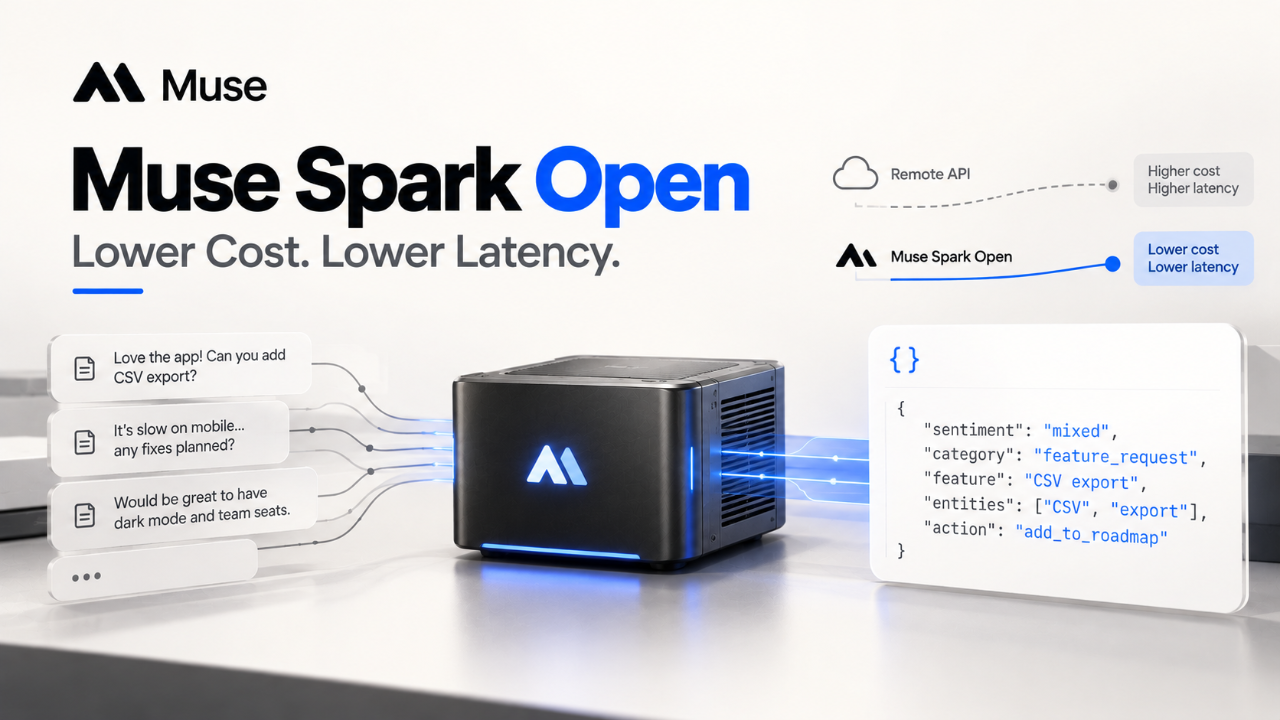
Instead, think of it as a highly-tuned 3-billion-parameter model, laser-focused on one task: structured data extraction. You give it messy, unstructured text, and it returns clean, predictable JSON. That's the magic trick.
It was trained specifically for tasks like:
Classification: "Is this email a support request, a sales lead, or spam?"
Entity Extraction: "Find the person, company, and date in this block of text."
Function Calling: "Turn 'schedule a meeting with Jane for tomorrow at 2pm' into a JSON object for the Google Calendar API."
It’s small enough to run on a modern laptop CPU or a single, cheap GPU. It’s fast because it has a tiny cognitive load. Unlike massive models that carry the weight of the entire internet in their parameters, Muse Spark knows what it’s good at and doesn’t waste time trying to be anything else.
Why a Solo Founder Should Care
When you're a team of one, every decision is a trade-off between time, money, and control. Muse Spark Open lands squarely in a sweet spot that’s been mostly empty until now.
The Cost Is Zero (ish). The model is free. The code is open source. The only cost is the hardware you run it on. Instead of a variable, per-token API bill that scales with your success (and your anxiety), you have a fixed cost for a $40/month Vultron VPS. This is predictable. You can build a business on predictable.
You Own the Stack. Remember that API you built your entire onboarding flow around, right before they 10x'd the price and deprecated the `v1` endpoint? That can't happen here. When you self-host, you control the upgrade cycle. There are no rate limits unless you impose them. No one can shut off your access. For features at the core of your product, that kind of sovereignty is priceless.
Latency Matters. Is a feature in your app powered by a remote LLM? Then your feature's speed is dictated by their server load, your internet connection, and the general state of the universe. An LLM running locally or on a server in the same datacenter as your app responds in milliseconds, not seconds. This unlocks interactive use cases that were previously impossible or felt sluggish. Think real-time feedback on a user’s writing, instant categorization of an inbound email, or dynamic UI adjustments based on user input.
This isn't just about saving a few bucks. It's about enabling a class of features that felt out of reach for a bootstrapped product. It's about moving a core piece of your value proposition from a third-party dependency into your own codebase. You wouldn't outsource your database; why outsource your product's core intelligence if you don't have to?
How to Try It in a Day
Talk is cheap. Let's get this running. The goal is to go from zero to a local API endpoint in under an hour. We'll use Ollama, the community-standard tool for running models locally in 2026.
1. Install Ollama. If you don't have it, head to their site. It’s a one-line command for macOS, Linux, and Windows (via WSL2).
2. Pull the Model. Open your terminal. It's one command. No `git clone`, no Python dependency hell.
ollama run muse-spark-openThis will download the model (around 2GB) and drop you into a chat interface. You can test it right there.
3. Run as a Server. A chat prompt is nice, but you need an API. Ollama has a built-in server. Just running the command above starts it in the background. It’s already serving on `http://localhost:11434`.
4. Query it with Python. Now let's use it to solve a real problem. Let's say you want to parse user feedback into a structured object. Create a file `test_spark.py`:
import requests
import json

# The user's unstructured feedback
user_input = "I love the new dashboard, but the export to CSV button is broken. It just spins forever."

# The prompt matters. Be specific. Tell it to return ONLY JSON.
prompt = f"""
You are an expert feedback processor. Your only job is to extract the sentiment and the specific feature mentioned from the user's text. Return ONLY a valid JSON object with the keys "sentiment" (either "positive", "negative", or "mixed") and "feature" (the specific part of the app mentioned).

Text: "{user_input}"

JSON:
"""

# The API call to your local Ollama server
response = requests.post(
    "http://localhost:11434/api/generate",
    json={
        "model": "muse-spark-open",
        "prompt": prompt,
        "stream": False,
        "options": {
            "temperature": 0.0 # We want predictable output, not creativity
        }
    },
)

# Parse the response
response_text = response.json()["response"]
try:
    data = json.loads(response_text)
    print(data)
    # Expected output: {'sentiment': 'mixed', 'feature': 'export to CSV button'}
except json.JSONDecodeError:
    print("Failed to decode JSON. Raw output:")
    print(response_text)
Run it with `python test_spark.py`. You just built a reliable, free, and instant text classification service. Total time: maybe 15 minutes.
The Catch: What Breaks in Production
This feels too easy, right? It is. Running a demo is not the same as running in production. Before you swap out your Stripe webhooks for Muse Spark, understand the trade-offs.
The "Open" License Isn't Always a Green Light. "Open" can mean many things. While Muse Spark Open uses a permissive Apache 2.0 license for the code, the model weights themselves are released under a more restrictive license. It’s free for research and for projects with less than 100,000 monthly active users. If you cross that threshold, you need a commercial license. This is a great strategy for them, and it's still a fantastic deal for indie makers. It's a structure we've seen work well, much like the Bitwarden dual-license model, which gives you a long runway before you have to pay. But you need to read the fine print.
Structured Output is a Guideline, Not a Guarantee. The model is *good* at JSON, but it's not perfect. About 1 in 100 times, it might prepend your JSON with "Sure, here is the JSON you requested:" or forget a closing bracket. Your production code MUST account for this. This means robust error handling, JSON validation (with a tool like Pydantic), and a retry mechanism. The Python script above is a starting point, not a production-ready parser.
Scaling is Your Problem Now. One user? Your laptop is fine. A hundred concurrent users? That local Ollama instance will fall over. You are now the SRE. You'll need to think about deploying the model to a dedicated server (or a fleet of them), load balancing, health checks, and GPU memory management. This is real work. The money you save on API calls you might end up spending on your own time, and as the latest Remote Developer Salary Report shows, developer time isn't cheap.
The table below frames the choice between the familiar OpenAI API, a self-hosted behemoth like Llama 3 (70B), and Muse Spark Open.
Factor | OpenAI API (GPT-4/5) | Self-hosted Llama 3 (70B) | Self-hosted Muse Spark Open |
|---|---|---|---|
Primary Use Case | General reasoning, content creation | Deep analysis, custom fine-tunes | Structured data, classification |
Cost | Variable, per-token | Very high fixed (multi-GPU) | Low fixed (CPU or single GPU) |
Setup Time | Minutes | Days | Under an hour |
Production Overhead | Low (API monitoring) | Very high (SRE team) | Medium (DevOps skills) |
Control | None | Total | Total (with license caveats) |
The Verdict: Is It Worth Switching?
So, do you rip out your OpenAI integration this week? No. But you should absolutely download Muse Spark Open this weekend.
Use it for:
Internal Tools. The first place to deploy Muse Spark is internally. Build a tool that auto-tags your support tickets. Create a Slack bot that summarizes your team's daily standup notes. The risk is zero, and the upside is immediate team productivity.
Non-Critical Features. Need to generate alt-text for user-uploaded images? Classify community posts? These are perfect jobs for Muse Spark. If it fails occasionally, it's not a catastrophe.
Prototyping New Products. Have an idea for a new micro-SaaS? You can build and test a fully-functional prototype using Muse Spark without paying a dime in API fees. This is a powerful way to validate ideas. If you find a winning formula, you can turn your project into a real business, following a path from open source to a paid indie product. You can even list early versions on indie product directories.
Don't use it for:
Your Core Value Proposition (at first). If your app's main feature is a complex AI-powered report generator, stick with the most powerful model you can afford. Don't swap a reliable, high-quality engine for a cheaper one that's less capable.
Replacing Complex Chains. If you have a multi-step prompt chain with a GPT-4 class model, Muse Spark will not be a drop-in replacement. It lacks the general reasoning power. It's a different tool for a different job, much like how you'd use EmbeddingGemma 2 for embeddings but not for text generation.
Muse Spark Open represents a shift. The era of giant, do-everything models is being complemented by a new wave of small, specialized, and open tools. For the indie hacker, this is a massive opportunity. It's a chance to build faster, cheaper, and with more control than ever before.
So spend a few hours with it this weekend. See what it can do. Build a small, useful thing. But on Monday morning, keep your production API keys right where they are. At least for now.