You launched your app on a Tuesday. It’s a niche stock photo site for brutalist architecture. You got 12 signups. The good news: people are uploading photos. The bad news: your search is just keyword matching on user-submitted tags. It’s brittle. A search for “concrete facade” misses a perfect shot tagged “raw concrete exterior.” You know vector search is the answer, but your OpenAI bill for a text-embedding model is already making you nervous. And image search? That feels like a feature for a Series A startup, not a weekend project.
Until this week.
Google just dropped EmbeddingGemma 2 on Hacker News, and it’s the kind of release that should make every indie hacker stop what they’re doing. It’s an open, lightweight, multimodal embedding model. Let’s translate that from research paper-ese into founder-speak.
Open: You can download it and run it. No API key. No rate limits you don't set yourself. No one can shut you off.
Lightweight: The base model is small. It’s designed to run efficiently on a single GPU, even on consumer-grade hardware or a cheap cloud instance. It’s not a 100B parameter monster that requires a dedicated server farm.
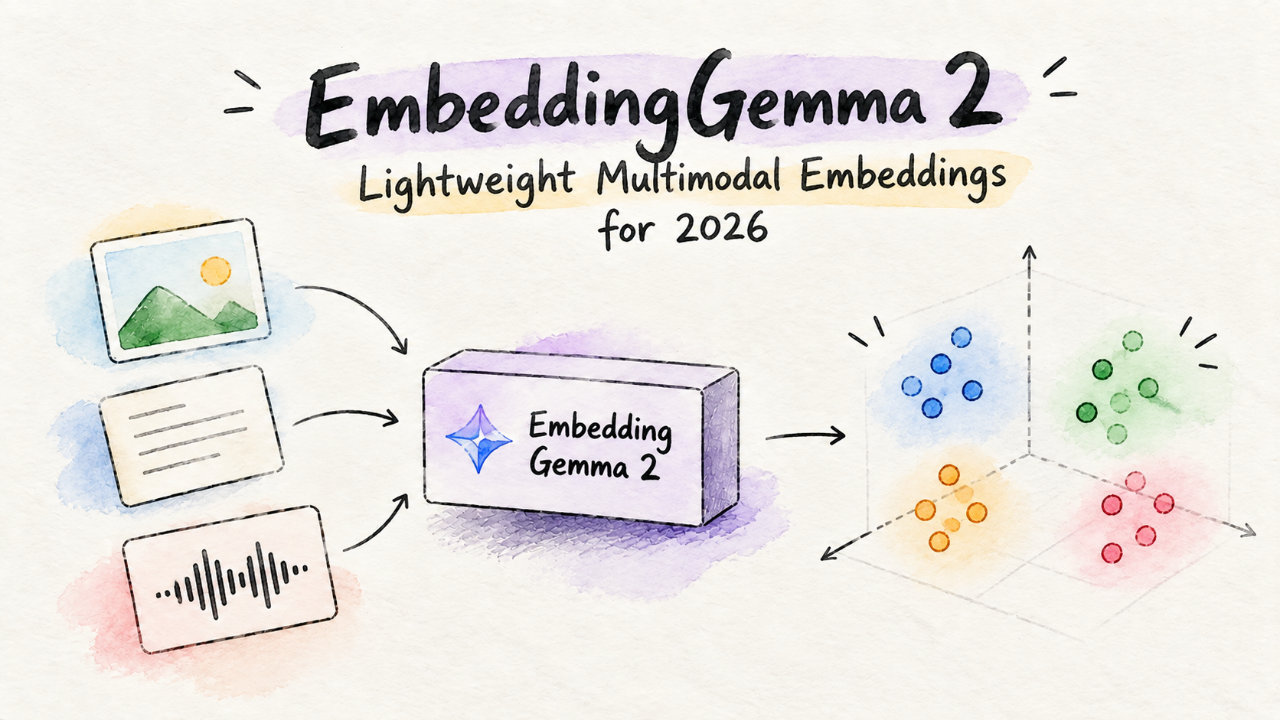
Multimodal: This is the headline. It understands text and images in the same vector space. You can embed a photo of a building and search for it using the text "stark concrete tower with repeating windows."
This isn't just another model release. It’s a capability unlock. For the last few years, multimodal search has been the domain of big tech or well-funded startups willing to pay for expensive, closed-source APIs. EmbeddingGemma 2 puts that power onto your laptop, for free. It’s a direct challenge to the pay-per-token API economy, and for a solo founder, that changes the calculus of what you can build.
Why You, a Solo Founder, Should Care
There are three reasons this matters for someone shipping on a tight budget and a tighter timeline.
1. You Can Erase Your Embedding Bill
Let's be blunt. The recurring cost of AI APIs is a tax on indie projects. Every search, every document chunked, every image processed is a few fractions of a cent. It adds up. For a project in its infancy, a $300/month OpenAI bill can be the difference between a sustainable side business and a failed experiment. When you’re trying to figure out your pricing, a variable, unpredictable COGS is a nightmare. Getting your SaaS pricing right is hard enough without a volatile AI bill eating your margins.
EmbeddingGemma 2 is free. The cost shifts from a variable operational expense (OpEx) to a fixed capital expense (CapEx)—or, more likely for an indie, a predictable, low monthly server cost. A $40/month GPU instance on Vultr or Hetzner that can handle your embedding load is a fixed, understandable cost. It doesn’t grow when you get a spike of signups from a successful launch.
2. You Own Your Stack
Relying on a third-party API for a core feature is a strategic risk. We’ve seen APIs get deprecated with little warning. We’ve seen pricing change overnight. We’ve seen models get “lobotomized” by safety filters that are misaligned with a niche use case. When you run your own model, you are in control.
Your search performance won’t degrade because of a silent update. You won’t get rate-limited during your moment in the sun on Hacker News. This is the same reason so many of us choose open-source databases like Postgres over proprietary alternatives. It’s about building a resilient, long-lasting product on a foundation you control. This is a critical step in turning an open-source project or tool into a real business.
3. You Can Ship Features That Were Previously Unaffordable
This is the most exciting part. What can you build this weekend that you couldn’t last weekend?
For an e-commerce store: Allow users to upload a photo of a style they like and find similar products. “Visual search” just went from a Shopify App Store upsell to a feature you can build yourself.
For a user-generated content platform: Automatically categorize and tag uploaded images. Your brutalist architecture app could now automatically add tags like “concrete,” “tower,” “brutalism” without relying on the user.
For a knowledge base or documentation tool: Let users search diagrams, screenshots, and text with a single query. Find the exact architecture diagram that mentions “asynchronous job queue.”
These aren’t toy features. They are genuine product differentiators that were previously locked behind a paywall. Now, the only cost is your time.
How to Try It in a Day
Talk is cheap. Let’s get this running. The goal for your weekend is simple: take one existing text-based search in your app and make it multimodal. You’ll need a machine with a modern GPU and at least 8GB of VRAM. An M-series Mac or a cloud instance with a NVIDIA T4 or L4 GPU will do the trick.
Step 1: Setup
You’ll use the `transformers` library from Hugging Face, which has become the standard interface for these models. You'll also need PyTorch and `Pillow` for image handling.
pip install transformers torch pillowStep 2: Generate Your First Multimodal Embedding
The beauty of these new models is their simplicity. The API is straightforward. You load the model and processor, then pass it either text or an image. It spits out a vector.
import torch
from PIL import Image
from transformers import AutoProcessor, AutoModel

# Load the model and processor
# In 2026, we assume the official model is on Hugging Face Hub
model_id = "google/embedding-gemma-2b"
processor = AutoProcessor.from_pretrained(model_id)
model = AutoModel.from_pretrained(model_id)

# 1. Embed some text
text_queries = ["A stark concrete tower with repeating windows"]
text_inputs = processor(text=text_queries, return_tensors="pt")
text_embeddings = model.get_text_features(**text_inputs)
# text_embeddings is now a tensor of shape [1, 2048] or similar

# 2. Embed an image
# Let's pretend you have 'brutalist-building.jpg' saved
image = Image.open("brutalist-building.jpg")
image_inputs = processor(images=image, return_tensors="pt")
image_embeddings = model.get_image_features(**image_inputs)
# image_embeddings is also a tensor of the same dimension

# Now you can use a vector database (like pgvector, Pinecone, etc.)
# to find the cosine similarity between text_embeddings and image_embeddings.
That’s it. That’s the core logic. You now have two vectors in the same latent space. One came from a sentence, the other from a picture. When their cosine similarity is high, it means the model "thinks" they represent the same concept.
Step 3: The Weekend Project
Don't try to boil the ocean. Pick one small thing.
Choose an existing content type in your app (e.g., products, articles, user posts).
Write a script that iterates through them, generates an image embedding for each, and stores it in your database. (If you're using Postgres, `pgvector` is a fantastic, no-fuss choice).
Modify your search bar. When a user types a query, generate a text embedding.
Query your vector database for the top N most similar image embeddings.
Display the results.
You’ve just implemented state-of-the-art multimodal search. Time for a celebratory beer.
The Catch: What Breaks in Production
This sounds too good to be true, and in some ways, it is. "Free" in open source means "your time is the cost." Here's what you're signing up for.
You Are the SRE Now
When you call an OpenAI API, you’re paying for a massive team of Site Reliability Engineers to keep it running. When you host EmbeddingGemma 2, you are that team. Is your server patched? Did you set up a process manager to restart the model if it crashes? What happens when you run out of VRAM? This operational overhead is real. Your time is not free; in fact, the average remote developer salary in 2026 shows just how valuable that time is. You're trading a predictable cash outlay for an unpredictable time commitment.
The Great Re-Indexing
This is the biggest hurdle to switching. You cannot just swap an OpenAI embedding model for EmbeddingGemma 2. They live in completely different vector spaces. A vector from `text-embedding-3-large` means nothing when compared to a vector from EmbeddingGemma 2. Migrating requires you to re-process every single item in your database. For a project with 10,000 images, this is a background job that might run for a few hours. For a project with 10 million, this is a major, risky engineering effort that needs careful planning.
It's "Good Enough," Not "The Best"
Let's be realistic. Google and OpenAI keep their absolute best, state-of-the-art models for their own APIs. The open models they release are typically a generation or two behind in raw benchmark performance. When choosing an AI model for your product, you're always balancing cost, quality, and speed.
Will EmbeddingGemma 2 be as uncannily accurate as OpenAI’s top-tier, unreleased `text-embedding-5-multimodal` API in 2027? Probably not. It might get confused by abstract concepts or niche visual jokes. But for 95% of indie use cases—searching for products, tagging photos, finding related documents—it is more than good enough. And "good enough" for free is a much better deal than "perfect" for a price that bankrupts you.
This table summarizes the trade-offs at a glance.
Model | Type | Multimodal | Cost (Embeddings) | Hosting |
|---|---|---|---|---|
EmbeddingGemma 2 | Open Source | Yes (Text, Image) | Free | Self-hosted |
OpenAI Embeddings | Proprietary API | Yes | Per token/request | Managed by OpenAI |
Cohere Embeddings | Proprietary API | Yes | Per token/request | Managed by Cohere |
The Verdict: Is It Worth Switching?
This is not a one-size-fits-all answer, but we can be specific.
YES, you should switch or start with EmbeddingGemma 2 if:
You are starting a new project from scratch. The cost savings and control are a massive advantage from day one.
Your embedding API bill is one of your top three operational expenses.
Your core product feature is, or could be, multimodal search. Owning this part of your stack is a strategic imperative.
NO, you should probably stick with an API if:
Your AI usage is minimal and the API bill is negligible (e.g., <$20/month). The operational overhead isn't worth the savings.
You need to move as fast as humanly possible on an MVP and can't afford the distraction of managing infrastructure. You can always migrate later.
You require the absolute highest-quality, state-of-the-art performance for a highly specialized task and are willing to pay for it.
EmbeddingGemma 2 represents a fundamental shift. It’s a powerful tool being handed to the builders, the makers, the solo founders. It levels the playing field, turning a feature that was once a competitive moat for large companies into a commodity. The trade-off is clear: you’re paying with your time and attention instead of your credit card. For most of us on Builtbyindies, that has always been the better deal.