Your repo has 1,482 stars. You launched on a Tuesday, posted it to a few subreddits, and went to bed. You woke up to a firehose of notifications. People are using your tool. They’re opening issues, submitting PRs, and asking for features in Discord.
It’s exhilarating. It’s also exhausting. You’re spending your weekends triaging bugs instead of shipping. The thought hits you, quietly at first, then louder: Can I charge for this?
Yes. But not for the reason you think. Nobody will pay you for the code they can already `git clone`. They will pay you to solve a bigger, messier problem that the code only partly addresses. They will pay for convenience, reliability, and features that serve a team, not just a single developer.
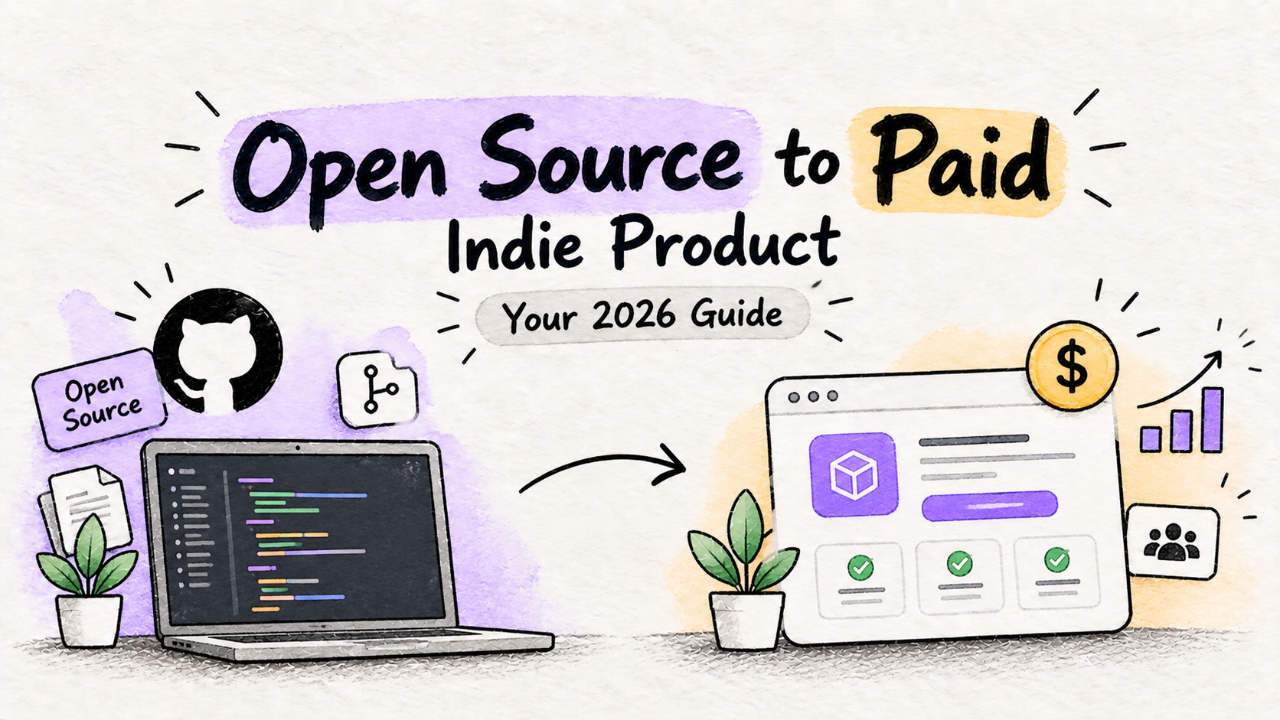
This is the guide to turning your open-source tool into a paid indie product in 2026. It’s not about tricking your users. It’s about drawing a bright, honest line between what’s free and what’s worth paying for.
Sell the Service, Not the Code
First, a mental shift. Your open-source project is not your product. It’s a powerful marketing engine and the core of your product, but it is not the thing you sell. You sell the hosted, managed, collaborative, enterprise-ready service built around that core.
Think of it like this: SQLite is the free, open-source database engine. Turso is the paid service that provides a hosted, edge-replicated, easy-to-use API on top of it. You can always download and compile SQLite yourself. But paying Turso means you don't have to think about servers, backups, or scaling.
Your job is to find the “server management” part of your own project. What’s the tedious, messy, or complex task that users would happily pay to avoid?
The community that starred your repo did so because the core tool solved a specific problem for them, as individuals. To build a business, you need to solve a problem for a team or a company. That’s where the money is.
What Stays Free: The MIT Core
The code that got you those 1,482 stars? Keep it free. Keep it MIT-licensed.
Don't pull a bait-and-switch. Don't re-license the existing code to something more restrictive. The trust you’ve built with early adopters is your single greatest asset. Violating it is a fatal, unrecoverable error.
The core library, the CLI, the essential functionality—this is your top of funnel. An MIT license is the most frictionless way to get developers to try your tool. It has virtually no strings attached. It tells them: “Use this, build with this, we won’t sue you.” This wide adoption is what feeds your commercial funnel.
You’re not giving away the farm. You’re giving away seeds. Your paid product is the fully-grown, harvested, and packaged produce.
By keeping the core MIT, you’re making a clear statement: “What was free yesterday is still free today. We’re just adding a new, optional, paid tier for those who need more.”
The Hosted Value: Why They’ll Pay
A "hosted version" is not enough. Simply putting your open-source app on a server and charging for access is a weak proposition. You must provide value beyond just `apt-get install`. This is where you build your actual product.
1. Managed Infrastructure
This is the most common and powerful value proposition. You take care of the servers, databases, updates, security patches, and backups. The customer gets to use your tool without ever thinking about `ssh`, `docker-compose up -d`, or "what happens if the disk is full?"
Plausible Analytics is a perfect example. Their analytics script is open source. You can self-host it. But for €9/month, they host it for you. It’s a simple, honest trade: your money for their time and expertise. Most developers are happy to make that trade. Their time is worth more than €9.
When you're building this out, you'll be making choices about your own stack. The same questions apply to you as to any other indie maker—which framework, which database, which cloud provider? The trends here shift, but the fundamentals don't. (If you're curious, our 2026 tech stack report shows what hundreds of other makers are actually using to ship.)
2. Collaboration Features
An open-source CLI is usually built for one person. A business needs tools for a team. This is your green field for paid features.
Team accounts: Let a manager invite and remove members.
Role-based access control (RBAC): Admin, editor, viewer roles. This is a classic "enterprise" feature that companies will pay for.
Audit logs: Who did what, and when? Critical for security and compliance.
Shared dashboards: Let the team see the same data without passing screenshots around in Slack.
These features are often useless to the solo developer who starred your repo, which is perfect. It means you’re not walling off functionality they rely on. You’re adding new functionality for a different type of user: the team.
3. A Polished UI and Dashboards
A good user interface is a feature. A great one is a moat. While your open-source tool might be a command-line utility that spits out JSON, your paid product should be a slick web interface that visualizes that data beautifully.
Provide charts, graphs, data tables with sorting and filtering, and historical views. Give users a "single pane of glass" to understand what’s happening. This is something that’s hard to replicate well in a terminal and is a clear differentiator for your hosted offering.
4. Integrations
Your tool doesn't live in a vacuum. It’s part of a larger workflow. Paid users expect it to connect to the other tools they already pay for.
Notification sinks: Slack, Discord, PagerDuty.
Data sources: Connect to GitHub, Vercel, Stripe, etc. to pull in relevant data.
Authentication: Sign in with Google, GitHub, or even a corporate SSO provider like Okta (a classic high-tier plan feature).
Each integration you build strengthens your product's gravity, making it harder for customers to leave.
Licenses in Plain English
Choosing a license feels intimidating. It’s not. There are three modern choices to understand. This is the "open core" model: you mix and match licenses for different parts of your codebase.
Disclaimer: I am a staff writer, not your lawyer. This is an opinionated guide for indie makers, not formal legal advice.
The Core: MIT
As we covered, use this for your library, CLI, or anything you want maximum adoption for. It’s the standard for a reason. It builds trust and a wide funnel.
// Your open-source package.json
{
  "name": "my-awesome-tool",
  "license": "MIT",
  ...
}
The Protector: AGPL
The Affero General Public License is for when your biggest fear is a cloud giant (think AWS) taking your code, hosting it, and out-competing you with your own work. The AGPL says that if someone runs a modified version of your code and lets users interact with it over a network, they must also make their modified source code available under the AGPL.
Use it if: You are building a complex, all-in-one application (like a database or monitoring system) and want to prevent large companies from creating a competing hosted version.
The trade-off: It’s a “viral” license. Some companies have strict policies against using any AGPL code because of its strong requirements. It can scare away potential users and contributors. Grafana, MongoDB, and Sentry (in the past) have used it.
The Pragmatist: BSL
The Business Source License is the modern compromise. It’s a source-available license, not technically "open source" by OSI definition, but it’s a popular and effective business model.
Here’s how it works: The code is publicly visible. You can read it, compile it, and use it for non-production or non-commercial purposes. However, you cannot use it to offer a competing commercial service. After a set period of time (e.g., 2-4 years), the license automatically converts to a true open-source license (like Apache 2.0).
Use it for: The code that powers your paid product—the web server, the collaboration features, the dashboard. It allows you to be the sole commercial provider for a few years, giving you time to build a sustainable business.
Who uses it: HashiCorp, Cockroach Labs, Sentry, MariaDB. It’s the de facto standard for venture-backed open-source companies in the 2020s, and it works just as well for indie makers.
The recommended stack: An MIT-licensed core library/engine, with a BSL-licensed server/UI built on top of it. This gives you the best of both worlds: a wide-adoption funnel and a protected commercial product.
How to Announce the Change (and Not Get Roasted)
Your users are not idiots. They know maintenance takes work. But they value transparency above all else. How you communicate this transition is more important than the transition itself.
Do not just flip a switch. Don’t hide the change in a minor patch release.
Write a blog post. Post it to your GitHub repo's "Discussions" tab. Title it something clear and direct, like "The Future of Project X and a New Hosted Offering."
Explain the Why: Be human. "I've been maintaining this project in my spare time for two years. To make it sustainable and dedicate the time it deserves, I need to build a business around it."
State What Isn't Changing: Lead with this. "The core open-source tool will remain MIT-licensed, free, and actively maintained. Nothing is being taken away."
Introduce the "Plus": Frame the paid product as an additive bonus. "Today, I'm launching Project X Cloud, a hosted version for teams that includes collaboration, managed backups, and a full-featured dashboard."
Offer a Deal: "As a thank you to all the early supporters, anyone with a GitHub account created before today can get 50% off their first year." This turns potential critics into potential customers.
Be Present: After you post the announcement, stick around. Answer every question in the comments and on GitHub, even the angry ones. A thoughtful reply to a critical comment is more powerful than ten positive ones.
Your communication about this change is a product in itself. It needs to be as carefully crafted as your code. The principles of a good announcement are the same as those for a good release summary. In fact, learning how to write a changelog your users actually read is great practice for this kind of communication.
Will the Community Hate Me?
A few people will. There’s a small, loud minority that believes all software must be free as in beer and free as in speech, and that any attempt to earn a living from it is a betrayal.
You cannot win these people over. Don't try.
The vast majority of your users are reasonable. They are developers, just like you. They understand `ECONNREFUSED` and they understand burnout. If you have been a good steward of the project and you communicate the change honestly, they will either be happy for you, indifferent, or become your first customers.
The ones who complain the loudest are often the ones who have contributed the least. Your true community—the ones who submit helpful bug reports, contribute PRs, and help others in Discord—are the ones most likely to have your back.
Launch, Price, and Iterate
Once your hosted MVP is built, you have a new product to launch. This is different from pushing a new version to npm. You need to treat it like a business. Start with a simple pricing page.
Free/Hobby: For the solo dev. Generous usage, but limited on team features. This keeps your open-source funnel alive.
Pro ($29/mo): For the professional or small team. Full feature set, higher limits.
Business ("Contact Us"): For larger teams. Custom limits, SSO, priority support.
Don't agonize over the price. Pick a number and get it out there. Your first ten customers will tell you if it's wrong.
Then, you launch. Post your new landing page everywhere you posted your original GitHub repo. But this time, you’re not just sharing a tool; you’re presenting a solution to a business problem. Listing your new product on directories for makers is a good start. While Product Hunt is the default, there are many Product Hunt alternatives for indie makers in 2026 that can give you a more focused audience. A comprehensive launch plan might involve posting to several of the 80+ product launch platforms out there.
Going from a popular open-source project to a paid product is a well-trodden path. It’s a journey from hobbyist to founder. It requires a shift in mindset—from writing code to solving customer problems. But for a developer shipping on nights and weekends, it’s one of the most direct ways to turn your passion into a sustainable, independent business.