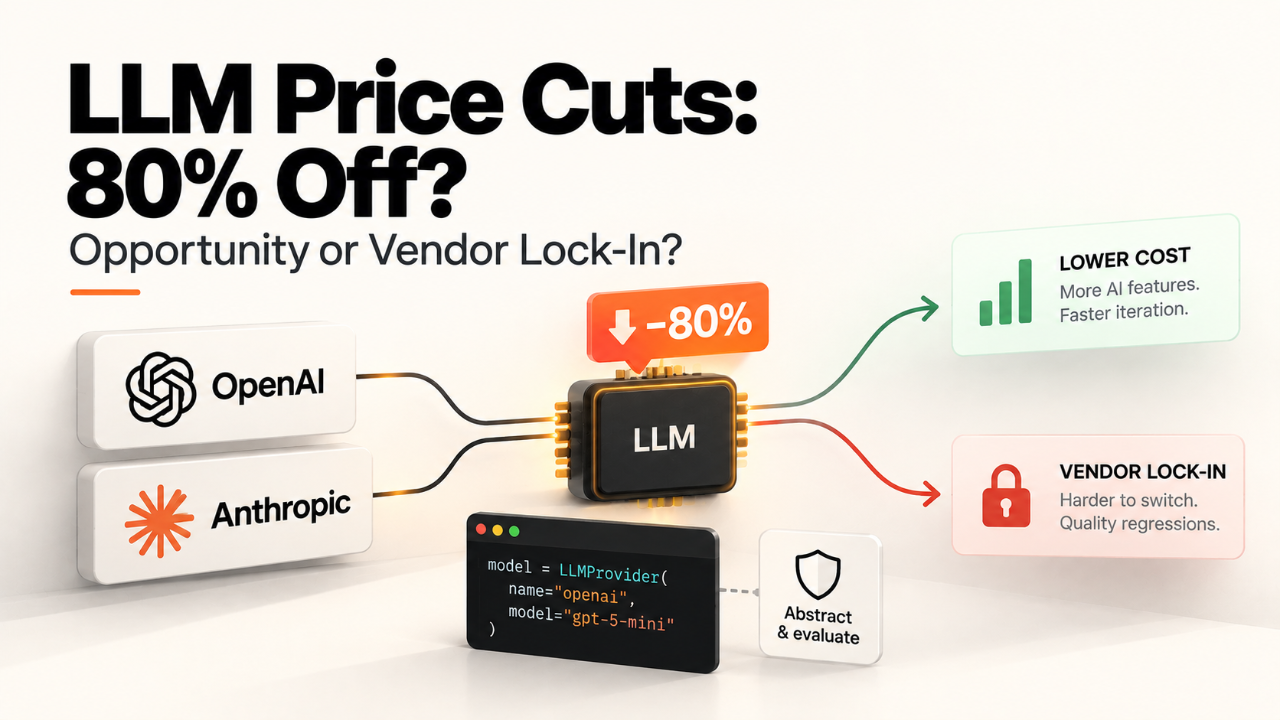
You shipped your feature on Tuesday. A simple AI-powered text summarizer for legal docs. By Friday, you have 50 users. You feel the thrill. Then you check your billing dashboard. The API costs are already three figures. Your stomach sinks. At this rate, your runway is a few months, max. Then you see the headline on Hacker News: OpenAI and Anthropic cut LLM prices by up to 80%.
Relief washes over you. This is it. The break you needed.
Slow down. It’s not a gift. It’s a trap.
The Race to Zero
Let’s be clear about what actually shipped. This isn’t OpenAI or Anthropic giving their best models away. The top-tier models—your GPT-5s and Claude 4s—cost about the same.
The price war is happening at the bottom. The new gpt-4-eco and claude-3.5-sonnet are incredibly cheap. We’re talking fractions of a cent for tasks that cost dollars just last year. This is a deliberate commoditization of "good enough" AI. The big players are racing to become the default utility for any task that requires a bit of intelligence but not genius-level reasoning.
They are no longer selling you a brain. They are selling you electricity.
Your Unit Economics Just Flipped
For a solo founder, this changes the math on what’s possible. An 80% price drop isn’t an incremental improvement; it’s a phase change.
Products that were DOA due to cost are now viable.
High-volume content processing: Auto-tagging every article, summarizing every customer support ticket, categorizing user-generated content.
Proactive agents: An AI that watches a user’s analytics dashboard and writes a daily plain-english summary, sent via email. Too expensive before. Now it’s a line item.
Speculative features: You can now afford to build AI features that might not work. The cost of failure is a few bucks for API calls, not a few hundred.
This unlocks entire product categories that were previously reserved for VC-backed teams. The barrier to entry just dropped through the floor. Your weekend project can now compete on features that used to require a seed round.
But that’s exactly what they want you to think.
How to Try It in an Hour (Safely)
You should absolutely experiment with these new models. Your burn rate demands it. But do it with your eyes open.
Don’t rewrite your core logic. Pick one, non-critical feature. Let’s say you have a function that generates a title for a blog post.
Your goal is to swap the model with zero changes to your application code. This forces you to build a proper abstraction. If you haven’t already, this is the time to read up on building your first AI wrapper.
It can be as simple as a single function:
# In your llm_service.py
import openai
import anthropic
import os

def generate_text(prompt, model="gpt-4-turbo"):
    if model.startswith("gpt"):
        # Logic for OpenAI API
        client = openai.OpenAI(api_key=os.environ.get("OPENAI_API_KEY"))
        # ... call client
        response = client.chat.completions.create(model=model, messages=[{"role": "user", "content": prompt}])
        return response.choices[0].message.content
    elif model.startswith("claude"):
        # Logic for Anthropic API
        client = anthropic.Anthropic(api_key=os.environ.get("ANTHROPIC_API_KEY"))
        # ... call client
        response = client.messages.create(model=model, max_tokens=1024, messages=[{"role": "user", "content": prompt}])
        return response.content[0].text
    else:
        raise ValueError("Unsupported model provider")

# In your application code, you only ever call this:
new_title = generate_text(my_prompt, model="gpt-4-eco")
This is not production-ready code. It’s a principle. Your application code should know nothing about OpenAI or Anthropic. It asks for a text generation and gets one back. The model string, pulled from a config file, is the only thing that changes.
By forcing this separation, you’ve already started to sidestep the trap.
The Catch: The Price Is Vendor Lock-In
Why are these models so cheap? Because the product isn’t the model. The product is the ecosystem.
OpenAI and Anthropic aren’t just competing on price-per-token. They are in a platform war, and they are fighting to win you, the developer. They want their SDK to be the first import in your project. They want you to build on their specific, non-portable features.
Think about OpenAI’s Assistants API or Anthropic’s tool use syntax. They are powerful. They solve real problems around state management and function calling. They also tie you to their platform with steel cables. The more you use these proprietary helpers, the harder it is to leave.
Here’s a comparison of the old, expensive models versus the new, cheap ones.
Attribute | Old Guard (e.g., GPT-4 Turbo) | New Guard (e.g., GPT-4 Eco) |
|---|---|---|
Cost | High | Drastically Lower (~80% less) |
Primary Use | Complex reasoning, core product magic | High-volume, "good enough" tasks |
Quality | State-of-the-art | Very good, but less nuanced |
Speed | Slower | Much faster |
Lock-in Risk | High (via ecosystem features) | Very High (the gateway drug) |
The cheap models are the gateway drug. You start using gpt-4-eco for simple tasks. It's fast and cheap. Then you think, "Maybe I'll try their new vector store feature." Then you start using their specific function-calling JSON schema. Six months later, you realize your entire product is a thin wrapper around one company's proprietary services.
Your AWS bill is low, but your switching cost is infinite. This is not a new playbook. It’s Heroku, it’s Firebase, it’s every platform that ever offered a generous free tier. The strategy is to make it easy to start and impossible to leave. If you're not careful, you'll end up another case study in one of our guides on avoiding vendor lock-in.
What Breaks When You Swap Models
Let’s say you ignore the warnings and just swap MODEL_NAME="gpt-4-turbo" to MODEL_NAME="gpt-4-eco" in your .env file and deploy.
Your app won’t crash. It will just get quietly, weirdly worse.
Prompts are code. A new model, even from the same family, is a new runtime environment. The same prompt will produce different results.
Your carefully tuned instructions to output valid JSON might suddenly start adding conversational boilerplate.
Your summarizer might lose its ability to grasp nuance, turning detailed reports into generic mush.
Your chain-of-thought reasoning prompts might just... stop reasoning.
The only way to switch models safely is to treat your prompts like source code. You need a regression test suite. It can be a simple script: a dozen input prompts and their known-good outputs. Before you deploy a new model, you run the suite. If the outputs diverge too much, you either stick with the old model or you spend the time to re-tune your prompts. This is non-negotiable. Building a simple system for prompt versioning is a weekend project that will save you weeks of pain.
Latency and rate limits will also change. The new models are faster, but they might have stricter concurrency limits. You need to load test.
The Indie Hacker’s Playbook for the Price War
You can’t afford to ignore these price cuts. But you also can’t afford to get locked in. So how do you win?
You use the indie advantage: agility.
Tier Your AI Usage. Don't use one model for everything. Use the new, cheap models for high-volume, low-stakes work. Think of it as the intern: good for bulk tasks like classification, summarization, and data extraction. Reserve the expensive, state-of-the-art models for the core "magic" of your product, the thing users actually pay you for.
Abstract Your Provider. I’ll say it again. Your business logic should never know which LLM it’s talking to. Build a wrapper. It adds a day of work up front and saves you from being a hostage later.
Compete on Product, Not Models. Every other indie hacker has access to the same cheap APIs. You will not win by having a slightly better prompt for a generic task. The value is in the workflow you build around the AI. The unique UI, the clever integrations, the specific problem you solve for a niche audience. That's the stuff that gets you featured on Indie Hackers. The LLM is just a component, like your database. And you wouldn't build your whole business logic inside Postgres triggers, would you?
This price war is a huge opportunity. It makes it possible to launch things that felt like science fiction just a few years ago, often in a single weekend. Like so many other founders who've shared how they launched, the key is focus.
The news from OpenAI and Anthropic isn't that AI is getting cheaper. It's that the baseline is getting commoditized. The opportunity isn't in using the commodity, it's in building something unique on top of it.
Use the cheap tokens. Keep your freedom. And go ship something.