You spent Sunday polishing the UI. Monday, you submitted your new SaaS to a dozen startup directories. By Friday, your analytics showed 47 visitors and two signups. One was your mom.
You conclude directories are dead. A spam-filled graveyard of forgotten side projects. You’re half right. Most directory listings are spam. They are thoughtless, zero-effort broadcasts into the void. And they get exactly the results they deserve.
But the problem isn’t the directory. It’s the approach. A directory is a tool. Used with precision, it can help you find your first users, test your messaging, and build a durable, long-tail source of traffic. Used like a shotgun, it just makes noise.
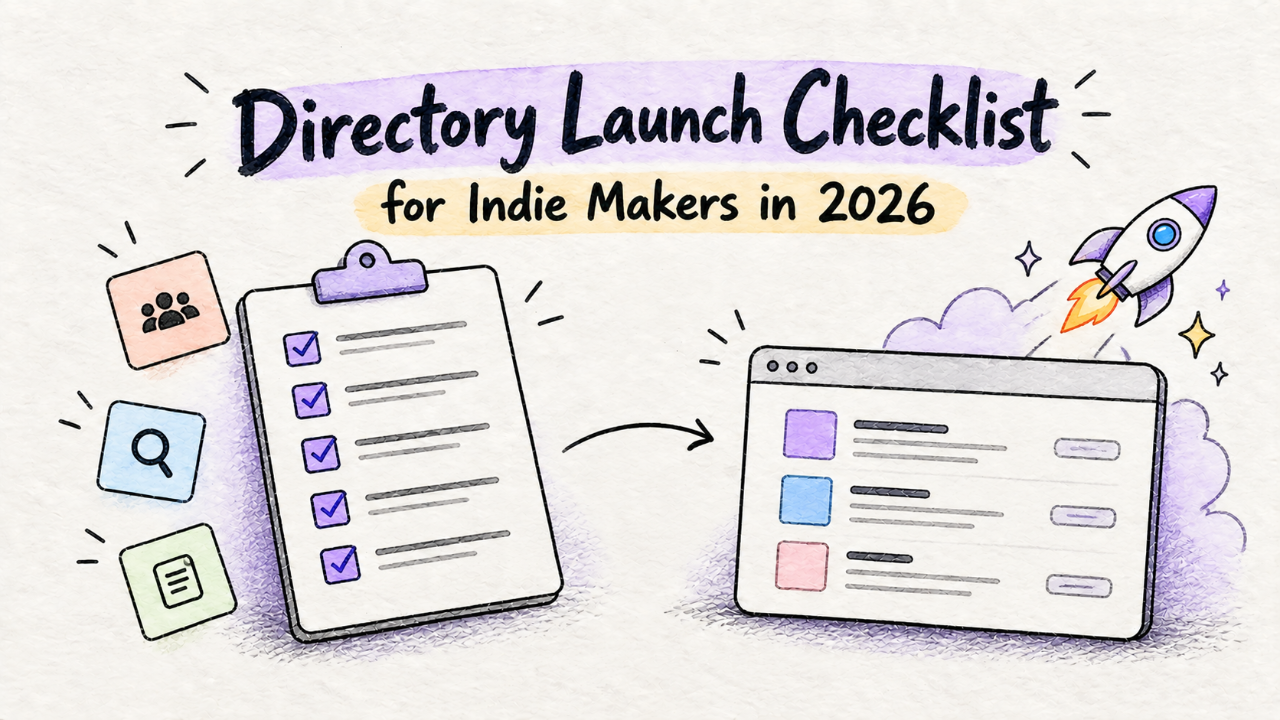
This is a checklist for using startup directories with intention. It’s about getting clicks, not just impressions. It’s about finding signal in the noise.
Are startup directories worth it in 2026?
Yes, if you have the right expectations. A directory submission is not a "big bang" launch. Product Hunt is a launch event. A directory listing is a long-term asset.
Stop thinking of directories as a way to go viral. Think of them as a structured way to do three things:
Test your messaging. Your tagline and description are hypotheses. A directory is a cheap, low-stakes lab to see if anyone understands what you do. Clicks are data.
Acquire your first true fans. You don't need 10,000 visitors. You need 10 people who feel the pain your product solves. The people who actively browse niche directories are often the most obsessive early adopters. They are looking for you.
Build SEO relevance. A listing on a reputable, human-curated directory is a quality backlink. It’s a signal to search engines that your project is real. Over years, these listings compound into a steady trickle of high-intent organic traffic.
A directory launch is a foundational part of a larger strategy. It’s a small, essential piece of the puzzle detailed in the product launch checklist that actually matters in 2026. It sets the stage for bigger moves.
The Directory Tiers: Where to Submit
Not all directories are created equal. Blasting your product to 50 random sites is a waste of time. Focus your energy where it counts. Group them into three tiers.
Tier 1: The Titans (Product Hunt, BetaList, Indie Hackers)
These aren't just directories; they are communities with their own culture and purpose.
Product Hunt: The Super Bowl of product launches. Use it for a single, coordinated "big bang" launch. It is not a directory for discovery in the same way as the others; it's a 24-hour leaderboard. Submitting here is a high-stakes, high-reward event. Don't waste your shot by submitting an untested MVP.
BetaList: The classic. For pre-launch products only. Use it to build a waitlist before you’ve written a single line of production code. The audience expects bugs and wants to give feedback. It’s a validation tool.
Indie Hackers: A community first, a product directory second. Your product page here gets traction if you are an active, contributing member of the community. Post your milestones. Share your revenue. Ask for help. A silent product page will be buried. Engagement is the price of admission.
Tier 2: The Curated Platforms (Builtbyindies)
This is where we fit in. Builtbyindies and similar platforms are not giant, open-to-all lists. They are curated galleries. The goal is signal, not volume. We review every submission by hand.
The value proposition is simple: your product is listed next to other high-quality indie products, not a hundred crypto scams and AI-wrapper clones. The audience consists of other makers, founders, and early adopters who appreciate craft and are actively looking to support independent businesses. They browse by specific categories, looking for solutions, not just the "product of the day."
Use these platforms to get in front of a discerning audience and to test your core messaging before you go for a big PH launch.
Tier 3: The Niche Specialists
The long tail is powerful. For every generic startup directory, there are a dozen niche ones. There are directories for AI tools, for Notion templates, for Webflow plugins, for developer APIs. A listing on one of these can send a small amount of traffic, but it’s hyper-qualified.
Finding them is the work. Search for "[your niche] tools directory" or "[your framework] showcase." The sheer number of product launch platforms can be overwhelming, but finding 2-3 niche directories that fit your product perfectly is worth more than submitting to 20 generic ones.
Anatomy of a Listing That Gets Clicks
This is where 99% of makers fail. They treat the submission form like a chore. They copy-paste a bland, feature-heavy description and upload a blurry screenshot. Your listing is an ad. Treat it like one.
Name & Tagline
Clarity is king. Your product’s name might be clever (e.g., "Zenith"), but your tagline must be brutally clear.
The best format is a Job-to-be-Done (JTBD) statement: "Helps [WHO] do [WHAT] so they can [OUTCOME]."
Bad Tagline: AI-Powered Synergy for Modern Workflows.
Good Tagline: An AI assistant that summarizes your Slack channels so you can skip the noise.
The bad tagline is meaningless jargon. The good tagline identifies the user (you), the job (summarize Slack), and the outcome (skip the noise). Write ten versions. Pick the clearest one, not the cleverest one.
Icon
Don't agonize over it. It needs to be clean, square, and recognizable at 64x64 pixels. If you don't have a logo, use a single emoji that represents your product. A simple, well-chosen emoji is better than a poorly designed logo. For a docs tool, a `📄` or `✍️` works. For a finance app, `📈`. Simple. Done.
Description: The Four Paragraphs
Structure your description to answer four questions in order: Why, What, How, and How Much.
The Problem (Why): Start with the pain. Don't lead with your solution. Lead with the user's struggle. Use "You" language. "You're tired of manually copy-pasting data from Stripe to Google Sheets every month."
The Solution (What): Now, introduce your product as the answer. "StripeSync is a one-click tool that automatically syncs your Stripe data to a Google Sheet in real-time."
The Features as Benefits (How): Use a bulleted list. Don't just list features; frame them as benefits.
Bad Feature List:
OAuth 2.0 Integration
Customizable webhooks
Real-time data sync
Good Benefit List:
Secure, one-click setup: Connect your accounts in seconds without sharing passwords.
Total control: Get alerts in Slack or Discord for new sales, disputes, or subscription changes.
Always up-to-date: Your spreadsheet is always current, with no manual CSV exports needed.
The Details (How Much): Be upfront about pricing and tech. Don't make people hunt for it. If it’s free, say it's free. If it's a paid product, state the price. "Starts at $19/month." Being transparent builds trust. And if your audience cares, mention your stack. "Built with SvelteKit and PocketBase for a fast, lightweight experience." This can be a trust signal for the right crowd, like the developers we surveyed for our 2026 Tech Stack Report. If you're struggling with pricing, our guide for indie makers is a good place to start.
The Launch Sequence: Test, Refine, Launch
Your launch is not a single day. It's a campaign. Use directories as part of a strategic sequence.
Phase 1: Test (T-minus 4 weeks)
Four weeks before your main launch (e.g., on Product Hunt), submit to 3-5 Tier 2 and Tier 3 directories. Use Builtbyindies and your chosen niche directories here.
Crucially, create two different listings.
Listing A: Use one tagline and description.
Listing B: On a different directory, use a completely different tagline and description. Maybe one focuses on saving time, the other on making money.
Track clicks. Which one gets more? This isn't about volume; it's about learning which message resonates. You just ran a free A/B test on your core value proposition.
Phase 2: Refine (T-minus 1 week)
Look at the data. Listing A got 50 clicks and 5 signups. Listing B got 20 clicks and 0 signups. Your market has spoken. Your messaging is now based on evidence, not just a guess.
Update your main landing page, your social media bios, and all your marketing copy to reflect the winning message from Listing A. You are now prepared for the main event.
Phase 3: Launch (T-Day)
Now, launch on Product Hunt. Your title, tagline, and description are battle-tested. When people click through to your landing page, the message is consistent and proven to work. You've maximized your chances of a successful launch.
How to Launch on Builtbyindies
We built Builtbyindies to be the launch platform we wanted for our own products. It’s a place for indie makers to showcase their work to an audience that gets it. There are no sponsored posts, no VC-backed behemoths dominating the homepage.
The process is straightforward:
Submit your product. Go to the submit page, and fill out the form. Take your time on the copy—everything in the section above applies.
We review it. A real human looks at every submission to ensure it’s a good fit for the community. We're looking for finished products made by independent founders. We prioritize quality and craft over hype.
Get featured. If approved, your product goes live on the site and is shared with our community. Products are displayed chronologically, giving everyone a fair shot at visibility.
Think of it as the difference between a crowded flea market and a curated art gallery. Both have their place, but the gallery provides a focused context that elevates the work inside it. That's our goal.
The Follow-Up Is 90% of the Work
Someone upvoted your product and signed up. Great. Your job has just begun.
Do not just dump them into your Mailchimp "welcome" sequence. That person just gave you their attention and their email address. They are your most valuable asset. Treat them like it.
Send a personal email. Not a template that looks personal. A real, plain-text email.
Subject: Re: [Your Product Name]

Hey [Name],

Just saw you signed up after finding [Product] on [Directory Name]. Thanks so much for checking it out.

I'm the founder, [Your Name]. I'm trying to solve [problem] because I experienced it myself.

Curious, what made you decide to sign up today? What were you hoping it could do for you?

No pressure to reply, but any feedback would be gold.

Thanks,
[Your Name]
Ninety percent of people won't reply. But the 10% who do are your future evangelists. They will give you your best feedback, your first testimonials, and your most valuable insights. An upvote is a vanity metric. A conversation is traction.
Stop treating directories as a launch-day chore. They are a continuous, strategic tool for testing, learning, and connecting. Don't just list your product; launch it with intent. The clicks you get will be the ones that matter.