You launched on Tuesday. By Friday, you have 150 signups and a few gigabytes of event data sitting in S3 as JSON logs. You want to know what users are actually doing. Which features are they using? Where do they drop off? The questions are simple, but the answers are trapped. Your primary Postgres instance is already sweating under transactional load. Spinning up a Redshift or ClickHouse cluster for a weekend project feels like hiring a pit crew to change a tire on a bicycle.
This is the gap. The painful void between your production database and a full-blown data warehouse. For years, we’ve patched it with scripts, cron jobs, and overloaded read replicas. This week, the answer got a lot better.
DuckDB 2.0.0 LTS “Cinnamon Teal” just landed. The Hacker News thread is full of benchmarks and academic debate. Ignore it. We’re not here to debate query planner architecture. We’re here to ship. Here’s the indie hacker’s take on what it means for the project you’re building this weekend.
What Actually Shipped (That You Care About)
DuckDB has always been fast for single-threaded analysis on your laptop. The promise of 2.0 LTS isn’t just more speed. It’s about stability and moving from a personal dev tool to a reliable piece of your production stack. This is the release where DuckDB stops being a cool experiment and becomes a boringly dependable choice for specific jobs.
Three things in “Cinnamon Teal” matter for builders:
Rock-Solid Concurrent Reads. The old story with DuckDB was “many readers, one writer.” This was true, but concurrent reads could still feel sketchy under heavy load, especially from serverless functions. 2.0 introduces a new multi-version concurrency control (MVCC) model specifically for reads. In practice, this means you can have dozens of Vercel functions hammering the same DuckDB file on a shared file system (like EFS) without worrying about locks or corruption. It’s now a legitimate read-only database for serverless architectures.
First-Party Extensions are Now Core. The extension ecosystem was powerful but fragmented. Finding, versioning, and loading them felt like a chore. DuckDB 2.0 pulls the most critical extensions directly into the main binary. Full-text search (FTS) and an improved geospatial module are now available out of the box. No more
INSTALL fts; LOAD fts;. This removes a major point of friction. You can now build a location-aware analytics tool or a searchable doc index with zero external dependencies.The v2 Storage Format. It’s backward-compatible, so your old files will still work. But new databases created with 2.0 use a refined columnar storage layout. The result? Smaller files on disk and significantly faster cold starts. For a serverless function that needs to load a 2GB DuckDB file from S3, this can be the difference between a 3-second cold start and a 500ms one. It matters.
The Solo Founder’s Use Case: Your Analytical Sidecar
Let’s be clear: DuckDB 2.0 is not a replacement for Postgres. Your users table, your session data, your transactional logic—that all stays right where it is. Trying to use DuckDB for your primary OLTP workload will end in tears.
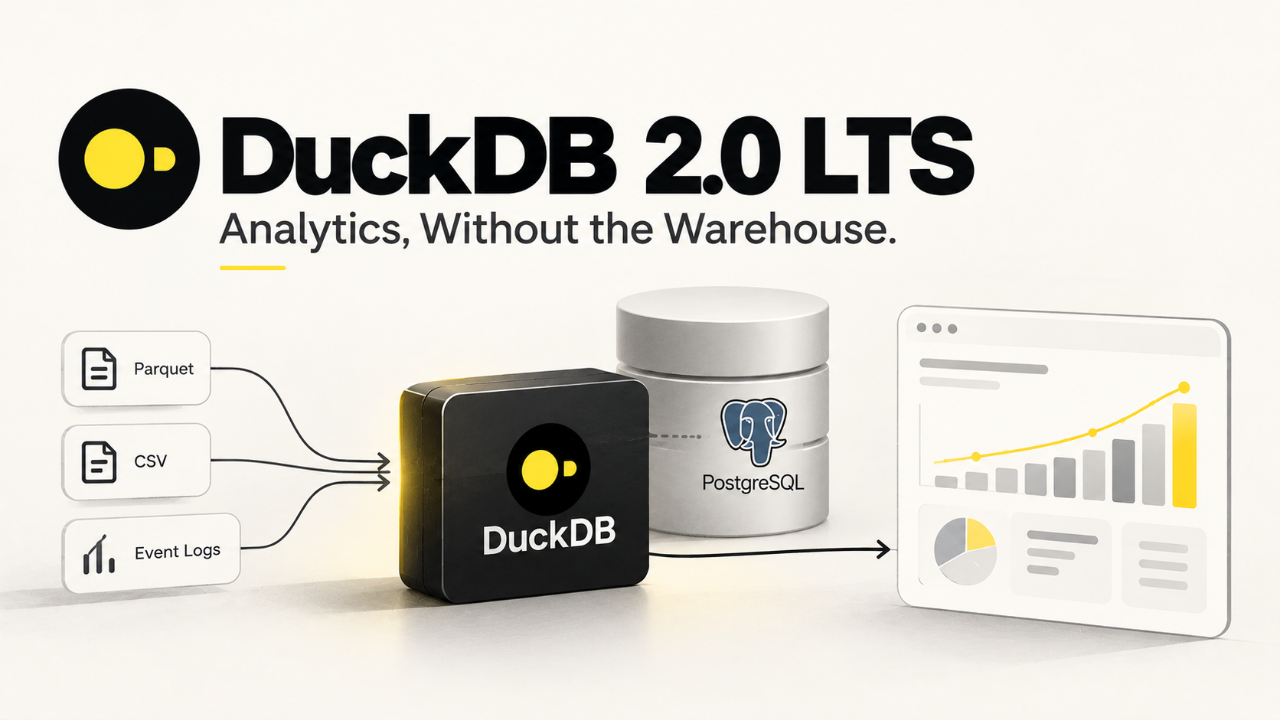
The mental model you need is the “analytical sidecar.” It’s a second database that lives alongside your main app, purpose-built for one thing: answering questions about your data, fast.
It’s not another server to manage. It’s just a file. You embed the DuckDB library in your app (Node.js, Python, Go, whatever) and query the file. It’s SQLite for analytics.
Use Case 1: The Blazing-Fast User Dashboard
Your SaaS app has a dashboard where users can see their own activity. A classic `COUNT(*)` and `GROUP BY` on your production Postgres. It’s fine for 100 users. It grinds to a halt with 10,000 users and a year of data. Your options used to be: spend a week optimizing indexes and creating materialized views, or spin up a separate analytics service.
The DuckDB way: 1. Once a day, a cron job runs a script. 2. The script queries your primary Postgres for all new event data. 3. It appends this data into a `dashboard_data.db` file, stored on a persistent volume or in S3. 4. Your application’s dashboard endpoints don’t touch Postgres. They query the DuckDB file instead.
The result is sub-50ms response times for complex analytical queries, with zero impact on your primary database’s performance. You’re effectively offloading your read-heavy analytics to a specialized, in-process engine. If you're building a product in the analytics category, this pattern is your new best friend.
Use Case 2: The Instant, Serverless Data API
You have a pile of Parquet or CSV files in an object store like Cloudflare R2 or AWS S3. You want to expose this data via an API. The old way involved a complex ETL pipeline: load the files into a data warehouse, then build an API on top of that. It’s slow, expensive, and a pain to maintain.
With DuckDB 2.0, your API is just a serverless function:
import duckdb
import os

# Set up S3 credentials via environment variables
# AWS_ACCESS_KEY_ID, AWS_SECRET_ACCESS_KEY, AWS_REGION

def handler(event, context):
    query = "SELECT user_id, count(*) FROM 's3://my-logs-bucket/2026/*/*.parquet' GROUP BY user_id ORDER BY 2 DESC LIMIT 10;"

    # DuckDB can query remote Parquet files directly
    results = duckdb.sql(query).fetchall()

    return {
        "statusCode": 200,
        "body": str(results)
    }
That’s it. You just deployed a scalable API that can query terabytes of data without ingesting it first. This is a massive unlock for anyone building developer tools or data-centric products. You can offer powerful data exploration features to your users with almost no infrastructure overhead.
How to Try It in an Hour
Talk is cheap. Let’s run a query on a real dataset. We’ll use the public NYC Taxi dataset, stored as Parquet files on S3.
First, install the new version:
pip install duckdb==2.0.0
Now, create a Python file and run a query. We need to install the `httpfs` extension to allow DuckDB to talk to S3. Even though some extensions are now core, remote filesystem access is still modular.
import duckdb

# Connect to an in-memory database
con = duckdb.connect()

# Load the httpfs extension to read from S3
con.execute("INSTALL httpfs; LOAD httpfs;")

# Configure S3 access (for this public dataset, region is enough)
con.execute("SET s3_region='us-east-1';")

# This is the magic. Querying a fleet of Parquet files directly from S3.
# Let's find the busiest hours of the day in January 2026.
query = """
SELECT
    hour(pickup_datetime) AS pickup_hour,
    count(*) AS num_trips
FROM 's3://nyc-tlc/trip data/yellow_tripdata_2026-01.parquet'
GROUP BY 1
ORDER BY 2 DESC;
"""

result = con.execute(query)
print(result.fetchdf())

# Done. Close the connection.
con.close()
You just ran a complex analytical query over a remote, multi-million row dataset in a few seconds, using nothing but a Python script. Now imagine pointing this at your own data. This is the power. You can go from raw data to insights in minutes, not days.
The Catch: Where DuckDB 2.0 Will Burn You
No tool is a silver bullet. The LTS label means the API is stable, but it doesn’t make DuckDB foolproof. Here are the trade-offs you accept when you use it.
It is not an OLTP database. I’ll say it a third time because it’s the mistake everyone makes. The single-writer model is a fundamental design choice, not a temporary limitation. If your workload involves many small, concurrent writes or updates (e.g., updating a user’s `last_seen_at` timestamp), DuckDB is the wrong tool. You will face locking errors and misery.
Memory is your responsibility. DuckDB is fast because it aggressively uses RAM to process queries. When running on your M3 Max MacBook Pro, this feels like magic. When running in a 512MB AWS Lambda function, a poorly-written query can instantly exhaust your memory and cause a crash. You need to be mindful of `LIMIT` clauses and test your queries against production-sized data to understand their memory footprint.
State management is on you. DuckDB is a library, not a managed service. The database is a file. Where do you store that file? Who backs it up? How do you handle migrations? For read-only replicas populated from another source, this is simple. But if the DuckDB file becomes your primary source of truth for analytics, you are now responsible for its care and feeding. Don't take that lightly.
Before you commit, understand which job you're hiring for. This table compares DuckDB to the other tools an indie hacker might reach for.
Use Case | DuckDB 2.0 | PostgreSQL | SQLite |
|---|---|---|---|
Primary User DB | No | Yes (The standard) | Yes (For small/local-first apps) |
User-facing analytics | Yes (Blazing fast reads) | Yes (With careful indexing) | No (Lacks columnar features) |
Internal BI dashboard | Yes (Query files directly) | No (Requires ETL/a replica) | No (Too slow for large datasets) |
High-concurrency writes | No (Single writer) | Yes (Built for it) | No (Write-locking issues) |
Stack complexity | Low (In-process library) | Medium (Separate server) | Low (In-process library) |
Ideal dataset | 1GB–100GB Parquet/CSV | 1MB–10TB structured rows | 1KB–1GB structured rows |
The Verdict: Don't Switch. Augment.
Is DuckDB 2.0 LTS worth switching to? Wrong question. The right question is: "Is it worth adding to my stack?"
The answer is an emphatic yes.
Don’t rip out Postgres. Augment it. Keep your transactional data in a battle-tested relational database. But for any task that feels like OLAP—dashboards, reports, internal BI, ad-hoc data exploration—give DuckDB 2.0 a serious look. It lets you deliver features that were previously out of reach for a solo founder by collapsing the stack. You get the power of a columnar data warehouse without the cost or complexity of a distributed system.
It’s one of those rare 10x tools. It doesn’t just make an old task faster; it makes entirely new workflows possible for small teams. The ability to ship a data-intensive product or feature without becoming a part-time data engineer is a superpower. And if you do build something amazing with it, you know where to launch it.
DuckDB 2.0 "Cinnamon Teal" is ready. It's not a toy anymore. It’s a tool. Go build something with it.