You have an idea. A good one. You’ve been sketching it out on nights and weekends, filling a notebook with UI flows and data models. But the gap between git init and stripe.charge.create feels like a canyon. The internet is full of five-year overnight success stories. It's a lie that paralyzes.
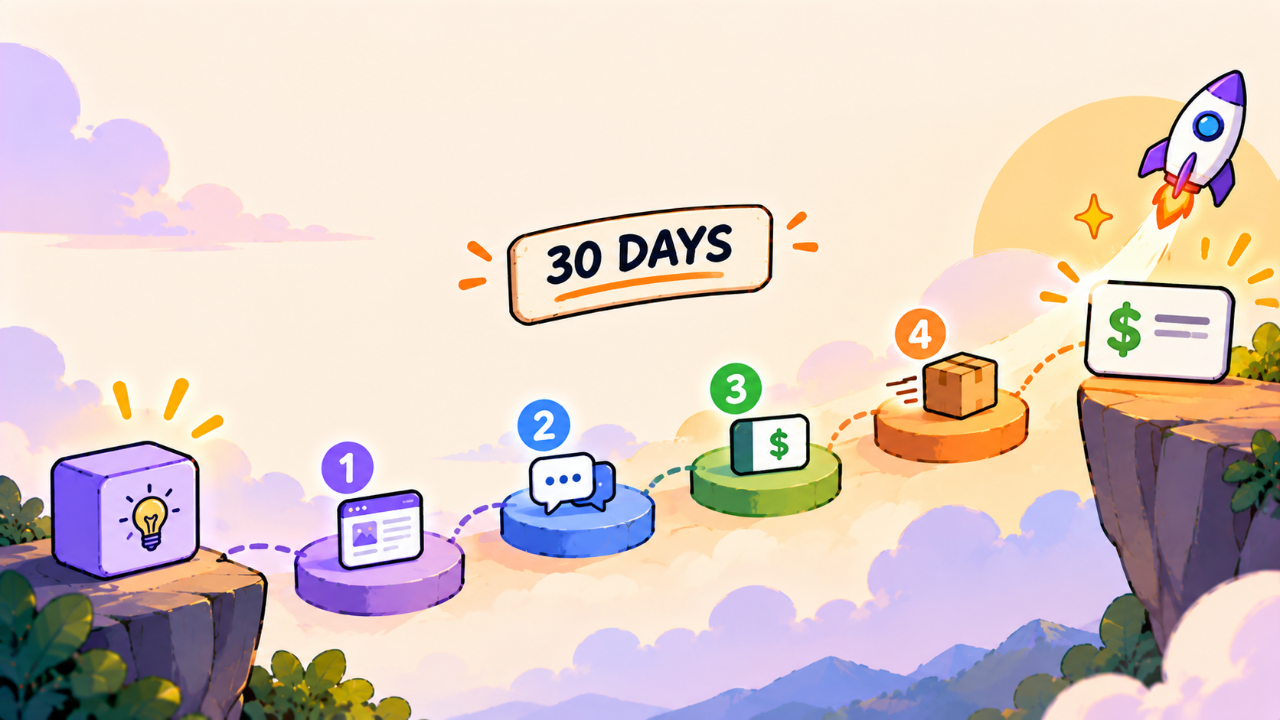
So let’s cut the noise. This is not a guide to building a unicorn. This is a tactical plan to validate your idea with real money in one month. It’s about speed, not perfection. It’s about getting your first sale.
How long until an indie product makes money? 30 days. If you follow this plan.
Week 1: Define One Problem, Build One Feature
Your biggest enemy is your own ambition. You want to build the ultimate tool, the one that solves everything for everyone. Stop. For the next seven days, your ambition is toxic.
The only task this week is to build the absolute, indivisible core of your product. One feature. Not one feature set. One feature.
The Scope Cut
Take your grand vision and throw it away. We’re not building that. We’re building a tiny, sharp tool that solves one excruciatingly specific pain point. This is the difference between a vitamin and a painkiller. No one pays for vitamins on day one.
Here’s what you are not building this week:
A settings page.
User profiles with avatars.
Team collaboration features.
Multiple themes.
An admin dashboard.
An integration marketplace.
If you are building a tool for social media scheduling, your one feature is not "social media management." It's "schedule one tweet for later." That’s it. If you're building a tool like Wisegrid, your one feature is "import a CSV and make one column editable." Nothing else.
Your goal is a URL that performs a single, valuable action. Everything else is a distraction.
Your Stack: The Fastest Path to Done
This is not the time to learn Rust, Svelte 5, or whatever just dropped at the last AI conference. Use the tools you know cold. The goal is velocity, not a perfect architecture.
For 90% of side project SaaS ideas in 2026, the stack is a solved problem:
Frontend/Backend: Next.js. It handles routing, server components, and API routes out of the box.
Database/Auth: Supabase or Firebase. Pick one. You get a database, user authentication, and file storage with a generous free tier. No, you do not need to self-host Postgres.
Hosting: Vercel. Connect your GitHub repo. It will be live in 3 minutes.
This entire stack is free to start. The decision is made. Move on.
Build the Landing Page First
Before you write a single line of your app’s code, deploy its landing page. Use Carrd. It costs $19 a year. Pick a template and write three lines of copy:
[Verb-based Headline]
Do [Job to be Done] without the [Pain].[Sub-headline]
[Your Product Name] is a simple tool for [Your Target User] who want to achieve [Desired Outcome].[Call to Action]
Get early access and a lifetime discount.
Hook up the form to a free MailerLite or ConvertKit account. Buy the domain. Your project is now real. It exists outside your head. This psychological shift is critical.
Week 2: Distribution Before Polish
Stop coding. I mean it. Your single feature is "done" for now. It’s ugly. It’s brittle. It doesn’t matter. Your job this week is not to write code, but to get feedback.
The classic developer mistake is to build in a cave for six months, emerge with a "perfect" product, and hear crickets. We are reversing the process. We find the users first, then we polish the product based on their exact needs.
Find Your Ten Users
Your first users are not on Product Hunt. They are not on TechCrunch. They are in niche communities, actively complaining about the problem you solve.
Your mission is to find ten of them and get them on a video call.
Where to look:
Reddit: Not r/Entrepreneur. Find the practitioner subreddits. If you’re building a developer tool, go to r/devops. A writing tool? r/writing. A tool for plant owners? r/houseplants. Use the search bar for terms like "any tool for," "I hate when," "how do you handle."
Slack/Discord Communities: Find the paid or private communities for your niche. The barrier to entry filters for quality.
LinkedIn: Search for people with the job title you’re targeting. Look at their posts. See what they complain about.
The Outreach Script
Do not spam a link to your landing page. That is an instant-ignore. Instead, lead with empathy and ask for help.
Send a DM or post a comment that looks like this:
"Hey, I saw you were struggling with [Problem]. I'm a developer building a small tool to try and fix that. It's super early, but would you be open to a 15-min call to look at what I've got and tell me if it's completely useless?"
The magic words are "tell me if it's useless." It disarms people. You're not selling; you're seeking expertise. Get ten people to say yes. On the call, shut up and listen. Watch where they get confused. Watch where their eyes light up. Their confusion is your bug report. Their excitement is your validation.
Week 3: Ask for the Money
You now have a list of real problems from ten real people. Spend Monday and Tuesday of this week fixing the most critical ones. Not adding features. Fixing. Make the login flow slightly less confusing. Clarify the button copy. Handle that one edge case that broke the demo for three of your ten users.
On Wednesday, it’s time to ask for the money. This is the moment that separates an indie hacker from a hobbyist.
The Pre-Sale Offer
Email the ten people you spoke with. The subject line: "Feedback + a special offer for you".
The body:
Hey [Name],
Thank you again for your time last week. Your feedback on [Specific Point] was incredibly helpful. I've already implemented [The Change You Made].
As a thank you, I want to offer you a spot in my 'Founders Program.' It's lifetime access to [Your Product] for a one-time payment of $49.
The product will be a monthly subscription ($15/mo) at public launch, but this is a special deal for the first few users who are helping me shape it.
If you're in, here's the link to grab your spot: [Payment Link]
No pressure at all, but I wanted to offer it to you first.
Best,
[Your Name]
The psychology here is crucial. It’s an exclusive, one-time deal. It values their feedback. It creates urgency. And it tests the only metric that matters: are they willing to pay to have this problem solved?
The One-Line Billing System
Do not build a billing system. Do not integrate Stripe with webhooks and subscription logic. Go to Stripe or Lemon Squeezy and create a payment link. It takes five minutes.
In the Stripe API, it's one command:
# This isn't even code you have to write. You do this in the Stripe dashboard.
# The result is just a URL.
payment_link = stripe.payment_link.create(
  line_items=[{"price": "price_1N...", "quantity": 1}],
  after_completion={"type": "redirect", "redirect": {"url": "https://yoursite.com/welcome"}},
)
Your entire billing system is a URL. When someone pays, you get an email. You then manually create their account in your Supabase table and email them their login. Yes, manually. It will take you ten minutes. Automating this right now is a waste of time.
If no one buys? Fantastic. You just saved yourself months of building something nobody wants. This isn't failure; it's high-speed learning. Go back to Week 2 with what you've learned. The "indie hacker 30 days" challenge isn't about guaranteed success, it's about a guaranteed verdict.
Week 4: Ship, Support, and Scope
You have at least one paying customer. You are a founder. You have achieved product-market fit with a market of one. That’s more than most people ever get. Now, we build momentum.
The "Launch"
A launch is not a single day. It's the start of a continuous process of telling people what you built. This week, you tell a slightly wider circle.
Write your story: Go to Indie Hackers and write a post. The title: "From idea to first paying customer in 21 days." Detail the steps. Be honest about what went wrong. People connect with the journey, not just the product.
Show, don't just tell: Record a 1-minute loom video showing your one feature in action. Post it on Twitter/X. The first comment should be a link to your landing page.
Get listed: Submit your project to directories where people look for new tools. A platform like Builtbyindies is designed for this. People browse all categories specifically to discover and support new makers. It's a targeted audience.
Your goal is not 10,000 signups. It’s to get 100 curious visitors and maybe, just maybe, 5 more paying customers.
What to Ignore (Your New Superpower)
Your success from this point on is defined more by what you ignore than by what you build.
Ignore feature requests from non-paying users. Their opinion is interesting, but not actionable. Your roadmap is dictated by the people who have paid.
Ignore the desire to build a public roadmap. You don't need that pressure. Your roadmap is a text file with the next three things you're going to build for your paying customers. That's it. For inspiration on what focused tools look like, browse a category like project management and see how many successful products do just one or two things well.
Ignore UI polish. Is it usable? Good enough. A beautiful but useless product is still useless.
Ignore scale. Don't worry about whether your architecture can handle 1 million users. Worry about whether it can handle 10. Manually onboarding your first 20 customers is a rite of passage, not a technical failure.
The Next 30 Days
You’ve done it. You have a real business. It might be making $49. It might be making $490. The number doesn't matter as much as the fact that it's not zero.
So, should you quit your job?
No. Absolutely not. Your job is your seed funding. It pays your rent and allows you to take these risks without betting the farm. The goal is to grow your side project SaaS to the point where it can cover your basic living expenses—"ramen profitability"—before you even think about quitting.
The 30-day cycle is your new blueprint. Talk to customers. Build the next most-requested feature. Launch it to them. Ask for feedback. Repeat. The path of an indie hacker is not a rocket launch; it's a flywheel. You just got the first, hardest push out of the way.
Now, go get it spinning.