You have an idea on Monday. A simple AI agent that watches a user’s GitHub repos and suggests dependency updates. You sketch it out. It’s a perfect weekend project. Then you do the math. A vector database, a hosted model, the orchestration logic. Even with cheap providers, you’re looking at $50 a month just to keep the lights on before you have a single user. So you shelve it.
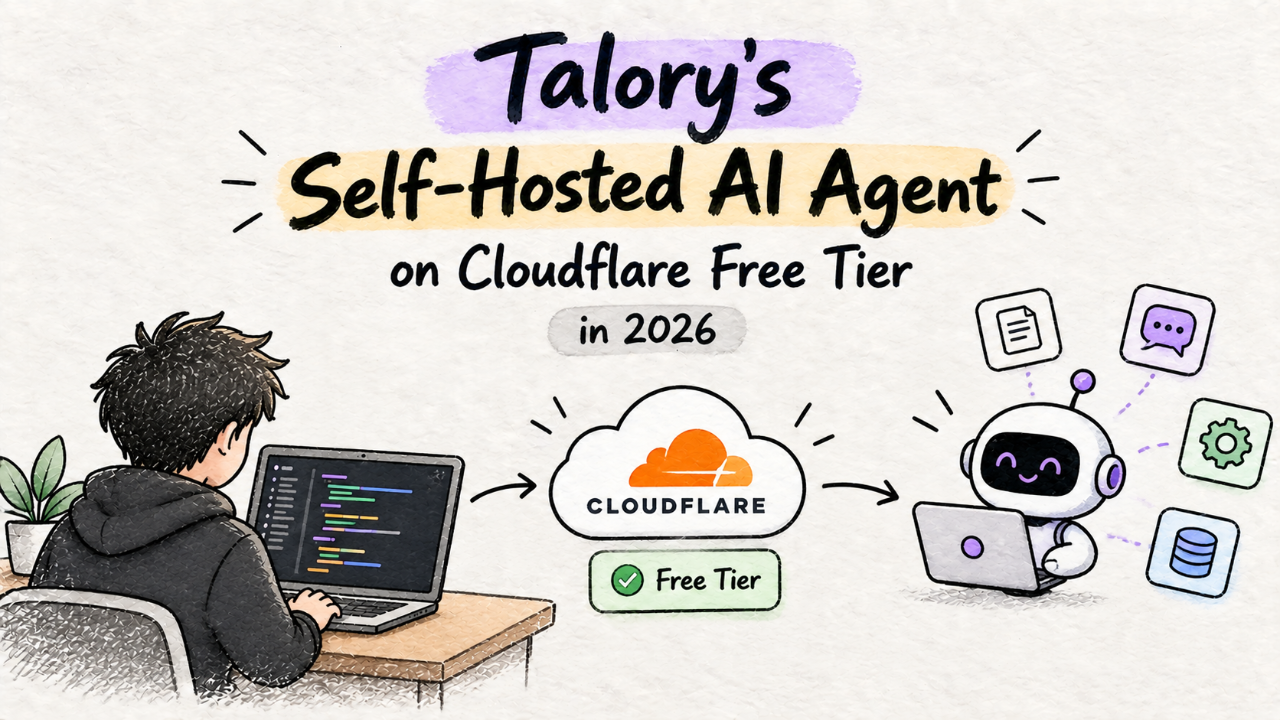
That was last week. This week, a post hit the top of Hacker News: “Talorys – A self-hosted personal AI agent on Cloudflare’s free tier.”
Most of these "free AI" projects are toys. They run a quantized Llama 3 model on your laptop and call it a revolution. This is different. Talorys isn’t a model or a UI. It’s a framework for building and deploying agents entirely within Cloudflare’s serverless ecosystem. And for a solo founder, that changes the math completely.
It’s not a magic bullet. It’s a sharp tool with specific trade-offs. Here’s the take for the founder who is shipping tonight, not debating architecture in a committee.
What Actually Shipped
Let's be clear: Talorys is not a product. You can’t sign up for it. It’s an open-source MIT-licensed repository containing a set of Cloudflare Workers and a deployment script. Think of it as the Next.js for personal AI agents on the edge.
Out of the box, Talorys – a self-hosted agent framework – gives you the plumbing:
An API Endpoint: A Cloudflare Worker that accepts prompts and manages agent state. This is your agent’s front door.
State Management: It uses Cloudflare D1, the serverless SQLite database, to store conversation history, user preferences, and agent state between executions.
A RAG Pipeline: It includes a basic retrieval-augmented generation setup using Cloudflare Vectorize to find relevant context and stuff it into the prompt.
Connectors: A `src/connectors` directory with stubbed-out modules for common data sources—Gmail, Notion, GitHub, local files. This is where you do the real work.
What it s>not include is the brain. You bring your own LLM. The framework routes your prompts through Cloudflare’s AI Gateway, which can then call out to OpenAI, Anthropic, Groq, or any of the open-source models hosted on Cloudflare’s own Workers AI.
The core concept is that you deploy one Talorys instance per user or per team, not a single multi-tenant monolith. This is why it fits the free tier. Each user’s agent lives within its own set of usage quotas, making the cost predictable: zero, until a user becomes a power user.
Why You Should Care: The $0 AI Stack
The default way to build with AI in 2026 is still handing your credit card to a big platform and watching the meter run. This is fine for validated products with revenue. It’s a death sentence for a pre-launch indie project.
Talorys on Cloudflare inverts the cost structure. Your primary cost is no longer cash; it's your own development time. The infrastructure bill for your first hundred users can genuinely be $0.
This unlocks an entire class of features that were previously non-viable for a bootstrapped SaaS.
Smart Onboarding: An agent that reads your product docs and answers new user questions, specific to their account state.
Proactive Monitoring: A bot that watches a user’s connected Stripe account and flags anomalous transactions.
Automated Reporting: An agent that connects to a user’s Google Analytics and writes a weekly summary of their key metrics.
You could build a new breed of personal finance tools where each user has a private, self-contained agent analyzing their spending patterns. The cost scales with usage, not with your user count. For a solo founder, this is breathing room. It's the freedom to experiment without going broke.
Your First Agent in an Afternoon
This isn't a week-long integration project. You can get a proof-of-concept running in a few hours. The goal is to go from `git clone` to a functioning API endpoint you can hit with `curl`.
1. Clone and Configure
It starts as you’d expect.
git clone https://github.com/talorys/talorys.git
cd talorys
npm install
Your main job is in the `wrangler.toml` file. This is Cloudflare’s manifest for serverless projects. You’ll create a D1 database and a Vectorize index with the Wrangler CLI, and then plug their names into the config.
# wrangler.toml

name = "my-first-agent"
main = "src/index.js"
compatibility_date = "2026-03-15"

# ... other config

[[d1_databases]]
binding = "DB"
database_name = "talorys-agent-state"
database_id = "your-d1-database-id"

[[vectorize]]
binding = "VECTORIZE_INDEX"
index_name = "talorys-rag-index"
You’ll also need to configure the AI Gateway to point to your LLM of choice. For a free start, you can use one of the models on Workers AI, like `llama-3-8b-instruct`.
2. Implement a Connector
The `src/connectors` directory is where you define your agent’s skills. A connector is a simple JavaScript module that exposes a `fetch` function. Talorys calls this function to get context for the RAG pipeline.
Here’s a skeleton for a hypothetical GitHub connector that fetches open issues.
// src/connectors/github.js

export default {
  // The 'spec' tells the agent what this connector can do.
  spec: {
    name: "github",
    description: "Fetches open issues from a GitHub repository.",
    parameters: {
      repo: "string", // e.g., "user/repo"
    },
  },

  // The 'fetch' function gets the data.
  async fetch(params, env) {
    const { repo } = params;
    const GITHUB_TOKEN = env.GITHUB_TOKEN; // From secrets

    const response = await fetch(`https://api.github.com/repos/${repo}/issues`, {
      headers: {
        "Authorization": `token ${GITHUB_TOKEN}`,
        "User-Agent": "TalorysAgent/1.0",
      },
    });
    const issues = await response.json();

    // Return text content for the vector store.
    return issues.map(issue => `Issue #${issue.number}: ${issue.title}`);
  },
};
You add your connector to the main agent file, and it becomes a tool the agent can use.
3. Deploy and Query
Once your config is set, deployment is a single command.
npx wrangler deployWrangler bundles your code, creates the Worker, and links your D1 and Vectorize bindings. It will output a URL. Now you can talk to your agent.
curl -X POST https://my-first-agent.your-worker.dev \
  -H "Content-Type: application/json" \
  -d '{ "prompt": "Summarize the open issues in the talorys/talorys repo" }'
If everything is wired correctly, Talorys will see the prompt, recognize the need to call the GitHub connector, fetch the issues, stuff them into a prompt for the LLM via AI Gateway, and return a JSON object with the summary.
You just built a stateful, RAG-enabled AI agent that costs you nothing to run.
The Catch: Where "Free" Breaks
There is no free lunch. The Cloudflare free tier is generous, but it’s a foundation built on strict limits. Talorys is cleverly designed to work within them, but production workloads will find the edges quickly.
The CPU Wall
This is the most important limitation. A Cloudflare Worker on the free plan has a CPU time limit—typically 10ms to 50ms, depending on the request type. This is not wall-clock time; it’s the time the CPU is actively working on your code. A complex agentic loop—parsing a prompt, deciding on a tool, calling the tool, analyzing the result, calling another tool—can easily exceed this limit.
When you hit the CPU wall, your Worker doesn’t slow down. It’s terminated. The request fails with a `1102` error code. For your user, the agent just dies mid-thought. You must design your agent to do one small, discrete thing per request.
Vectorize Is Not a Production Vector DB
Cloudflare Vectorize is incredible for what it is: a zero-admin vector store on the edge. But the free tier has hard limits on the number of vectors and dimensions. It’s perfect for RAG over a single user’s data—a few hundred documents, a personal knowledge base. It is not for building a search engine across all your users' data. You will hit the storage ceiling, and there’s no paid tier to graduate to (as of early 2026). It's a starting point, not a final destination for heavy RAG workloads.
D1's Eventual Consistency
Talorys uses D1 to store agent state. D1 is SQLite, but it’s distributed. Writes are sent to a central primary and then replicated to edge locations. This means there’s a small delay—usually seconds—before a write is visible globally. If your agent needs to perform rapid, state-dependent actions (e.g., read its own last message to decide the next one), it can encounter race conditions where it reads stale data. You have to build with this in mind, which can complicate your logic.
The following table compares the Talorys approach to more traditional methods.
Factor | Talorys on Cloudflare | Agent on a VPS | Managed Service (e.g., OpenAI Assistants) |
|---|---|---|---|
Starting Cost | $0 | $6/mo (Hetzner) | Pay-per-token |
Scalability | Automatic (within limits) | Manual | Automatic |
Maintenance | Low (serverless) | High (OS, packages, security) | None |
Data Privacy | High (self-hosted) | Highest (your own box) | Platform-dependent |
Vendor Lock-in | High (Cloudflare APIs) | Low (open source) | Very High (proprietary APIs) |
So, Is It Worth Switching?
This is the wrong question. Talorys isn't for switching from something; it's for building something from nothing.
You should absolutely use this for:
New "smart" features on a bootstrapped product. If the alternative is no AI at all because you can't afford the burn, Talorys is a game-changer. It's the perfect way to build many of the developer tools and micro-SaaS products that launch every day.
Internal tools. Build a Slack bot that summarizes your team’s GitHub activity or a custom agent to query your company knowledge base. The cost is zero.
Prototypes and MVPs. Validate an AI-powered idea without a credit card. If you get traction, you've earned the right to worry about scaling past the free tier.
You should not use this for:
Replacing a mission-critical AI system. If you have a feature on OpenAI's Assistants API that's working and generating revenue, don't rip it out. The operational stability of a managed platform is worth paying for when real money is on the line.
High-performance, low-latency tasks. The "cold start" and CPU limits of serverless functions make this a poor choice for anything that needs to respond in sub-200ms, every time.
The rise of frameworks like Talorys signals a shift. For years, building with AI meant building on someone else’s platform, by their rules, and on their pricing plan. The primitives are now moving to the edge, becoming part of the infrastructure fabric. This is a massive win for the indie hacker. It lowers the activation energy for building the next wave of AI-native products.
Talorys is not a revolution. It’s a pragmatic, well-engineered solution to a common problem: how do I ship an AI feature this weekend without getting a surprise bill next month? It’s a tool for builders, not talkers. It gives you another option, another way to get your idea out into the world. In the diverse world of indie products you see across all product categories, that’s all that matters.