You launched on Tuesday. A post on X, a link on a niche subreddit. By Friday, you have 12 signups and your first Stripe notification for $29. It works. The dopamine hits. Then, a second thought, quiet and cold, creeps in: what if I get sued?
Your brain, a well-trained pattern-matcher for productive procrastination, latches on. Suddenly, you’re not thinking about your next feature. You’re on Google, typing “LLC vs S-Corp,” “Delaware vs Wyoming,” and “how to protect my side project.” You spend a weekend reading legal blogs written for companies with funding rounds, not a SaaS with a single-digit monthly recurring revenue.
This is a trap. It feels like work. It feels responsible. But it’s the most common, respectable way for a maker to waste their most valuable assets: time and focus.
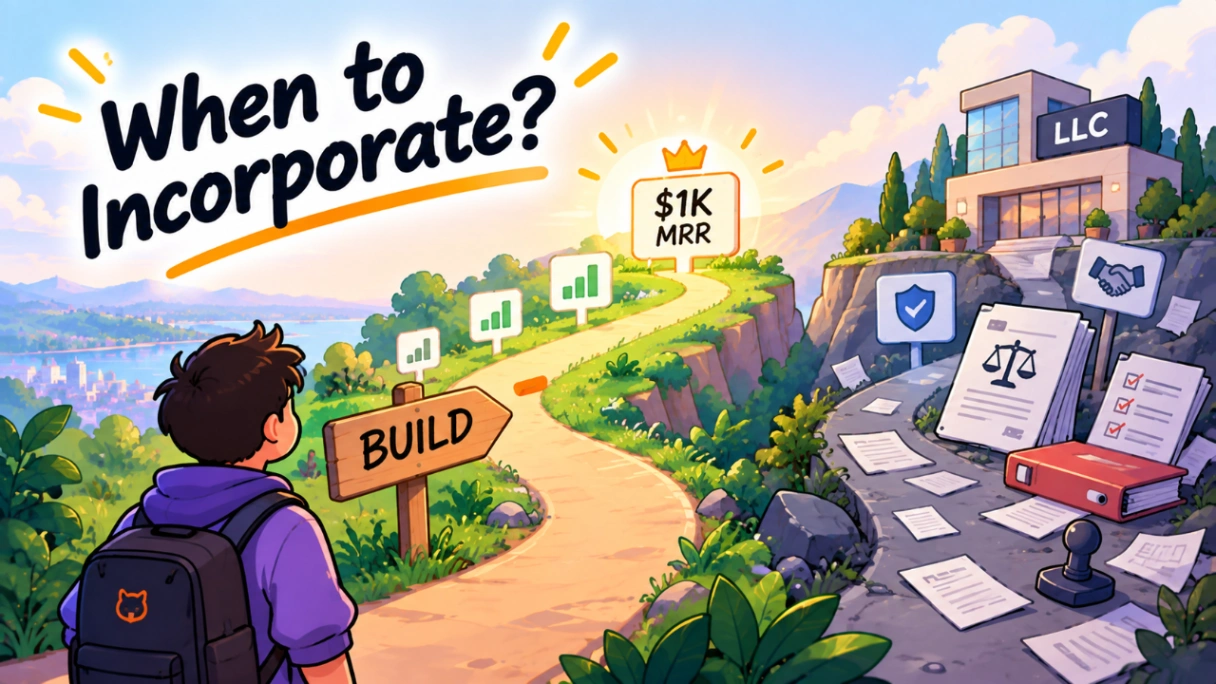
Stop. The answer to "when should I incorporate?" isn't a 50-point legal checklist. It’s a number: $1,000 MRR.
Not a dollar less. Not a day sooner. Until you hit that number, you don’t have a business. You have a project. Your only job is to turn it into a business.
The Real Problem Is Distraction, Not Liability
Let's be blunt. For a project with less than $1,000 in monthly revenue, your legal risk is a rounding error. The real, existential risk is building something nobody wants. Incorporating early doesn’t solve that. It actively works against it.
Forming an LLC costs money. At a minimum, you're looking at a few hundred dollars in filing fees. Then comes the registered agent fee ($100-300 per year), the separate business bank account (often with its own fees), and potential state franchise taxes or annual report fees ($50 to $800+ per year, depending on the state). This is a recurring tax on a business that can't yet support itself.
It also costs time. It’s not just the initial paperwork. It’s the mental overhead. You now have compliance tasks. Annual reports. Separate accounting. Tax season becomes twice as complicated. This is time you should be spending talking to your first 12 users, fixing bugs, and figuring out how to get your next 100.
Worrying about incorporation when you have $29 in revenue is like optimizing database queries for a million concurrent users when your app is still running on localhost. It's a fantasy problem. The immediate problem is survival.
What to Do This Week: The $1,000 MRR Gauntlet
Your goal is not to create a legal entity. Your goal is to create a predictable stream of revenue. One thousand dollars a month is the signal. It means you’ve achieved two critical things:
You built something people are willing to pay for.
You built something people are willing to keep paying for.
One-time sales are nice. A single $1,000 sale is validation. But $1,000 in recurring revenue is a business. It's a foundation. It’s also enough cash flow to easily cover the costs of incorporation and the recurring administrative burden that comes with it.
So, for now, forget legal structures. Here is your entire focus:
Operate as a sole proprietor. This is the default. In the US, when you accept money for a service, you are automatically a sole proprietor. Your business income is your personal income. It’s simple. Stripe will ask for your Social Security Number instead of an Employer Identification Number (EIN). That’s fine.
Track everything in a spreadsheet. Create a simple Google Sheet. One tab for revenue (date, customer, amount). One tab for expenses (date, service, amount). That's it. You don't need QuickBooks. You don't need a bookkeeper. You just need a record.
Get a separate bank account (maybe). If you want to keep things clean, open a separate personal checking account. Call it "[Your Project Name] Ops". Route all your Stripe payouts there. Pay for all your business expenses (Vercel, OpenAI API credits, domain names) from that account. This makes tax time trivial, even without a formal business entity.
Focus on your price. Getting to $1,000 MRR is math. Is it 100 customers at $10/mo? 40 customers at $25/mo? 10 customers at $100/mo? Your pricing model is an infinitely more important decision at this stage than your legal model. Spend an afternoon on your SaaS pricing strategy, not on legal Zoom calls.
That’s your entire business administration plan until you see `$1,000.00` in your Stripe dashboard’s MRR metric.
What to Ignore: A Field Guide to Phantom Risks
Your brain will fight you on this. It will present a portfolio of very serious-sounding risks. They are, for you, right now, phantoms.
The Lawsuit Bogeyman
The fear of being sued is the number one reason makers incorporate prematurely. Let’s ground this in reality. What is the actual risk that your new AI-powered favicon generator or your Notion template pack is going to attract a lawsuit?
For most indie SaaS, dev tools, and info products, the risk is astronomically low. You aren't handling sensitive health data, offering financial advice, or building physical hardware that could malfunction. The most likely "legal" issue you'll face is a customer asking for a refund. You give it to them.
No one is mounting a multi-thousand-dollar legal campaign against a solo maker with a few dozen customers. The economics don't make sense. The liability protection of an LLC is real, but you need a real threat to protect against. Right now, your threat is obscurity, not litigation.
The "Look Professional" Trap
Some believe an "LLC" at the bottom of their landing page signals legitimacy. This is a founder-centric view of the world. Customers do not care. Not once in the history of software has a user checked the Delaware business registry before typing in their credit card number.
What looks professional?
A clean, fast landing page.
Clear copy that solves a real problem.
A product that works.
Good support.
Your tech stack says more about your professionalism than your legal status. The fact that you're using modern, reliable tools—the kind we see in our annual Indie Maker Tech Stack report—matters more than a suffix on your company name.
The Tax Optimization Nightmare
You’ll hear about the "pass-through deduction" or the tax advantages of an S-Corp election. This is chatter for people with significant profits. When you have $500 in profit for the year, your tax optimization strategy is irrelevant. Filing your business income on a Schedule C with your personal taxes is the simplest, cheapest path forward.
Don't spend a dollar on an accountant to save a nickel on taxes you don't even owe yet. The IRS is not going to kick down your door for a side project that’s barely breaking even. File honestly as a sole proprietor, and move on.
The one major exception: Co-founders. If you are not a solo founder, you need to formalize your relationship immediately. This isn't about external liability; it's about internal liability. An LLC with a well-written operating agreement is not for your customers; it's for you and your partners. It forces the hard conversations: equity splits, roles, responsibilities, what happens if someone leaves. If you have a co-founder, incorporate now. For everyone else, the $1,000 MRR rule stands.
The Catch: So You Hit $1,000 MRR. Now What?
Congratulations. You did the impossible. You built a small, profitable, independent internet business. It's real. The revenue is predictable. Now, and only now, is it time to incorporate.
At $12,000+ ARR, your business is a real asset. The liability, while still small, is now attached to something with tangible value. The tax conversation starts to matter. The administrative cost is now a fraction of your revenue, not a multiple of it.
Here’s the playbook:
Use a service. This is a solved problem. Do not hire a lawyer for $3,000. Use a service like Stripe Atlas or Clerky. It will cost you about $500. They handle the filing, the EIN, and the standard paperwork. It takes an hour.
Choose an LLC. Don't agonize. For 99% of indie hackers, a Limited Liability Company is the right choice. It provides liability protection and is simple to manage from a tax perspective (it's a "pass-through" entity by default, just like your sole proprietorship was).
Your home state is probably fine. Unless you have a specific, well-researched reason, just form the LLC in the state where you live. The perceived benefits of Delaware or Wyoming are often outweighed by the complexity of being an "out-of-state" business, which can involve extra fees and filings.
Once you’re done, you’ll get your EIN. Go to your bank, close your temporary personal account, and open a real business bank account. Update your Stripe account with your new EIN and business details. Update your website's terms of service and privacy policy to list the LLC's name.
Be prepared for the new reality. You will now pay annual fees. You will file annual reports. You might need to make quarterly estimated tax payments. Your accounting can no longer live in a spreadsheet; it’s time for QuickBooks or Wave. This is the cost of graduating from a project to a business. It’s a good problem to have, and one you can now afford to solve.
Whether you're building with the latest serverless tools or experimenting with the stacks that power today's top indie AI products, the principle is the same. The legal structure is the final piece of scaffolding you erect, not the foundation you pour.
The urge to incorporate early is a proxy for the desire to be "taken seriously." But the market doesn't take you seriously because you have an LLC. It takes you seriously when you solve a painful problem and charge a fair price for it. Build the product, find the users, and earn the revenue. The rest is just paperwork.