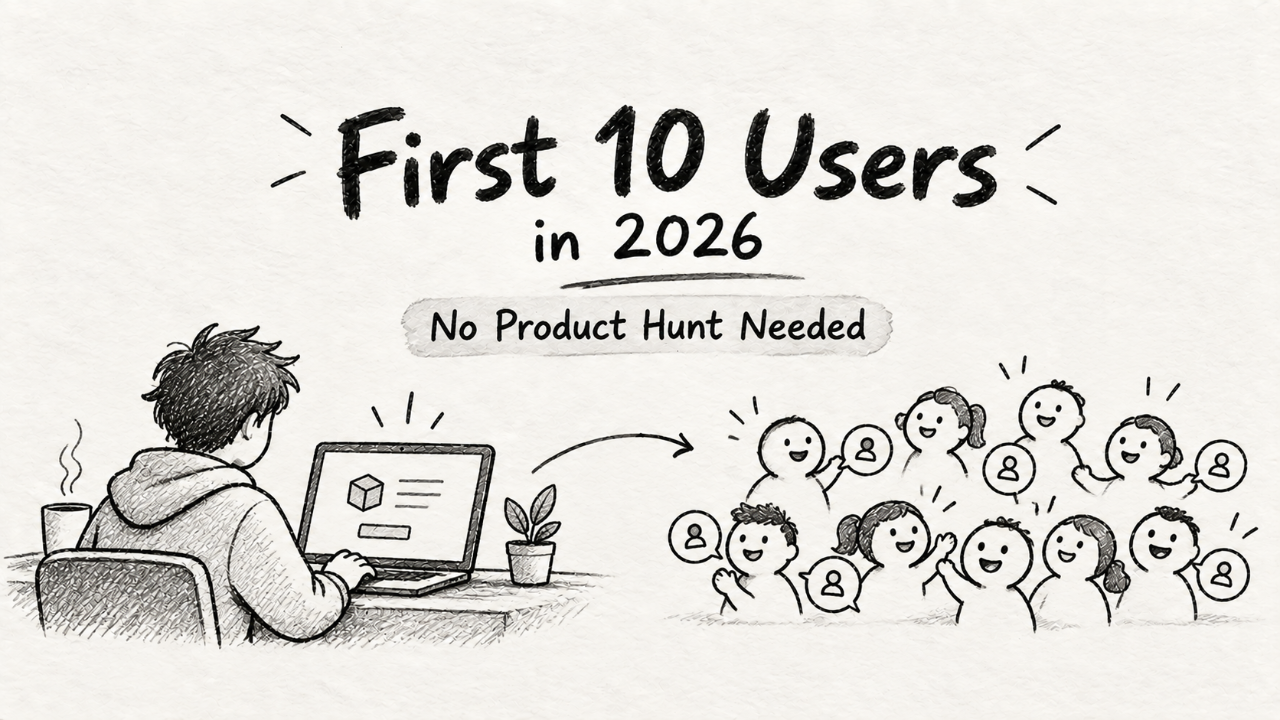
It’s 11 PM on a Tuesday. You just pushed the last commit. Your MVP is live. The temptation is to draft a Product Hunt launch for next week, picking the perfect GIF and polishing your first comment. Don't.
A big launch feels productive. It’s a sugar rush of vanity metrics—upvotes, page views, maybe a hundred signups who will never log in again. But at this stage, that's a distraction. Your product is fragile, probably broken in ways you can’t yet see. Your first 10 users aren't customers; they are your co-founders. Their job is to show you what you've actually built.
Chasing a vanity launch is a rookie mistake. The real work is manual, unscalable, and quiet. Here’s the playbook for getting your first 10 real users in 2026, the ones who will give you the feedback that matters.
The Show HN Litmus Test
Your first stop is Hacker News. Not for a launch, but for a litmus test. A Show HN post is a request for feedback from a deeply technical, skeptical, and brutally honest audience. If your product survives this, you have something.
A Show HN is not a marketing channel. It’s a technical- and product-focused discussion. Treat it as such.
How to Not Flop on Show HN
Most Show HN posts get a handful of views and zero comments. They fail because the author misunderstands the assignment. The goal is to start a conversation, not to broadcast a press release.
The Title is Everything. Use the format:
Show HN: I built X to solve Y. Be specific and descriptive. "Show HN: A self-hosted analytics platform using ClickHouse" is great. "Show HN: Reimagine Your Data with Insightify" is a guaranteed flop. Kill the marketing speak.Post on a Weekday Morning. The highest engagement on Hacker News is typically between 8 AM and 12 PM US Eastern Time on a weekday. Post then.
Your First Comment is the Real Post. As soon as you submit, add a comment. This is where you tell the story. Why did you build this? What problem were you personally facing? What’s the tech stack? What hard trade-offs did you make? Be transparent. If you're using a novel approach, explain it. For example, if you're one of the many indie hackers building an AI product, briefly touching on your rationale for a model choice can spark a great discussion. Did you fine-tune a Llama 3 variant or use a new multimodal API? Knowing how to choose an AI model is a product decision worth sharing.
Engage with Every Single Comment. Your job for the next 6-8 hours is to be in the comments section. Reply to everyone. Thank them for their feedback. Answer their questions. When someone points out a flaw or a bug, don’t get defensive. Say, "That's a great point, thank you. I hadn't considered that." Your humility and engagement will get you more goodwill—and better feedback—than a perfect product.
A successful Show HN isn't about hitting the front page. Success is 20-30 thoughtful comments, a handful of signups from people who actually read your explanation, and at least one comment that makes your stomach drop because you know they’re right about a critical flaw. That feedback is the prize.
Find Your People in Niche Communities
After Show HN, you have a bit of signal and a slightly more robust product. Now it’s time to leave the broad tech forums and find your specific audience where they live.
Generic communities like r/SideProject are mostly noise. It’s a feed of founders promoting their own projects to other founders who are also promoting their own projects. The signal-to-noise ratio is abysmal. You need to find the watering holes where your ideal users gather to talk about their problems, not their products.
Go where your users already are. Don’t try to make them come to you.
If you built a tool for TypeScript developers, hang out in the TypeScript Discord server. If your product helps artists manage commissions, be active in art-focused Discords and subreddits. If you built a plugin for Figma, you need to be in communities for Figma designers.
The Rule of Contribution
Do not just show up and drop a link. You will be ignored or banned, and you'll deserve it. Become a member of the community first. The rule of thumb is to provide value before you ask for anything. Answer questions. Share your expertise. Upvote good content. Participate in discussions.
This isn't about "karma farming." It's about building trust and understanding the community's language and problems. When you’ve become a familiar, helpful name, you’ve earned the right to share your work.
When you do post, frame it as a solution for the community. Instead of "Check out my new app!" try: "Hey, a few people were talking about the pain of managing client assets last week. I built a small tool to help with that and would love some feedback from other designers in this group."
This is slow. This is manual work. But one engaged user from a high-signal community is worth 20 drive-by signups from a random link aggregator. These are the people who will use your product, find its breaking points, and tell you what they’d pay for.
Directories That Send Signups, Not Vanity Traffic
Now, let's talk about directories. Do they still work in 2026? Yes, but you have to be ruthless in your selection. Most "startup directories" are SEO farms designed to capture long-tail keywords. Submitting to them is a waste of your time. You'll get a backlink and zero users.
The key is to separate the wheat from the chaff. Ask yourself: does this directory have a real, engaged audience, or is it just a list of links? The best directories are either hyper-specific or heavily curated.
The Two Types of Directories Worth Your Time:
Niche Marketplaces: These are the most valuable. If you built a Shopify app, the Shopify App Store is your primary distribution channel. A Webflow app? The Webflow Marketplace. A Slack integration? The Slack App Directory. The traffic here is as qualified as it gets—users are literally searching for a solution like yours within the platform they already use.
Curated Launch Platforms: These are platforms where new products are showcased to an audience that trusts the platform's taste. They are the modern evolution of the blogroll. Places like our own Builtbyindies, Betalist, or other curated indie sites serve this function. The value isn't just the listing; it's the implicit endorsement from the curator and access to an audience of early adopters. There are many Product Hunt alternatives for indie makers in 2026, but focus on the ones that have a clear point of view and an active community.
Avoid any directory that promises to submit your site to "100+ platforms for $50." It’s junk. Your time is better spent submitting to three high-quality, relevant directories than 100 low-quality ones. The goal here is not a one-day spike, but a slow, steady trickle of one or two qualified signups per day. That’s a healthy signal that your product is resonating.
The Art of the Cold (but Warm) DM
The term "cold outreach" has a bad reputation because most people do it wrong. They spam a generic template to a list of scraped emails. We're not going to do that. We're going to have targeted, respectful conversations.
Your goal is to find a handful of people who are acutely feeling the pain your product solves. You aren't a marketer selling a product; you're a builder seeking expert feedback.
How to Find and Approach Your First Users
Search Twitter, Reddit, Hacker News, and niche forums for people publicly complaining about the problem you solve. Use search operators to get specific:
"I wish I could" + "[your problem domain]"
"is there an app for" + "[your task]"
"[competitor name]" + "is so frustrating"
You'll find a goldmine of potential users. Now, craft a short, personalized message. This is not a numbers game. Send five thoughtful DMs a day, not 500 automated ones.
A good DM has three parts:
The Context: "Hey [Name], I saw your tweet about how frustrating it is to sync your Airtable bases." This shows you've done your research and aren't spamming.
The Pitch: "I'm the founder of a new tool that solves exactly that. It offers real-time, two-way sync." Keep it to one sentence.
The Ask (with an easy out): "Since you're feeling the pain, I'd love to get your feedback on it. Would you be open to taking a look? No pressure at all if you're busy."
Respect their time. Make it easy to say no. The goal is to start a conversation with someone who has the problem you solve. You are looking for product-shaping feedback, not just a signup.
The First 10 Conversations: Your Real Product Roadmap
You got a signup. Congratulations. The real work starts now.
Your goal is not to "onboard" or "activate" this user in the traditional sense. Your goal is to learn from them. Every action they take, or fail to take, is a signal. The fastest way to decode those signals is to talk to them.
As soon as someone signs up, trigger a personal email from your own account. Not a stylized marketing email from `noreply@yourproduct.com`. A plain-text email from you, the founder.
Here’s a template that works:
Subject: Quick question about [Your Product Name]
Hey [User Name],
I'm [Your Name], the founder of [Product Name]. Thanks so much for giving it a try.
I'm talking to my first few users to make sure I'm building something people actually want. Would you be open to a 15-minute chat next week to share your thoughts? I'd love to hear what you're trying to accomplish.
As a thank you, I'd be happy to give you a lifetime discount.
Best,
[Your Name]
Many won't reply. That's fine. But the few who do are your champions. On these calls, your job is to shut up and listen. Don't pitch. Don't defend. Ask open-ended questions:
"What were you hoping this would do for you?"
"Talk me through what you did right after you signed up."
"What was the most confusing part?"
"What were you using to solve this problem before? A spreadsheet? Another tool?"
"If you had a magic wand and could change anything, what would it be?"
These conversations are more valuable than any analytics dashboard. This is your roadmap. The patterns you hear in these first 10 conversations will tell you what to build, what to fix, and what to charge.
Learning, Not Launching
Getting your first 10 users is a manual, unscalable, and often humbling process. That’s the entire point. You're not looking for scale; you're looking for signal.
A Product Hunt launch is for when you have product-market fit and want to amplify it. Right now, you have a hypothesis and an MVP. The playbook is different: use Show HN for a technical gut check, find your champions in niche communities, use curated directories for a trickle of qualified traffic, and talk to every single person who gives you their time.
Once you have 10-20 users who are actively using your product and giving you feedback, you'll have something real. You'll have a product that's been battle-tested by the people it's meant for. Then, and only then, should you start thinking about how to get your first 100 users. The hype can wait. The learning can't.