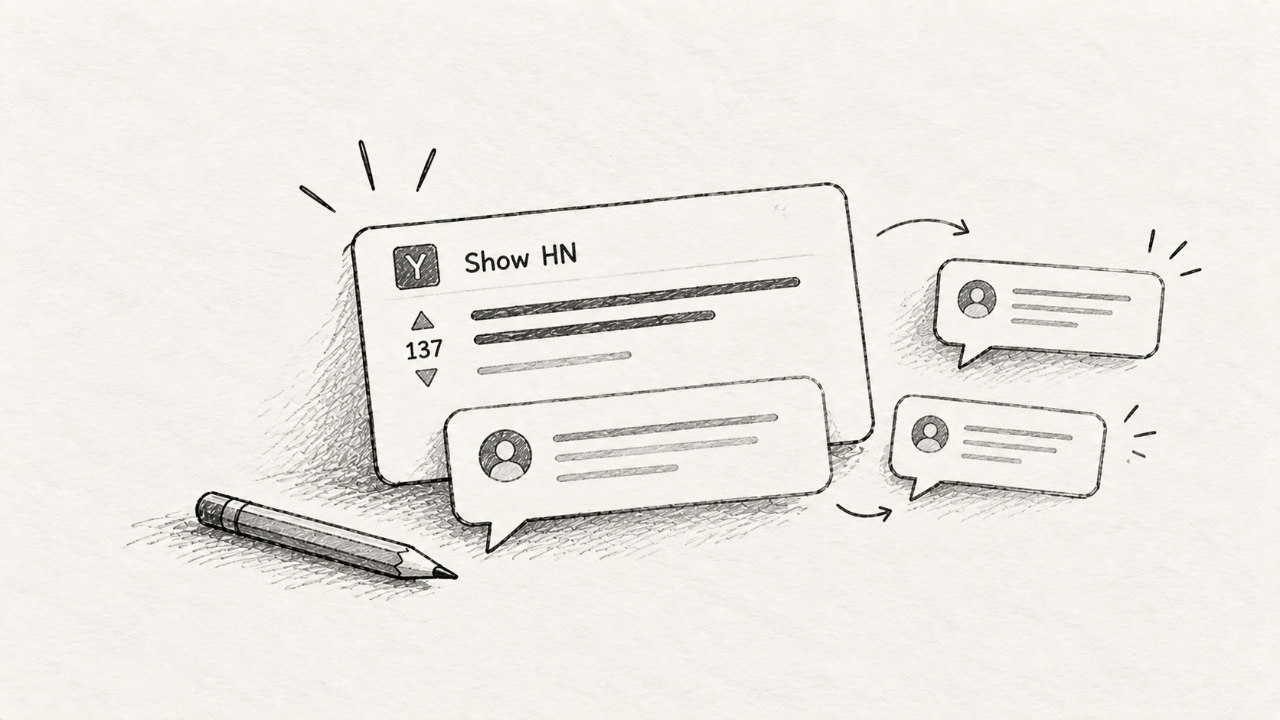
You shipped. You pushed the button on a Tuesday morning, 9 AM Eastern. You wrote “Show HN: My new app” and pasted the link. You waited. By lunch, you had three upvotes and zero comments. Your post was gone, buried somewhere past page 10. Your launch was dead.
This isn't bad luck. It’s a failed execution.
Hacker News is not a magical traffic firehose. It’s a specific community with a distinct culture, and it punishes posts that ignore its norms. Getting to the front page—and staying there long enough to get feedback—requires a plan. A successful hacker news launch is a craft. This is how you do it in 2026.
Why Your Show HN Died
Most Show HNs fail for three reasons:
A bland title. Your title is the only thing 99% of people will ever see. “Show HN: A new tool for developers” is a death sentence. It’s vague, uninteresting, and shows you don’t understand the audience.
No first comment. You posted a link and walked away. HN users are skeptical. They want context before they click. Without a first comment explaining what you built and why, they assume the worst: it’s spam, a marketing ploy, or just a low-effort post.
Wrong product, wrong audience. You built a Web3-based social network for dog walkers. HN is primarily developers, founders, and engineers. They care about tools that solve their problems, interesting technical feats, and well-crafted products. A generic consumer app with no technical hook will almost always fall flat.
We’ll fix the first two. The third is on you.
The Title: Your 80-Character Sales Pitch
The HN title is everything. You have 80 characters. No marketing fluff. No emojis. Just a clear, concise description of what you made. Your goal is to make a specific person—a developer, a sysadmin, a founder—stop scrolling and think, "Huh, I have that problem."
Don't reinvent the wheel. Use formulas that work.
Formula 1: The Standard
This is the most common and effective format. It's clear and information-dense.
Show HN: [Product Name] – [Concise, technical tagline]Good:
Show HN: Logfire – An open-source, self-hostable alternative to LogflareBad:
Show HN: Logfire – The future of logging
The first title tells me exactly what it is: open-source, self-hostable, and a competitor to a known product. The second is meaningless marketing speak. The tagline is where you win or lose. Nailing this is so crucial, it’s a skill in itself. If you're struggling, spend an hour on how to write a product tagline that actually gets clicks. It will pay dividends.
Formula 2: The Personal Problem
This format builds an immediate connection. You’re not a faceless corporation; you’re a fellow builder who solved a personal pain point.
Show HN: I built [Product Description] to solve [My Own Problem]Good:
Show HN: I built a CLI to search my shell history because I kept forgetting commandsBad:
Show HN: I built a revolutionary new CLI
The "I built" framing is powerful. It makes it personal. It’s not just a product; it’s a story. The good example is relatable to almost every developer. The bad one is just noise.
Formula 3: The Tech-Centric Angle
This is for when your implementation is the most interesting part of the story. HN loves technical details.
Show HN: [Product Name], a [Thing] built with [Interesting Tech]Good:
Show HN: Readlater, a Pocket clone built entirely on SQLite and LitestreamBad:
Show HN: A new read-it-later app with a scalable backend
Mentioning SQLite and Litestream immediately signals to a segment of the HN audience that this is for them. It sparks curiosity about the architecture. "Scalable backend" is a feature, not a hook.
Your hn title is your first and only impression. Don’t waste it.
The First Comment: Your Real Landing Page
Many experienced HN users will not click your link. They will read your title, then scroll down to read your first comment. If it’s not there, they move on. Your first comment is more important than your product’s landing page.
Post your Show HN, then immediately post a comment. It must contain these five elements:
1. The Hook
Start with a one-sentence summary. What is it? Who is it for? What problem does it solve?
Hi HN, I built Tapes (https://tapes.example.com), a simple screen recorder for macOS that automatically transcribes the audio to text using a local Whisper model.
2. The Origin Story
Why did you build this? Connect it to a personal pain. This is your chance to show you're a real person who understands the problem deeply. This is a micro-version of building in public; it provides context and builds trust.
I was constantly recording short demos for my team and then spending 10 minutes writing up a summary for Slack. I wanted a tool that would do it for me, without sending my data to a third-party cloud service.
3. The Tech Stack
Be specific. HN is an audience of engineers. They want to know how it’s built. This is not the place for modesty or vagueness.
It's a native Swift/AppKit app for macOS. The transcription runs locally using a quantized version of OpenAI's Whisper. The website is just static HTML, and payments are through Lemon Squeezy.
The more detail, the better. SvelteKit on Cloudflare Pages with Turso for the database? Say that. A Go binary deployed on Fly.io? Mention it. These details are conversation starters.
4. The Trade-offs and Roadmap
What did you choose *not* to do? Being honest about your trade-offs shows you've thought deeply about the problem. It also preempts common "Why doesn't it do X?" questions.
For now, it’s macOS only because I wanted to build a truly native app. A Windows version is on the roadmap if there's enough demand. There are no teams or collaboration features; it's designed for the individual.
5. The Ask
What do you want from the HN community? Be direct. Don't say, "Let me know what you think." That's too broad. Ask a specific question.
I'm launching it today for a one-time price of $29. I'd love to get your feedback on the pricing model—is a one-time purchase fair for a utility like this in 2026? Thanks for checking it out.
A specific ask guides the conversation and gives people a clear way to contribute. It turns passive readers into active participants.
The First Hour: Handling Criticism Without Melting Down
You’ve posted your title and your first comment. Now the hard part begins. The first hour of a Show HN is a high-velocity, high-stress experience. You must be present, engaged, and thick-skinned.
HN is a crocodile. It has a hard, scaly exterior, but if you treat it with respect, it can be a powerful ally. If you poke it, it will bite.
Be Responsive, Not Desperate
Reply to every top-level comment you can, especially in the first hour. Thank people for their feedback. Answer their questions. Acknowledge bug reports gracefully. Your engagement shows you care and fuels the comment velocity, which helps keep you on the front page.
Embrace the "Why not just use X?" Question
This is the most common comment you will get. It is not an attack. It's a request for positioning. Have a clear, concise, and non-defensive answer ready.
Weak Response: "Ours is better and has more features."
Strong Response: "Great question. Figma is an incredible tool for collaborative design systems. We're focused on a different use case: solo developers who want to quickly generate UI mockups from a simple text-based syntax, without ever leaving their code editor."
The strong response validates the competitor and clearly defines your niche. It turns a challenge into a positioning statement.
Disarm Criticism with Agreement
You will get negative feedback. Someone will call your UI ugly. Someone will say your idea is stupid. Do not argue. Do not get defensive. This is the single fastest way to get your post flagged to death.
Instead, use the "Yes, and..." technique from improv.
Commenter: "The UI on this looks like it's from 2016. The contrast is too low and the padding is all over the place."
Your Response: "That's fair feedback. I definitely focused more on the backend logic for this first version, and the UI/UX needs more attention. The low contrast is an accessibility issue I hadn't considered—I've just added it to my backlog to fix this week. Thanks for pointing it out."
You’ve done three things here: validated their criticism, shown humility, and demonstrated that you listen to feedback. You’ve turned a critic into a potential advocate. The community sees this and respects it.
Ignore the Trolls
Some comments are just mean. They offer no constructive feedback. They're just drive-by negativity. Ignore them completely. Do not reply. Do not engage. Let the community downvote them into oblivion. Your silence is the strongest response.
After the Spike: What Now?
You hit the front page. You survived the comment storm. You got hundreds, maybe thousands of visitors. The traffic spike will last 24-48 hours, then it will fall off a cliff. Your launch is not over. This is where the real work begins.
Capture the Momentum
Don't let that traffic evaporate. Your goal is to convert temporary visitors into a long-term audience.
Funnel traffic: Guide interested users from your app to a mailing list, a Discord/Slack community, or a public issue tracker. Give them a way to stay connected.
Write a retrospective: A few days later, write a blog post titled "What I learned from launching on Hacker News in 2026." Share your traffic stats, what feedback was most valuable, and what you're building next. Post it back to HN (not as a Show HN). This can often start a second, smaller wave of interest.
Update your changelog: Take the bug reports and feature requests from HN and ship them. Write a clear, concise update in your product's changelog. This demonstrates that you listen and execute. If you're not sure how, learn how to write a changelog that users actually read. It's a powerful retention tool.
Build a Distribution System
A Hacker News launch is a single event in a long-term distribution strategy. It's a great start, but it's not the whole game. Where else will users find you next month? Next year?
Your HN post will have a long SEO tail, but you need more. This is the time to list your project on relevant directories. Find your niche in a place like the Builtbyindies product directory, submit to other aggregators, and start building out other channels. One successful launch is not a business.
A successful Show HN is not luck. It is preparation meeting a very specific opportunity. It’s about understanding the culture, respecting the audience, and having a plan for the title, the first comment, and the conversation that follows. Now go build something worth showing.