You launched on a Tuesday. By Friday, you have 12 signups. The app is a simple Next.js project you’ve been hacking on for a month. You deployed it to Vercel because the docs said to. It worked. But now you see the chatter—Cloudflare is faster, Cloudflare is cheaper, Cloudflare is the future. And that familiar indie dev anxiety kicks in: did I make the wrong choice on day one?
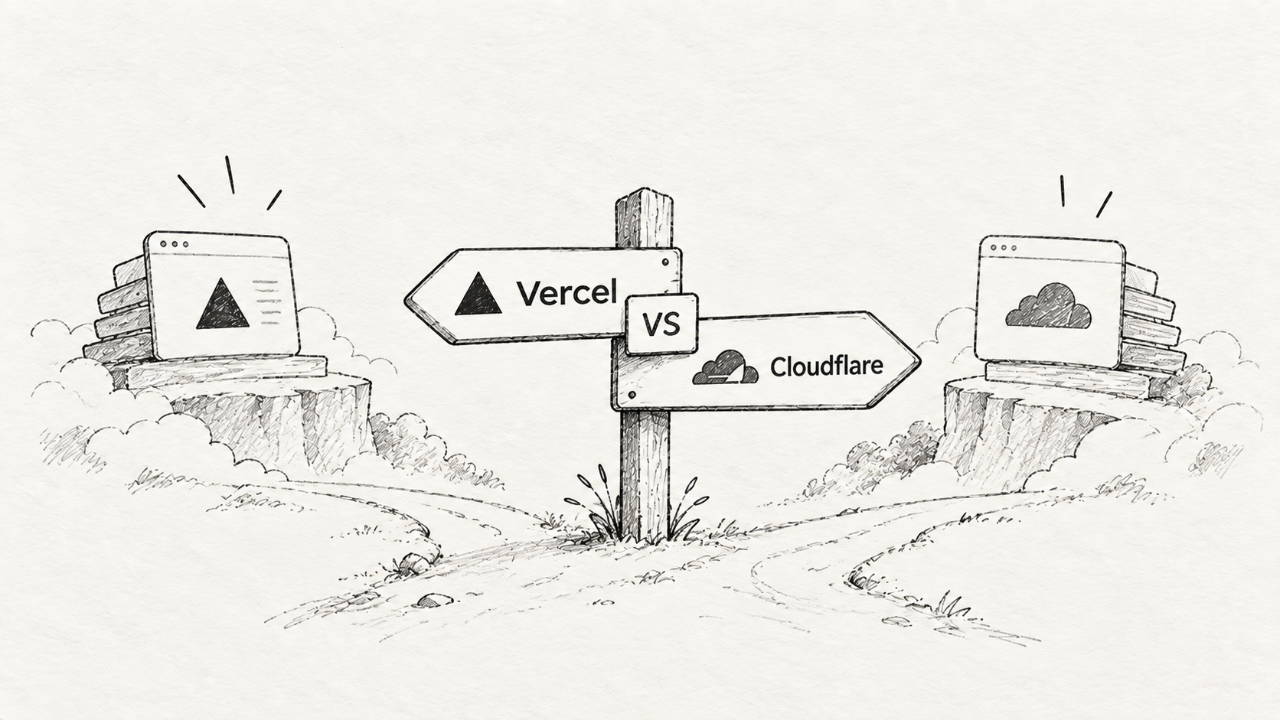
This isn't another "it depends" analysis. This is an opinionated guide for 2026. We're going to make the call on Vercel vs. Cloudflare Pages for a solo-built app, focusing on the trade-offs that actually hurt.
The core choice is simple: Vercel sells elite developer experience. Cloudflare sells infrastructure at utility pricing. Your job is to know which one you need more right now.
The Next.js Hosting Reality
Let's get this out of the way. If you are building a Next.js application, especially one using the App Router and Server Actions, Vercel is the default choice for a reason. They built the framework. Every feature is designed, tested, and optimized for their platform first.
When you deploy to Vercel, it just works. New canary releases of Next.js, experimental features, intricate caching headers—the integration is seamless. The `vercel dev` local environment is a near-perfect mirror of production. This is not a small thing. The hours you don't spend debugging weird platform-specific inconsistencies are hours you spend shipping features.
Hosting a Next.js app on Cloudflare Pages is a different story. It’s possible, and it has improved dramatically with the `next-on-pages` adapter. But you are running a compatibility layer. You are compiling your app to a target it wasn't natively designed for. This introduces a class of problems you will not have on Vercel.
What kind of problems? Subtle differences in how Server Actions handle headers. A new version of Next.js drops and `next-on-pages` is a week or two behind, blocking your upgrade. A Node.js API you depend on isn't polyfilled correctly by Cloudflare's edge runtime. You spend a Saturday afternoon figuring out why your form submission works locally and on Vercel, but fails silently on Pages. The friction is real.
The Call: Use Vercel for your primary Next.js application. The developer experience is a competitive advantage for a team of one. Use Cloudflare Pages for your marketing site, blog, or documentation if it's a separate, simpler Next.js project. The cost savings there are worth it.
Cold Starts, Timeouts, and Jobs That Don't Fit
The "serverless" promise is to forget servers. The reality is you're trading server management for runtime-limit management. This is where most indie apps first feel pain.
Both platforms want you to run your code on "the edge"—geographically distributed functions that are close to your users. They are designed for short, fast operations.
Vercel: Two Speeds
Vercel gives you two function types: Edge and Serverless.
Edge Functions: No cold start. Blazingly fast. But they have tight CPU limits. Think of them for middleware: running auth checks, A/B testing, or rewriting URLs. You can't do heavy lifting here.
Serverless Functions: These run in a single region (e.g., `us-east-1`) with a full Node.js runtime. They can do more work, but they have cold starts. On the free Hobby plan, the cold start can be a few seconds. The timeout is the real killer: 10 seconds on Hobby, 60 seconds on Pro.
That 10-second timeout on the free plan is the first wall you'll hit. Generating a PDF, processing an uploaded video, or running a report on a few thousand database rows can easily exceed this. Your app will just fail.
Cloudflare: One Speed, One Catch
Cloudflare's model is simpler: everything runs on their edge, via Workers. The "no cold start" claim is largely true and is a massive selling point.
But the catch is the `edge runtime limits`. Cloudflare Workers are not meant for long-running tasks. A standard Worker has a CPU time limit measured in milliseconds—typically 10ms to 50ms depending on the plan. This is CPU time, not wall-clock time. An idle function waiting on a database query doesn't burn much CPU, but a tight loop processing data does.
// This might be fine in a Cloudflare Worker
export default {
  async fetch(request, env) {
    const user = await env.DB.query("SELECT * FROM users WHERE id = ?", [id]);
    return new Response(JSON.stringify(user));
  }
}

// This will almost certainly fail in a Cloudflare Worker
export default {
  async fetch(request, env) {
    const data = await getLargeDataset(); // 10,000 items
    let processedData = [];
    for (const item of data) {
      // Some CPU-intensive operation
      processedData.push(complexTransform(item));
    }
    return new Response(JSON.stringify(processedData));
  }
}
A user exporting their data to a CSV? A script that iterates over 500 records to generate a report? These are not jobs for a synchronous Worker request. They will hit the CPU limit and terminate. Many of the tools indie makers are building, especially those analyzed in our report on what AI products are built with, involve compute tasks that last for several seconds. These are fundamentally incompatible with the standard Worker request-response model.
The Call: Neither platform is built for jobs that take more than a few seconds. Vercel's standard Serverless Functions give you more breathing room (up to 60 seconds on Pro) for synchronous tasks than Cloudflare Workers. But if your app's core function is a long-running job, you need to architect for it. Use a queue (Vercel KV, Cloudflare Queues, Upstash QStash) to offload the work to a background process. For truly heavy lifting, you'll need to look elsewhere entirely.
Price as You Grow: The $20 Pro Plan and the Surprise Bill
For a bootstrapped project, cost is a feature. This is where Cloudflare shines and Vercel requires caution.
Vercel Pricing: Pay for Convenience
Vercel's free Hobby plan is generous enough to get you launched and validated. But as soon as you need to collaborate with a partner or want the longer function timeouts, you're on the Pro plan. That’s $20/month per developer seat.
The seat price is not the real cost. The real cost is usage-based. Bandwidth, Function Invocations, and especially Function Execution (measured in GB-hours) are where the bills can spike. An inefficient function that holds a lot of memory, or an image-heavy site that gets a surge of traffic, can generate a surprise bill.
Let's say you get a feature on one of the popular Product Hunt alternatives. Your traffic spikes 100x for 48 hours. On Vercel, this is a moment of both excitement and terror. You might owe several hundred dollars for that traffic spike. It's a good problem to have, but only if you have the cash to cover it. This dynamic forces you to think carefully about your business model. If you're building a high-traffic, low-revenue product, Vercel's pricing model can be a liability, a topic we cover in our SaaS pricing guide for indie makers.
Cloudflare Pages Pricing: The Unbeatable Free Tier
Cloudflare's pricing is its killer feature for indie hackers. The free tier for Pages is almost unbelievable: unlimited sites, unlimited requests, and unlimited bandwidth. Your builds are limited (500/month), but for most solo projects, this is a non-issue.
The free tier for Workers is also generous (100,000 requests/day). The paid plan, Workers Unbound, is priced based on resource consumption (CPU time, duration) and is significantly cheaper for high-traffic, low-compute workloads than Vercel's model.
For an app with 10,000 users, the cost difference can be stark. A moderately active app on Vercel Pro might cost you $50-$100/month in usage on top of the seat price. The same app on Cloudflare Pages, assuming it fits within the Worker runtime constraints, is very likely still free.
The Call: If your biggest constraint is money and your app can be built within the limitations of Workers, Cloudflare is the financially sound choice. The free egress bandwidth alone is a massive advantage. If your biggest constraint is development time and you're building a Next.js SaaS, pay the Vercel tax. The DX is worth it in the early days.
The Escape Hatch: When to Leave Either Platform
No platform is forever. Knowing when to leave is as important as knowing when to join. This isn't about Vercel vs. Cloudflare; it's about graduating from the all-in-one PaaS model.
When to Leave Vercel
You outgrow Vercel for two reasons: cost or control.
Cost: Your monthly usage bill consistently exceeds a few hundred dollars and is eating into your margins. You've optimized your functions, but the traffic is just too high for the pricing model to make sense.
Control: You need more than a serverless function can offer. You need to run a WebSocket server for real-time collaboration. You need a background process that is always on, polling an external API. You need to shell into a machine to run a specific binary. You are spending your time trying to hack long-running processes into a stateless, short-lived paradigm.
Where to go: Fly.io, Railway, or a "boring" VPS from Hetzner or DigitalOcean. You package your Next.js app in a Docker container (or run it as a standalone Node server), and you get a long-running process with predictable pricing and full control. This is a common graduation path we see in our annual indie tech stack report.
When to Leave Cloudflare Pages
You leave Cloudflare Pages because of friction.
Friction: You're tired of fighting the platform. You're debugging `next-on-pages` more than you're debugging your own code. The local development workflow feels clunky. You want to use a new Next.js feature the day it comes out, not when the adapter supports it. The time you save on hosting costs is being spent on compatibility wrangling.
Where to go: Often, the answer is Vercel. You've validated your product on Cloudflare's free tier, you now have revenue, and you're ready to pay for the premium DX to iterate faster. Or, just like with Vercel, you might jump to a platform like Fly.io if your needs have grown beyond what a serverless frontend platform can offer.
Final Verdict: A Decision Framework
Stop agonizing. The stakes are low to start, and migration is always an option. Here's how to decide in under a minute.
Building a Next.js SaaS, B2B tool, or paid product?
Start on Vercel. Your time is more valuable than your hosting bill. Pay for the world-class DX and ship faster.Building a static marketing site, a blog, or docs?
Use Cloudflare Pages. It's free, fast, and the bandwidth is unlimited. It's a perfect fit.Building a free tool, a viral side project, or a high-traffic B2C app?
Start on Cloudflare. Vercel's usage-based pricing is a ticking time bomb for this kind of project. The cost ceiling on Cloudflare is much higher.Building an app with WebSockets, long-running jobs, or complex background tasks?
Neither. Start with a platform designed for long-lived processes like Fly.io or Railway from day one. Augment it with a static frontend on Vercel or Cloudflare if you wish.
The platform isn't the product. Choose the one that gets out of your way and lets you build. Check out what other indie makers are shipping on our product directory—you'll see successful apps built on both. Pick one from the list above and get back to coding.